

Bitcoin is currently holding near $101,000 after successfully reclaiming the critical $100,000 level, marking a tentative recovery from this week’s dramatic selloff. The cryptocurrency has declined 1.18% over the last 24 hours and is trading in a narrow channel between support at $99,192 and resistance at $102,463.
The cryptocurrency faces a 20% drop from its peak and needs approximately a 10% rally to hit quarterly breakeven around $114,000. Market participants remain cautious as spot Bitcoin ETFs continue their outflow streak, recording $137 million in net redemptions on Wednesday, marking the sixth consecutive day of withdrawals.
Analysts point to the U.S.-China tensions, a looming government shutdown, and thinner liquidity as factors keeping prices in a range-bound pattern, though some institutional voices remain optimistic about a potential recovery if macroeconomic conditions improve.
Market Meltdown 🔗
Bitcoin experienced one of its most volatile weeks in months, ultimately breaking below the psychologically critical $100,000 threshold on Tuesday for the first time since June. The flagship cryptocurrency plunged to $99,000 on Coinbase before recovering to around $103,000 by Thursday morning.
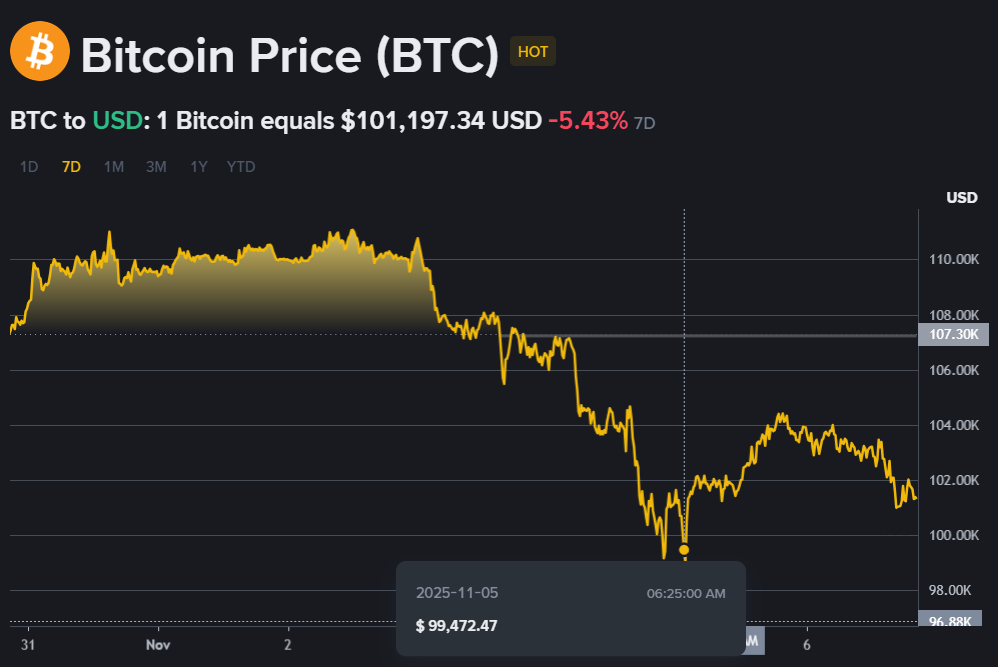
This was a decline of more than 20% from Bitcoin’s October 6 all-time high of $126,210, triggering a wave of forced liquidations and sending shockwaves through the entire cryptocurrency market.
The week’s turmoil arrived as multiple problems converged at once. The U.S. government shutdown entered its 35th day, tying the longest closure in American history. Market participants watched as Bitcoin fell from approximately $105,300 on Monday to briefly touch $99,990 on Tuesday before stabilizing. The breakdown came after weeks of mounting pressure, with the cryptocurrency shedding nearly 12% over seven days.
The selloff wasn’t isolated to Bitcoin. Over $300 billion in total crypto market capitalization was erased as the sector declined 6.4%. Ethereum fell nearly 10% to below $3,300, while other major cryptocurrencies including XRP (down 7.5%), Solana (down 8%), and Dogecoin (down 7%), followed suit. According to TECHi, this marked Bitcoin’s first negative October in six years, breaking a historically strong seasonal pattern.
The initial decline triggered a wave of forced liquidations meaning automatic sales that occur when leveraged positions can no longer meet margin requirements. Over $1.3 billion in leveraged positions were liquidated across the crypto market in a 24-hour period, with $1.1 billion coming from long positions. Bitcoin alone accounted for $470 million in liquidations, followed by Ethereum at $377 million. These forced closures created a feedback loop where declining prices triggered margin calls, which in turn forced more selling and accelerated the downdraft.
A critical driver behind the week’s turbulence proved to be the ongoing government shutdown’s impact on market liquidity, primarily the availability of dollars in the financial system. BitMEX analysts identified a specific mechanism through which the shutdown drained market liquidity.
As the Treasury General Account ballooned to $1 trillion, approximately $700 billion was removed from circulation. This was far from a typical rotation of capital, it was in fact, a mechanical withdrawal of dollars from the financial system entirely. The liquidity drain showed up in observable ways, with overnight repo usage reaching record highs as financial institutions scrambled for short-term funding.
The dollar’s strength made Bitcoin’s weakness even worse. The U.S. Dollar Index climbed above 100 for the first time since August, putting more pressure on risk assets as dollar strength typically correlates with weakness in speculative investments.
Annabelle Huang, founder of Altius, told DL News that
“sentiment is a bit low among VC funds and trading firms” because “a rate cut seems a lot less likely than it used to, and we’re likely to stay with high interest rates for longer than we expected.”
Quantifiable measures of market psychology showed growing pessimism. The Fear & Greed Index plummeted to 21, entering “extreme fear” territory and marking the most depressed reading since early April. This metric combines various factors including volatility, market momentum, social media sentiment, and trading volume to provide a snapshot of investor emotion.
As one analysis noted,
“even during the market crash on the night of October 11, 2025, the index only fell to 24 points.”
Technical indicators reinforced the bearish picture. The daily chart confirmed a bearish crossover between the 9-day and 21-day moving averages, with both trending below the 200-day simple moving average at $109,000. The Relative Strength Index on the daily timeframe fell to 31.8, signaling oversold conditions. Most concerning for bulls, Chaikin Money Flow dropped to its lowest level in 16 months, indicating sustained institutional selling pressure.
Galaxy Digital’s Institutional Slide 🔗
Perhaps the week’s most significant development came from Galaxy Digital, one of the crypto industry’s most prominent institutional players. Alex Thorn, Galaxy’s head of research, slashed the firm’s year-end Bitcoin target from $185,000 to $120,000, representing a 35% reduction in expectations.
In an investor note shared with DL News, Thorn explained that Bitcoin has entered what Galaxy calls a “maturity era” where “the days of 1,000x, 100x, or even possibly 10x gains are over.”
Thorn provided specific reasoning for the downgrade. First, he noted that
“Bitcoin started the year as the hottest investment narrative, but AI, hyperscalers, gold, and the Magnificent 7 have absorbed capital and attention that might otherwise flow into BTC.”
In a liquidity-rich environment, Galaxy wrote, “attention is finite.” The AI build-out, data center arms race, and hyperscaler infrastructure trades have attracted unprecedented capital, leaving digital assets competing for marginal investment dollars.
Second, Thorn pointed to the October 10 liquidation cascade that erased roughly $78 billion in open interest across crypto futures, which “materially damaged” market liquidity and confidence. Futures markets remain fragile, with open interest still well below the pre-crash levels.
Third, Galaxy’s analysis revealed that approximately 470,000 Bitcoin worth $50 billion changed hands in 2025, marking the second-largest annual transfer in Bitcoin’s history. Thorn noted
“Coins once held by ideological early adopters are now being sold into a liquid market that can finally handle their absorption,”
Galaxy even facilitated one of the year’s largest single transfers which was a $9 billion sale of a legacy whale’s assets. Thorn described it as part of a broader shift toward passive ETF ownership.
The firm’s revised outlook represents more than a simple price target adjustment. Galaxy argues that “Bitcoin has matured. It now behaves more like gold or high-beta equities – less explosive, but more stable and policy-sensitive.”
This evolution brings both benefits and constraints. Increased stability and institutional acceptance reduce the risk of catastrophic crashes but also limit upside explosiveness.
U.S. spot Bitcoin ETFs, which launched with great fanfare and were widely expected to provide stable institutional demand, turned decisively negative during the week. On Wednesday, these products recorded $137 million in outflows, marking their sixth consecutive day of withdrawals. That brought total November outflows to $890 million, making it the worst month since February.
November 4 proved particularly brutal, with $577.7 million exiting in a single day. The breakdown by product is a show of the breadth of institutional retreat. Fidelity’s FBTC led outflows at $356.6 million, followed by Ark’s ARKB at $128.1 million and Grayscale’s GBTC at $48.9 million. This wasn’t concentrated in one or two products but represented institutional withdrawal across the board.
The significance extends beyond only the immediate price impact. Charles Edwards, founder of Capriole Investments, noted that institutional buying had dropped below daily mined supply for the first time in seven months. This metric had been, in his words, “the key that had kept him optimistic” through previous market volatility. When institutions purchase less Bitcoin than miners produce each day, it removes a critical source of buying pressure that had previously absorbed new supply and supported prices.
Additionally, according to DefiLlama data, spot Bitcoin ETF and Ethereum ETFs showed negative weekly performance, with outflows totaling about $1.9 billion and $719 million respectively over the past five trading days.
Whale activity intensified the selling pressure, with mining firm Marathon Digital transferring $236 million in Bitcoin to institutional exchanges, including FalconX, TwoPrime, Galaxy Digital, and Coinbase Prime.
Despite the prevailing selling pressure, some institutions demonstrated continued conviction. Japan’s Metaplanet secured a $100 million loan backed by its Bitcoin holdings, representing just 3% of its 30,823 BTC reserves. The firm generated ¥24.4 billion ($160 million) in Q3 2025 through its Bitcoin income business, up 3.5x year-over-year, with plans to reach 210,000 BTC by 2027.
Switzerland’s Future, co-founded by Bitcoin pioneer Adam Back, raised $34.5 million for Bitcoin treasury services. Meanwhile, Korea’s Bitplanet acquired 12.33 BTC for $1.08 million, bringing total holdings to 185 BTC.
Conversely, Paris-based Sequans Communications sold 970 BTC, trimming holdings from 3,234 to 2,264 BTC valued at $232 million in what CEO Georges Karam called “strategic asset reallocation.”
The divergence in institutional behavior highlights uncertainty about Bitcoin’s near-term trajectory and optimal position sizing in a maturing market. Strategy shares tumbled 5% to their weakest since April, while Coinbase and Galaxy declined by similar amounts, reflecting broader concern about crypto-related equity performance.
Recovery Attempts and What Lies Ahead 🔗
By Thursday, Bitcoin had recovered to approximately $103,000, stabilizing above the $100,000 threshold. Trading volume remained elevated at 56% above average, indicating continued active participation but without the panic selling that characterized earlier in the week. Technical analysts identified immediate resistance at $104,500 and key support at $101,000.
The analyst community offered wildly different views on Bitcoin’s path forward. CryptoQuant analyst Julio Moreno warned Bitcoin could drop to $72,000 within one to two months if the $100,000 level fails to hold. Trader Captain Faibik identified a rising wedge pattern suggesting potential decline toward $55,000 if major support breaks.
On the opposite end, Grok AI projected Bitcoin averaging $123,000 in November, establishing an estimated range between $117,200 and $135,800. The model cited bullish MACD patterns and recovery of key support around $103,000 as justification.
Lacie Zhang, research analyst at Bitget Wallet, told DL News that Bitcoin will likely trade between $94,000 and $118,000 in the near term, with “the lower bound representing a healthy retracement zone consistent with subdued ETF inflows.”
These competing narratives reflect genuine uncertainty about whether the week’s selloff represents healthy consolidation within an intact bull market or the beginning of a deeper correction. Polymarket data showed 78% probability that Bitcoin falls below $100,000 again before 2026, suggesting market participants lean toward continued volatility. Yet Polymarket also showed 44% probability the shutdown extends beyond November 16, meaning any liquidity reversal timing remains uncertain.
The Congressional Budget Office estimated the shutdown could reduce annualized U.S. GDP growth by 1% to 2% in Q4 2025, potentially erasing as much as $14 billion in economic output. This reads as a warning of real economic damage beyond financial market turbulence.
However, BitMEX analysts remained optimistic, predicting a “massive liquidity snap-back” when the Treasury General Account begins spending again, potentially injecting hundreds of billions back into markets and triggering a “strong relief rally.”
Bitcoin’s November struggles contrast sharply with historical performance. The month averages 42% gains over the past twelve years, making it Bitcoin’s strongest seasonal period. As TECHi noted,
“November has often been a strong month for Bitcoin, with an average return of over 40% in the past decade.”
Yet October’s first negative performance in six years, dubbed as “Red October”, already set an ominous precedent, and November’s continued weakness is a show of significant departure from typical patterns.
November opened with Bitcoin trading near $109,964, briefly approaching the $110,000 mark before the selloff accelerated. The failure to sustain gains during a historically bullish month suggests that deeper structural changes may be underway. Some analysts drew parallels to November 2024’s “it’s over” dip, which preceded a 45-day rally seeing Bitcoin rise 60%.
Galaxy’s “maturity era” framework gives us a clearer picture of a fundamental reassessment of Bitcoin’s market dynamics and what drives price action. The firm expects that ETF and institutional flows will define Bitcoin behavior going forward, with passive flows dominating and thereby lowering volatility and moderating cycles.
Galaxy noted that retail participation “never fully returned at scale post-2021”, with memecoin speculation fostering “short-termism” rather than long-term Bitcoin accumulation.
A qualitative shift from previous cycles emerged clearly this week. Bitcoin not only competes with other cryptocurrencies but it does so with entirely different technological narratives for marginal capital. That shows a genuine challenge which didn’t exist at scale during earlier Bitcoin bull markets.
In previous cycles, Bitcoin commanded undivided attention among digital asset strategies. Now it has to compete for investor attention with AI infrastructure, which offers its own compelling growth narrative backed by transformative technology and established corporate adoption.
The rapid growth of stablecoins, reaching $19.4 billion year-to-date, also redirected venture and equity interest into fintech and payments infrastructure. Kyle Chassé, founder of MV Global, stated that the current downturn reflects a generational handover in Bitcoin ownership;
“We’re seeing wallets from the earliest days of Bitcoin waking up and selling for the first time.”
Financial analyst Jacob King offered a contrarian view, arguing that Bitcoin “is closely correlated with the stock market and will fall many times more than other assets.”
He called Bitcoin
“the worst asset to hold during a recession,” noting that “every time in history when the economy has weakened, bitcoin has lost 85-95% of its value.”
However, an expert under the pseudonym Maartunn countered that the current drawdown “looks relatively moderate,” with Bitcoin trading about 15% below its all-time high; “significantly less than the 20%-50% collapses seen during the 2019-2021 bull rally.”
November 13’s Consumer Price Index report emerges as a critical near-term catalyst. Cooler inflation data could reopen prospects for Federal Reserve easing, potentially reversing the dollar strength that has pressured Bitcoin throughout this period. The CME FedWatch Tool shows investors see a 74% chance of another rate cut in December. Higher-than-expected inflation would likely extend the current challenging environment and reinforce the risk-off sentiment that has dominated markets.
The government shutdown’s resolution represents another major variable. The timing and magnitude of liquidity returning to markets could significantly impact Bitcoin’s trajectory in coming weeks. If BitMEX’s analysis proves correct and hundreds of billions flow back into the financial system when the Treasury begins spending, it could provide the catalyst for a sharp reversal in risk asset performance.
Galaxy’s revised $120,000 target represents “a reasonable target for short-term bulls” if markets stabilize, but getting there requires resolution of the liquidity constraints and restoration of institutional buying above mined supply.
Thorn emphasized that
as long as Bitcoin holds above the $100,000 mark, the broader bull market structure remains intact,” though he cautioned that “the pace of future gains may be slower.
Bulls eyeing the $110,000-$115,000 band for confirmation that the selloff has ended face a market with elevated uncertainty. The week’s events raised fundamental questions about Bitcoin’s evolving market structure.
- Has institutional demand permanently shifted to a lower level, or does this represent temporary digestion of supply from early holders?
- Can Bitcoin maintain its correlation with traditional risk assets while claiming status as a distinct asset class?
- How do ETF flows interact with native crypto market dynamics in ways that differ from previous cycles?
Bitcoin has weathered numerous cycles and declarations of its demise, yet its evolution into a mature asset class brings new dynamics. K33 Research’s Vetle Lunde described Bitcoin’s current phase as a “crucial inflection point,” expecting “conditions aligning for a potential bullish reversal once risk appetite returns.”
The coming weeks will determine whether this represents a temporary setback or a fundamental shift. What remains clear is that Bitcoin’s behavior increasingly reflects traditional risk asset forces with liquidity conditions, interest rate expectations, competitive capital narratives, even as its fundamental scarcity endures.