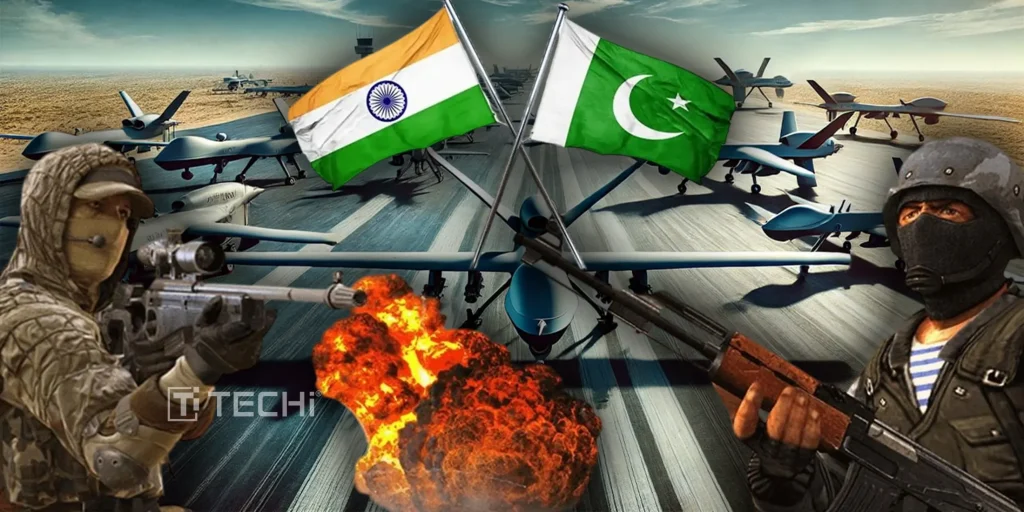
Since the India-Pakistan cross-border tension has entered into a drone war situation, with both sides claiming to intercept each other’s drones, there is a critical difference in terms of quantity, capability, and origin of Unmanned Aerial Vehicles (UAVs). While both nuclear powers integrated UAVs into their military arsenals for multiple purposes, their operational effectiveness remains unproven for drone warfare.
In terms of quantity, India’s inventory includes approximately 200 Medium Altitude Long Endurance (MALE) UAVs, 980 mini-UAVs, and various in-procurement variants. Meanwhile, Pakistan possesses a smaller fleet of around 60 MALE UAVs, 60 navy UAVs, 70 air force tactical UAVs, 100 army tactical UAVs, and some mini-UAVs. Although exact figures vary across sources; however, the overall numerical gap between the two neighbouring countries remains evident.
In recent years, India and Pakistan have spearheaded the development of indigenous UAV programs. However, the majority of their drone fleet remains largely reliant on imports. It indicates the distinct strategic and procurement preferences of both countries. India primarily sources its UAVs from Israel and the United States, leveraging advanced platforms such as the Heron series and the MQ-9B SeaGuardian. In contrast, Pakistan’s UAV inventory is predominantly composed of Turkish and Chinese systems, including models like the Bayraktar TB2 and the CH-4.
Although both India and Pakistan have advanced UAVs, their operational utility, combat effectiveness, and technological sophistication reveal notable disparities. India possesses some of the latest Israeliloitering munitions such as the Harop and Harpy, designed for precision strikes and electronic warfare roles. Meanwhile, Pakistan operates the widely acclaimed Turkish-origin Bayraktar TB2 armed drones, which have demonstrated battlefield success in the 2020 Nagorno-Karabakh War. These differences reflect not only divergent procurement strategies but also varying levels of integration and battlefield experience. Some of the key UAVs from both countries include:
Global Industrial Defence Solutions (GIDS) in collaboration with NESCOM
Fuselage Length
4.2 meters
Wingspan
6.6 meters
Cruising Speed
150 km/h
Operational Endurance
Over 7 hours
Maximum Take-Off Weight
480 kg
Operational Altitude
Up to 5,000 meters
Primary Roles
Intelligence, Surveillance, Reconnaissance (ISR), and disaster response
In 2021, Pakistan unveiled an advanced variant, Shahpar II. This new model exhibits multiple improvements, especially in endurance and operational altitude. In 2024, Pakistan unveiled another variant, Shahpar-III, having Intelligence, Surveillance, Reconnaissance (ISR), and multi-role combat missions.