
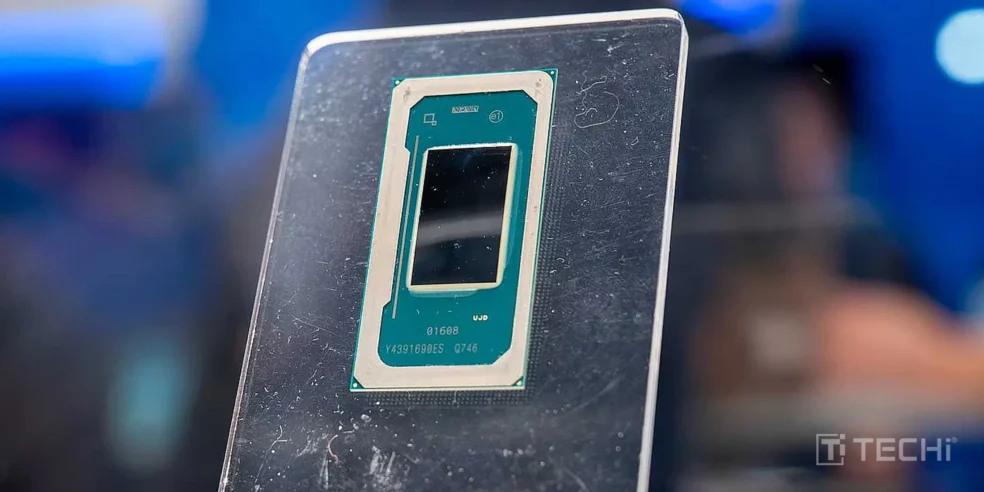

The next-generation Panther Lake processor represents a critical rebound for Intel, and this is how the company has managed to work towards a unification of power consumption and computer performance in all its laptop product brands. The processor is expected to be released in the 2026 laptop market, and is a combination of the uncouth performance of Arrow Lake and the sophisticated power efficiency of Lunar Lake, thus creating a next-generation platform that has the potential to redefine the operational basis of laptops based on Intel.
Panther Lake utilises the high-tech 18A process node of Intel, which is a 2-nanometer-based fabrication process that provides significant improvements in efficacy and performance indices. There are two major innovations in this manufacturing method, which include RibbonFET and PowerVia. RibbonFET enhances control of the transistor by surrounding the gate area on all four sides and hence reduces leakage currents and allows making smaller and more efficient integrated circuits.
On the contrary, Power Via reconfiguration of power distribution, moving power lines to the backside of the die, provides more frontside real estate to data pathways and leads to chip density. All these technologies put together give Intel a strong competitive edge in creating faster and more efficient processors in terms of power consumption.
Another innovation is the fact that Panther Lake has shifted to a modular architecture of a system of chips, rather than a traditional monolithic system on a chip architecture. This modularity allows the uptake and down takes of specific modules such as central processing units and graphic processing units, thus increasing the design flexibility and performance scalability.
The high-performance Cougar Cove P-cores are internally coupled with efficient Darkmont E-cores to make up the architecture. P cores are used when there is a heavy demand, like gaming and video editing, and E cores are used when it comes to light workloads, so as to save on energy. This core heterogeneity in strategy accounts for more than half of the overall system performance over previous generations, and at the same time, operates at lower power consumption.
Lastly, the graphics subsystem is built around the Xe3 architecture of Intel. The graphics subsystem is a fifty per cent improvement in graphical throughput over Lunar Lake, and is forty per cent faster in performance per watt than Arrow Lake. These quantifiable advantages have a significant influence on the gaming and creative production processes. Titles like Dying Light 2 were demonstrated live with sustained 140fps, which highlights the high level of progress made on integrated graphics performance.
Furthermore, the GPU has state-of-the-art features, including the use of ray tracing and artificial-intelligence enhanced frame interpolation through XeSS 3 technology, which forecasts and creates extra frames to support more visually consistent experiences, which had previously only been available to the most expensive dedicated graphics cards.
The artificial intelligence of Panther Lake is a great development. The new neural processing unit, NPU5, offers up to $50 billion operations per second TOPS and is 40% more efficient with regard to energy consumption as compared to its predecessor.
The composite architecture can support up to 180TOPS of processing, sufficient output to permit advanced on-device AI applications, including real-time language translation, intelligent image editing, and other applications of agentic AI when combined with the central processing unit CPU and graphics processing unit GPU.
Notably, Intel has been able to design this system in such a way that it boosts performance and, at the same time, minimises power consumption, thus increasing the battery life of the laptops without affecting the overall performance.
Another feature that is being improved is a betterment of the daily features, like webcam and image processing through the new IPU 7.5. The unit is compatible with cameras up to 16 megapixels, 1080p resolution with 120 frames per second, as well as uses AI-based colour adjustment, tone mapping, and noise reduction. These are upgrades that provide more natural and clearer video calling at reduced energy consumption.
Another interesting fact is that the Panther Lake will be produced in the US, more precisely, at the new Fab 52 plant in Arizona, manufactured by Intel. This move boosts domestic chip manufacturing and also puts Intel in a stronger position to compete with the world’s players in chip manufacturing, e.g. TSMC and Samsung.
Together, the Panther Lake of Intel refers to a critical change. It is a combination of maximum computational capability and best energy efficiency in one, well-balanced package. The latest process technology of 18 nanometers, improved architectural design, increased the power of the GPUs, and advanced AI are all other confirmations that Intel is back in the competitive frontline. After the long and arduous wait of falling behind the competitors like AMD and Apple, Panther Lake has the promise of giving Intel the much-needed boost.
Assuming that the initial performance indicators are still representative, laptops built on Panther Lake in 2026 will be faster, cooler, smarter – and will form a new standard of mobile computing.


