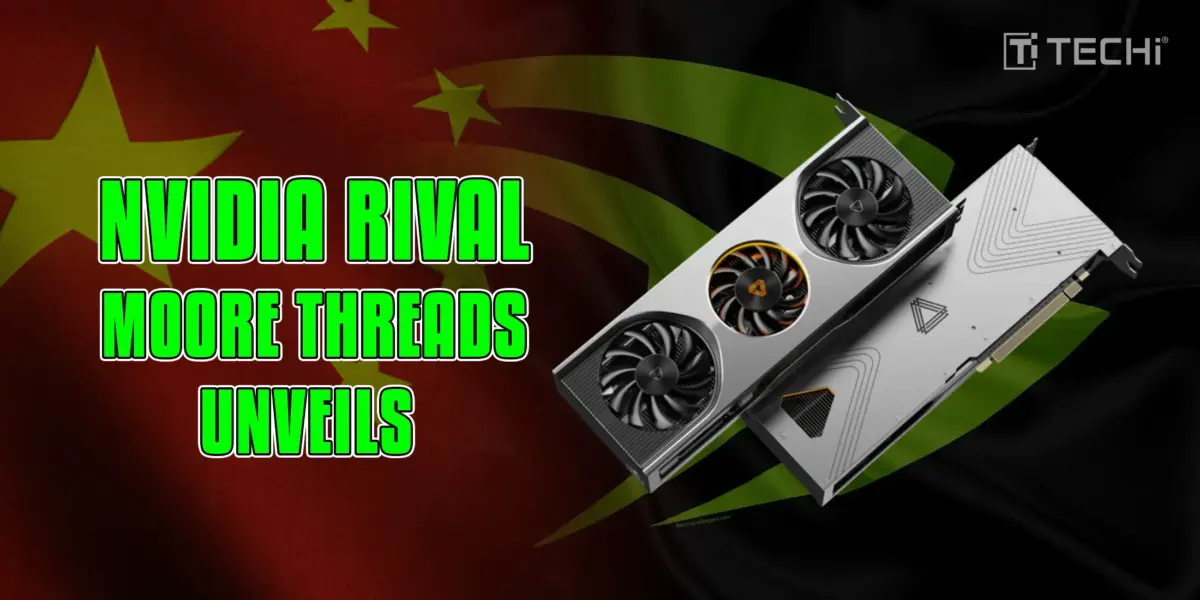
A recent Chinese start-up, Moore Threads, which has been a direct competitor of Nvidia, released an entire family of GPUs, calling them Huagang.
The announcement led to a noticeable increase in the market value of the company, as the shares of Moore Threads Technology jumped by 2% in Shanghai and reached a price of Y = 664.10 after a sequence of volatile after-IPO changes.
Company Background
Moore Threads, a startup by a former Nvidia executive Zhang Jianzhong, has become one of the contributors to the Chinese strategic goal of building native AI acceleration servers as the U.S. export policy increasingly restricted.
The company announced that it was soon going to suffer net losses and at the same time announced that it would become a leader within both the gaming as well as AI arena following an impressive early-December initial public offering.
Zhang has officially stated that the Huashan architecture outperforms Nvidia Hopper in terms of computation, bandwidth, and bandwidth capacity, and this drives a significant amount of investor attention despite the lack of published benchmark data.
The Beijing-based firm, hailed as China’s “little Nvidia”, introduced two forthcoming chips Huashan and Lushan, named after two famous Chinese mountains, at a developer conference in the Chinese capital on Saturday.
Launch Highlights
At the MUSA Developer Conference, Moore Threads unveiled the Huagang architecture on which the Lushan gaming GPUs and the Huashan AI accelerators are based.
The Lushan Gaming GPU from Moore Threads is expected to offer a 15x boost in AAA gaming performance, 64x boost in AI compute, 16x the geometry processing performance, 4x the texture fill rate performance, 8x atomic memory access performance, and a massive 50x boost in RT (ray tracing) capabilities, a significant improvement compared to the 16400GDDR6-based configuration of the current S80/S90 series.
Similarly, Chinese chip designer Moore Threads Technology has unveiled a suite of new products, including its next generation of chip architecture and artificial intelligence chips as it looks to challenge US chip-making heavyweights Nvidia and AMD.
The Huashan features a pair of chiplets and nine HBM modules with the company claiming it can have a greater raw compute and match to the upcoming Blackwell generation.
The platform also supports MTLink 4.0, which is claimed to support more than one hundred thousand GPU clusters that have a hypothetical bandwidth of 1,314 GB/s.
Market Analysis
The semiconductor industry in China can be said to be gaining pace, and this can be attributed to new recent developments in extreme-ultraviolet lithography, which has resulted in less reliance of the country on imported production machinery.
According to in-house data, Huagang architecture has boosted compute density by around 50% and performance by 10%, making Moore Threads a potential force to challenge the domination of Nvidia, as it already controls about 80% of the AI graphics unit market.
The AI chip based on this GPU, named ‘Huashan,’ is set to compete with NVIDIA’s Hopper and Blackwell product lines.
The goal is mass production next year. Bloomberg noted,
“This technology enables the implementation of clusters connecting over 100,000 chips for AI training in data centers.”
However, a good part of these assertions is still unsupported and the intended product launches of the company will fall in 2026 bringing a significant level of indecision.
Future Outlook
In the event that the intended benchmarks are proved by mid-2026, Moore Threads might scoop up more of the domestic AI-GPU market, thus reducing the competitive advantage of Nvidia, especially in the environment of the possible increase in the severity of the U.S. sanctions.
The enterprise also has high risks of execution like failure to deliver on promises of performance or avoid additional restrictions that may soon dim gains.
Nevertheless, the Economist Intelligence Unit estimates that China’s total state-led investment in chips has likely exceeded $150 billion in total commitments since 2014, suggesting that Moore Threads can help create a multipolar environment in the GPU industry.