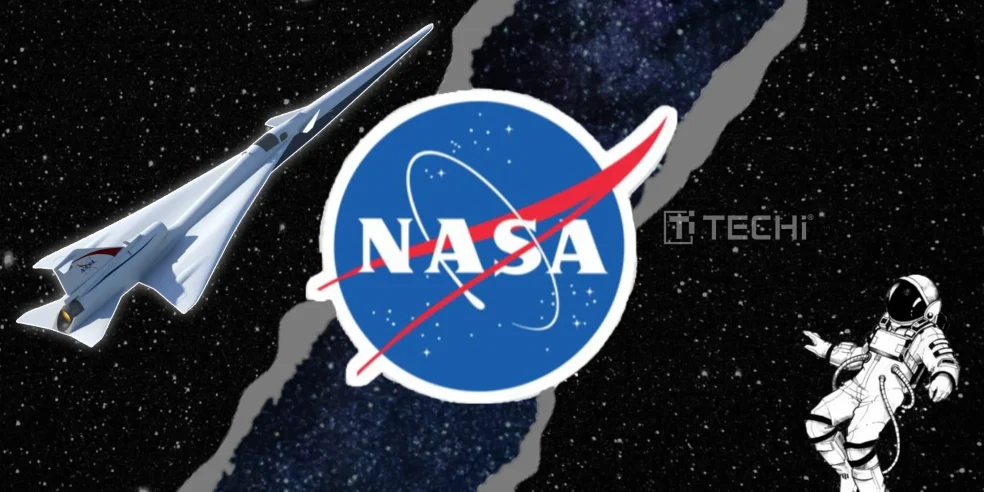

Illustration of NASA’s X-59 supersonic jet with the NASA logo and astronaut floating in space, representing the quiet flight breakthrough.
NASA’s X-59 supersonic jet illustrated in space as it enters taxi testing in 2025, marking a critical milestone toward noise-free faster-than-sound flight.

NASA’s X-59 “Quiet” Supersonic Jet Begins Taxi Tests

TECHi's Author Qaiser Sultan
Opposing Author Space Read Source Article
Last Updated
TECHi's Take
Qaiser Sultan
Qaiser Sultan
  • Words 312
  • Estimated Read 2 min

NASA, the American space agency, recently hit the runway with its long awaited rather revolutionary X-59 for its first Taxi test at California Plant 42. 

Quite temptingly, with this taxi test, it is safe to say that we are very close to witnessing an unprecedented event in the history of aviation; viable supersonic civilian flight.

This taxi test is more than just another air-exploration quest. It’s quite potentially a paradigm shift in aircraft science. The supersonic travel dream that was buried with Concorde might be resurrecting with the new X-59. With its elongated nose and no front windscreen, forcing pilots to rely on an augmented reality camera system, the aircraft feels like an ensemble of designing innovation.

Such finesse of this aircraft is quite telling on how sensitively NASA and Lockheed Martin, the manufacturer of the aircraft, take the issue of solving the most fundamental problem that killed the supersonic aviation in the first place; its noise.

The aircraft promises to replace ear-splitting sonic booms with a gentle “thump” comparable to a car door closing. If successful, this breakthrough could overturn nearly 50 years of supersonic flight bans over populated areas, shrinking cross-continental flights to three hours and revolutionizing emergency response times.

The most compelling in this project would be NASA’s methodical approach. They said NO to the inevitable sonic booms and engineered around the physics through innovative shaping. This is what you call pulling a bunny out of the hat. Even more interesting is NASA’s collaboration with the Japanese JAXA, in a way this a new era of setting global standards for aviation brilliance.

Following successful low-speed tests with NASA, pilot Nils Larson at the controls says, the program advances to high-speed trials before the anticipated first flight in late 2025. The real test comes when NASA flies over populated areas to gauge public reaction to the reduced noise signature. 
Space

Space

  • Words 49
  • Estimated Read 1 min
Read Article

“This month, NASA took the experimental aircraft out for a drive, performing what are known as taxi tests. During these tests, NASA test pilot Nils Larson drove the X-59 across a runway at low speeds so crews could ensure the jet’s steering and braking systems work as intended”

Source

NOTE: TECHi Two-Takes are the stories we have chosen from the web along with a little bit of our opinion in a paragraph. Please check the original story in the Source Button below.

Balanced Perspective

TECHi weighs both sides before reaching a conclusion.

TECHi’s editorial take above outlines the reasoning that supports this position.

More Two Takes from Space

Telescope spies rare interstellar comet 3I/ATLAS zooming through our solar system

The appearance of 3I/ATLAS is not merely an astronomical curiosity; it's a human reminder of just how tiny we truly…

SpaceX sends two batches of Starlink satellites on Saturday

SpaceX has somewhat turned space into a factory operation. Adding 53 satellites in one day is more than impressive. It's…

Scientists may have picked up a dark matter signal

Dark matter remains one of the most mysterious elements of the universe, because it's completely invisible to us. It neither…

NASA 3D prints the first ever object in space

The folks over at NASA are certainly knee deep in research and development as well, and they have been working…