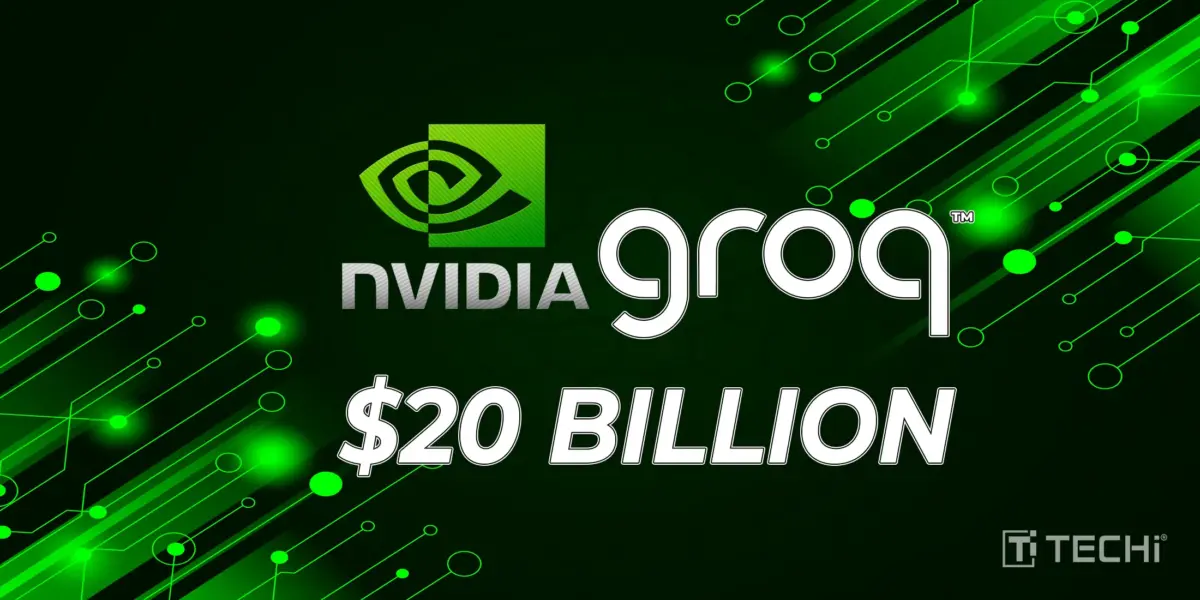
A deal that Nvidia has announced is a deal with the up and coming AI chip start-up Groq where it has made a big purchase of important assets of the company valuing it at an unprecedented $20 billion in the form of cash dealings.
Published on Christmas Eve, this announcement puts Nvidia even further into the realm of superfast AI inference, making it worth more than Groq considers itself to be after a recent valuation of over $6.9 billion after a funding round of over $750 million in September.
Groq said in a blog post that it
“entered into a non-exclusive licensing agreement with Nvidia for Groq’s inference technology,”
without disclosing a price. With the deal, Groq founder and CEO Jonathan Ross along with Sunny Madra, the company’s president, and other senior leaders said
“will join Nvidia to help advance and scale the licensed technology,”
Deal Breakdown
Groq did not disclose financial details of the deal. CNBC reported that Nvidia had agreed to acquire Groq for $20 billion in cash, but neither Nvidia nor Groq commented on the report.
Groq said in its blog post that it will continue to operate as an independent company with Simon Edwards as CEO and that its cloud business will continue operating.
In similar recent deals, Microsoft’s top AI executive came through a $650 million deal with a startup that was billed as a licensing fee, and Meta spent $15 billion to hire Scale AI’s CEO without acquiring the entire firm.
Amazon hired away founders from Adept AI, and Nvidia did a similar deal this year. The deals have faced scrutiny by regulators, though none has yet been unwound.
Having a minimum of $60.60 billion in cash reserves by October 2025, Nvidia can well afford this strategic move, which will surpass a $7 billion purchase of Mellanox made in 2019.
Groq’s Rise
Groq, founded in 2016, raised $750 million in September at a valuation of about $6.9 billion, with investors including BlackRock, Neuberger Berman, Samsung, Cisco, Altimeter and 1789 Capital.
It has competitive processors with Nvidia GPUs when it comes to real-time tasks like large language models.
There was a major inflow of investment in form of BlackRock, Samsung and Cisco among others, but Nvidia played its way out and concluded the deal in a few weeks after Groq had raised funds.
Market Impact
This deal is related to a larger trend of Nvidia buying out companies in the recent past, an example being an acquisition to the tune of $900 million of Enfabrica technology in September and buying out CoreWeave before its initial public offering.
In 2026, 55% of AI-optimized IaaS spending will support inference workloads and it is projected to reach more than 65% in 2029. Singh said
“Unlike training which involves intensive, large-scale compute cycles that occur during model development and ongoing updates, inference happens continuously powering real-time applications such as chatbots, recommendation engines, fraud detection systems and industry-specific applications,”
Looking Ahead
It is projected that the Nvidia AI factory-style model will take the lead in inference workloads and will serve hyperscale data centers with a forecasted increase by 2026.
However, the consolidation will still be subject to scrutiny by the regulatory authorities due to the potential antitrust consequences of the same.
It is believed that the financial resources possessed by Nvidia would allow additional acquisitions that will basically transform the AI silicon market by 2027.