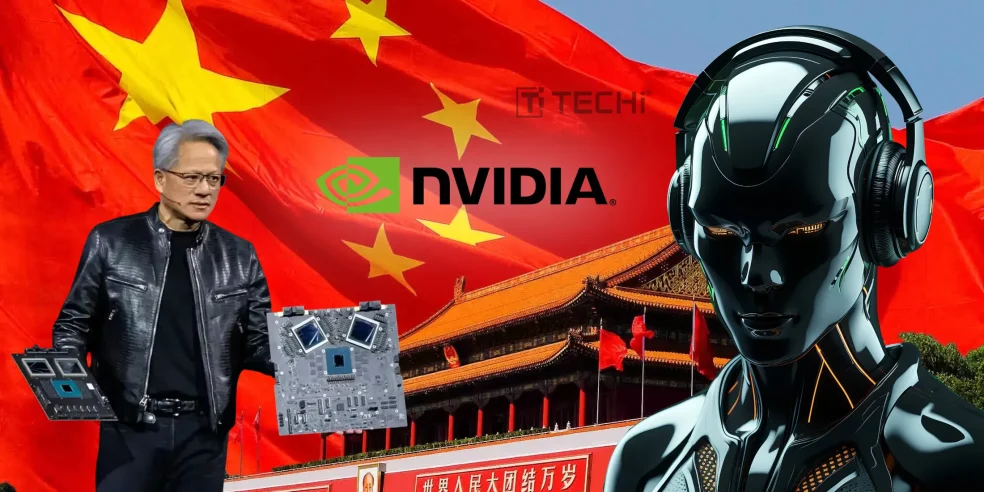
Nvidia has planned to restart sales of its H20 AI chips to China, just months after the U.S. banned them. The company has applied for license approval and expects to get the green signal soon. This decision is linked to recent trade discussions about rare earth metals between the U.S. and China.
U.S. Commerce Secretary Howard Lutnick said that when the U.S. and China made a new trade deal about rare earth minerals, they also added an agreement that would allow Nvidia to sell its H20 AI chips again to China.
Rare earths are a group of 17 metals that are really important for making electric cars, smartphones, missiles and military gear, wind turbines, AI chips, and electronics. China controls over 80% of the global supply of these metals. If China blocks them, U.S. industries will face big problems. Therefore, even though the U.S. doesn’t want to keep China from becoming too powerful in AI, it also needs rare earths from China to build its own tech. So, the U.S. made an exchange offer:
“You give us rare earths, we’ll let Nvidia sell some limited AI chips again.”
Why Is This Issue So Sensitive? 🔗
Many U.S. lawmakers are against this move. They believe China will still use H20 chips to strengthen its AI capabilities, especially chatbots like DeepSeek. Because they are building powerful models at lower costs.
Some democratic members of Congress have still raised concerns that even selling weakened AI chips will help China catch up. They warned that the U.S. is giving away its lead in AI to China.
Even though Nvidia is allowed to resume chip sales to China, these H20 chips are less powerful than their other models, such as the H100 or GH200. These toned-down versions are designed to meet U.S. export rules, which ban the sale of highly advanced AI chips to China.
However, the H20 still supports Nvidia’s CUDA software. It’s a platform used worldwide to build and run AI models. Even with weaker specifications, China can still train and operate AI systems effectively using this chip. Because most of the AI tools are designed to run on CUDA.

As soon as Nvidia announced the license plans, Chinese tech firms started placing orders. Big companies of China, like ByteDance and Tencent, are already trying to become official buyers of these chips.
While these H20 chips are weaker, they are still the best option in China. Other alternatives from Huawei and local firms are not on the same level, and they lack support for industry-standard software.
Why China Still Depends on Nvidia 🔗
China has chip designers like Huawei’s HiSilicon and Alibaba’s T-Head, but they can’t manufacture high-end chips themselves. They need EUV machines from ASML (Netherlands), and the U.S. has already pressured ASML to block exports to China.
So even if China knows how to design a chip, it can’t produce it. Therefore, Chinese AI companies still invest billions in Nvidia’s hardware. Moreover, it is faster, supported, and globally trusted.
CEO Jensen Huang is currently in China, and sources say he’ll speak at a local event soon. He has said if the U.S. government blocks Nvidia from selling its AI chips in China, Nvidia could start losing its legacy in the global AI market. Chinese companies like Huawei are quickly improving and offering their own AI chips to local developers.
China gave Nvidia $17 billion in revenue last year, which is about 13% of its total earnings. So, if NVIDIA stops exporting its stock, it will lose that significant percentage of its revenue.
Nvidia’s main rival, AMD, also announced it will apply for licenses to ship its MI308 chips to China. Its shares jumped 7% after the news, while Nvidia’s shares rose only 4%. This shows how powerful the Chinese market is, even with an export ban, every chipmaker wants to seize the opportunity to sell in China.
Final Thoughts 🔗
This whole situation proves one thing clearly: AI chips aren’t only about tech anymore, they’re about power, politics, and global control. Nvidia is trying to protect both the U.S interest and its AI chip consumers. For now, the deal benefits both sides. But if China keeps improving its local chip-making, this dependency phase will end soon. Until then, weaker chips compatible with CUDA software are a good option.