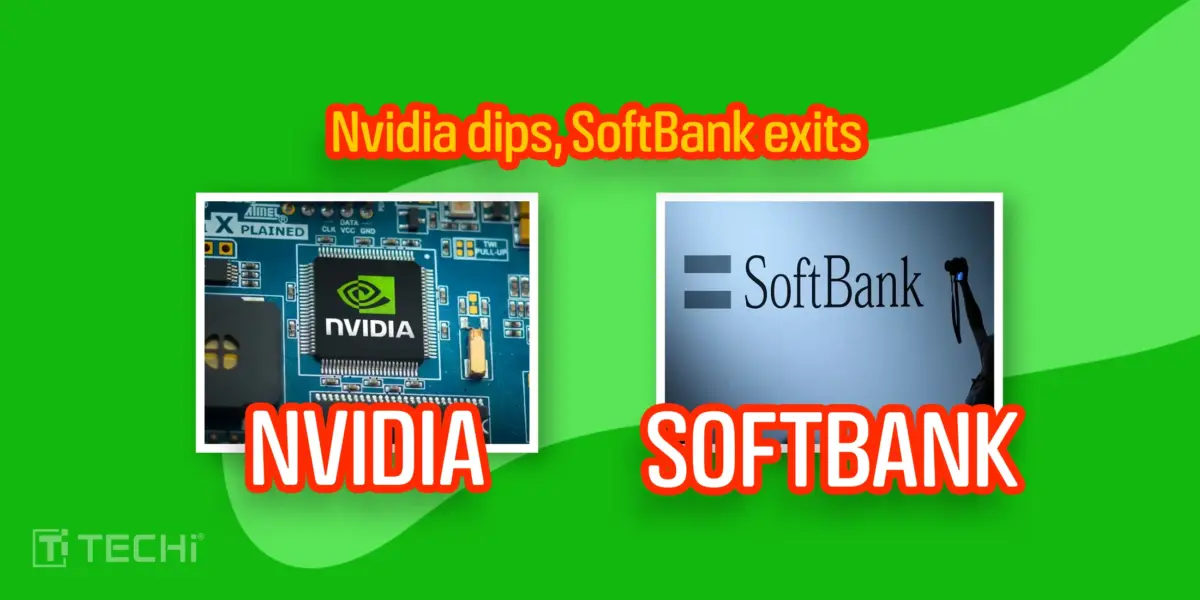
The stock prices of Nvidia dropped by more than 2% at the start of U.S trading after SoftBank proclaimed that it had completely disposed of its stake in the AI chip leader, which was worth $5.83 billion.
The earnings statement issued by the company indicated that the sale had 32.1 million shares in Nvidia, in addition to a partial reduction in T-Mobile.
The CFO of SoftBank, Yoshimitsu Goto, told the investors that the action was a part of a larger strategy of “asset monetization” which would enable the company to free up cash and to realign the investment portfolio.
The decision is a reflection of SoftBank’s determination to keep its financial flexibility, while investing heavily in the growing sectors where AI has been the most prominent area.
From Nvidia to OpenAI 🔗
The sale does not mean that SoftBank is moving away from AI but it is a change of direction in strategy. The firm has gained exposure to OpenAI during the last few months, who is one of the most powerful players in the AI world.
Earlier this year, SoftBank signed a deal to lead a $40 billion funding round which gave OpenAI a $300 billion valuation. Soon after that it became part of the consortium that was acquiring $6.6 billion worth of shares from OpenAI employees at a $500 billion valuation.
This change of direction is evidence of SoftBank’s shifting strategy, from having stakes in large established AI hardware companies like Nvidia to focusing on AI software and the necessary infrastructure.
It is a bold and calculated move that is in tune with CEO Masayoshi Son’s vision of making SoftBank a significant player in the AI revolution, either through hardware or software.
Risks and Rewards 🔗
Questions about the future sustainability of the existing huge capital investments in AI are starting to raise, even though the excitement around AI is still very much alive.
Some analysts are expressing their concerns about when and how these investments will turn into the real profits that the companies have been waiting for. Nevertheless, SoftBank is still convinced that the biggest risk would be not to invest at all.
Goto supported this view and said,
“[t]here are various opinions […] SoftBank’s position is that the risk of not investing is far greater than the risk of investing.”
Such strong belief, along with the company’s Vision Fund earnings, was responsible for the 2.5 trillion yen ($16.3 billion) second-quarter net profit that was more than twice the amount expected by the analysts.
SoftBank and Nvidia’s AI Future 🔗
SoftBank sold its shareholding in Nvidia, but the company hasn’t cut off its links with the chipmaker’s future yet. Through its participation in major projects like Stargate, which is a $500 billion U.S data center initiative, SoftBank is keeping its indirect connection to Nvidia’s semiconductor supremacy.
The offloading of the Nvidia shares seems to be more a case of timing and capital recycling rather than loss of trust. The valuation of Nvidia has skyrocketed along with the AI hype, and SoftBank’s profit taking can be viewed as wise portfolio management before the markets that are potentially volatile.
Bottom Line 🔗
SoftBank’s strategy brings in consideration something that is one of the frequently neglected realities in tech investing, which is that timing and perseverance are as crucial as the technology itself.
Selling Nvidia at almost peak value and simultaneously investing more in OpenAI could be seen as something that is genius, or a high-stakes gamble.
SoftBank is not abandoning AI, it is simply relocating its spot in the decision-making process. SoftBank’s exit from Nvidia has made a notable impact on the transformation of global AI investments.
Although the market responded with a slight decline in Nvidia’s stock, the overall scenario is one of a strategic evolution rather than a retreat.