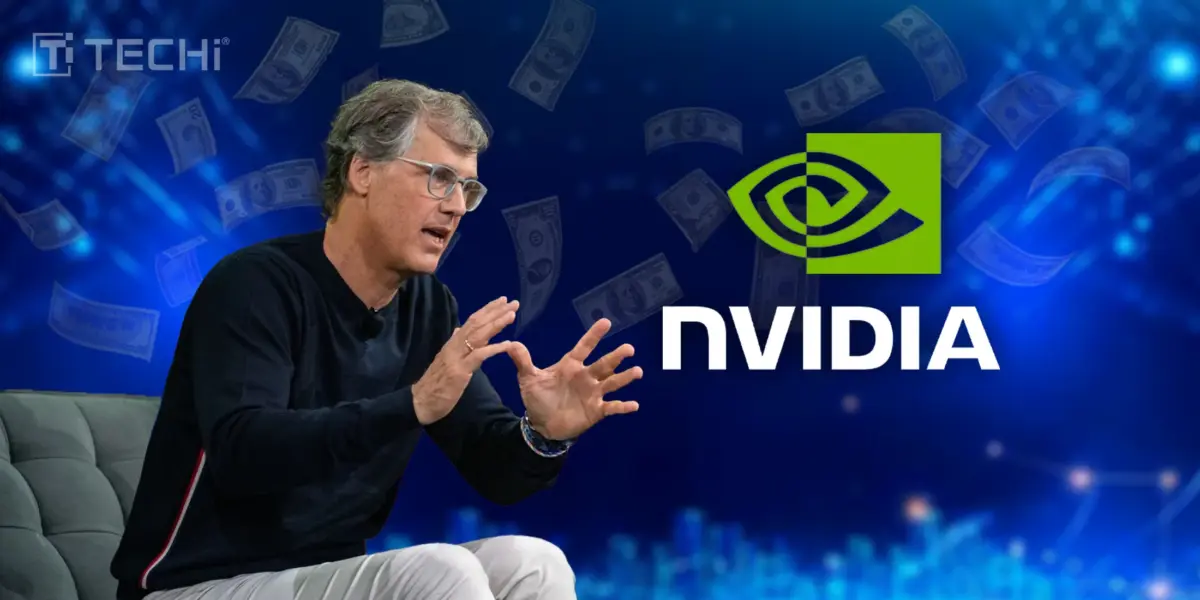
There are very few things that can match the sight of a billionaire who is subtly shifting his holdings to remind us how dramatic markets can be. Billionaire Philippe Laffont, the head of Coatue Management, is not someone whose investment choices could ever be described as cautious. He is the one whose fund’s performance over the last three years has outshined the S&P 500 by 94 percentage points, which is a very impressive record that draws attention every time he moves his money.
Laffont did a couple of unexpected trades in the third quarter, where he reduced his investment in Nvidia by 14%, selling 1.6 million shares. He also increased his investment in BlackRock’s iShares Bitcoin Trust, where he bought 76,000 shares.
The first reaction might be that such a drastic cut in Nvidia might be a little silly, and going for a Bitcoin ETF could be even more ridiculous. However, the reality is that selling half of the investment in Nvidia and doubling in the Bitcoin ETF is a clever way of balancing between present strength and a very far away risk.
Nvidia, an AI Powerhouse 🔗
Nvidia’s impact on the AI ecosystem is still quite extraordinary and unmatched. The launching of ChatGPT in 2022 was a turning point by which the whole world turned to AI, and Nvidia was the leading force. Its GPUs are the best for both training and running the largest AI models, and its networking solutions are the backbone of AI supercomputers in every corner of the world.
The competitions in AI are moving from text and image generation to robotics, autonomous vehicles, and advanced simulations, thus the full stack advantage of Nvidia is becoming even more important. Huang made the point simply and said,
“We build all three computers: the training computer, the simulation computer, and the robotics computer or self-driving car computer”.
Nvidia then provides this type of computer with other components such as software frameworks, AI models and development tools that attract the customers and speed up the process of their acceptance for it
The stock market is predicting an annual growth rate of 37% of Nvidia’s earnings over the next three years, which is an extraordinary figure for a company that is valued at one trillion dollars. Hence, the company’s price-to-earnings ratio of 44x might be classified as the upper limit, but the growth forecast makes it not so expensive as compared to other hyper-growth companies.
So, what could be the reason behind Laffont’s decision to sell? Probably, it is profit-taking. Nvidia is still his eighth-biggest holding that accounts for 4.5% of his portfolio. There are no signs that he is losing faith in the stock, it is just a matter of sensible portfolio management after a spectacular run.
iShares Bitcoin Trust & Betting on a 20,300% 🔗
On one hand, Laffont selling part of his Nvidia stake is a headline making event, but on the other hand, his acquisition of the iShares Bitcoin Trust (IBIT) is even more fascinating. There is no doubt that Bitcoin’s price movements can be very drastic and unpredictable.
But so are the claims of its backers including Saylor, who is one of the aggressive proponents of Bitcoin on Wall Street. Saylor has very recently come to the conclusion that Bitcoin might deliver 30% annually for the next two decades, which would put the price of one coin at $19 million in 2045. That is equal to a jaw-dropping 20,300% up from the current price of $93,000.
This optimistic scenario is based on a number of factors such as;
- The fixed supply of 21 million coins which will increase the price and reduce the demand as well.
- There is an influx of spot Bitcoin ETFs, which have sped up the process of bringing both institutions and retail investors into the market.
- The current government’s crypto-friendly U.S. policies are instilling confidence in investors.
- The institutional adoption rise is phenomenal, as the number of asset managers with holdings in IBIT worth over $100M has increased by 150%, and corporate Bitcoin wallets have doubled.
Bitcoin has therefore been accepted in mainstream finance, which is a fundamental change from previous cycles.
Volatility Warning & Potential Opportunity 🔗
In spite of the optimism, Bitcoin is still very much unstable. It attained its greatest value ever in October, but then within a month, in November, the price collapsed by more than 30%, and currently, it is about 27% lower than its peak. For those patient investors with high risk taking ability, Laffont’s intensified position is a sign of strong belief that the upside in the long run will more than compensate for the turbulence in the short run.
By selling part of his Nvidia shares and purchasing IBIT, Laffont is not deciding on one future while neglecting the others, he is rather spreading his investments across various technological frontiers. For those investors who are still hesitant to take the plunge, his actions provide both a guideline and a reminder that the largest victories often belong to those who manage to strike the right balance between certainty and taking calculated risks.