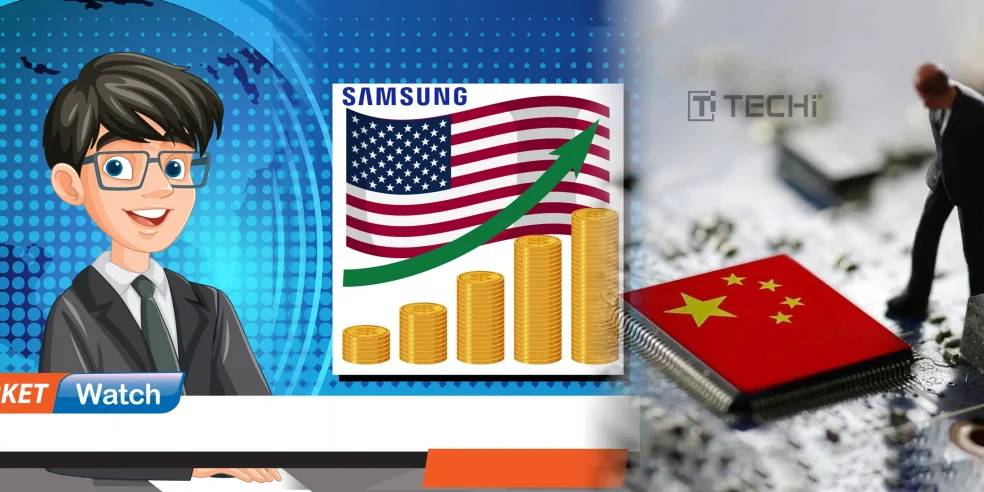
After a surprisingly strong first quarter, Samsung Electronics just hit a wall. On July 7, 2025, the company estimated a 56% drop in Q2 operating profit, which is far below expectations. While the chip industry has been bouncing these days, Samsung has reported disappointing performance. According to Samsung’s preliminary report, Q2 operating profit landed at 1.5 trillion won ($1.1 billion), well below the market forecast of 2.6 trillion won, even though its first quarter operating profit was KRW 6.7 trillion.
The company claims that U.S. restrictions on AI chip exports to China are the key reason behind this loss, telling us that geopolitics is now reshaping business outcomes. For other companies, this might be a seasonal hiccup but Samsung is a tech giant, it’s a warning sign for them.

Samsung’s journey in the chip industry started in 1983, launching its very first 64Kb DRAM chip. Then by 1992, it shocked the world by becoming the #1 DRAM manufacturer globally, overtaking Japan’s Toshiba. Their progress continued and in 2004 Samsung launched 8 GB NAND, making themselves a memory powerhouse. Today they stand among big companies like TSMC and Intel, positioned as the world’s largest memory chipmaker by revenue. With this impressive and successful history, the recent Q2 loss feels nothing short of a chokehold.
This profit plunge came just after a surprise Q1 rally, where Samsung’s chip division posted its first operating profit since 2022. Investors thought Samsung was making a strong comeback in chips, because of improved DRAM pricing and signs of recovery from a brutal memory downturn. But it didn’t last long.
The U.S., in its continued push to curb China’s AI advancement, tightened export controls in late Q1 and early Q2, especially on advanced chips and equipment. While the policy directly targets U.S. firms like Nvidia and AMD, it impacts global firms too, especially those like Samsung. China is one of Samsung’s largest markets. The company relies on selling memory chips, high-performance processors, and AI-related semiconductors to Chinese clients.
Why China Matters More Than the Numbers Admit 🔗
An estimated 25–30% of its chips are exported directly or indirectly to China, which includes both memory (NAND, DRAM) and custom chips. The loss of access to Chinese AI server companies, including major buyers such as Baidu and Tencent, has badly hit Samsung. Its struggle is not just about numbers, it’s about timing. Notably, this hit comes at a time when competitors are leading in the chip industry.
- TSMC is expected to post double-digit profit growth this quarter, due to the contracts with Apple, Nvidia, and AI server.
- SK Hynix is taking advantage of the demand for High Bandwidth Memory (HBM3), supplying it to Nvidia and making strong profits without depending on Chinese customers.
Right now Samsung is paying the price of being caught between two superpowers. Its heavy reliance on the Chinese data center market and less diversification outside traditional memory chips have hit it badly. Meanwhile, the U.S. CHIPS Act restrictions have made them think about their customer strategy.
On the flip side, Samsung is spending a huge amount of money to build a new chip manufacturing plant in Taylor, Texas. But even though the construction and investment are happening now, the factory can’t start making money at this time. It takes years to build, test, and start full production in such advanced facilities, so Samsung won’t see profits from it soon.
Meanwhile, U.S. incentives under the Inflation Reduction Act (IRA) and the CHIPS & Science Act favor chipmakers present in U.S. AI systems. Companies building fabs in the U.S. get grants, tax credits, and subsidies. Critics say these funds mainly benefit U.S. native players or those deeply embedded in American supply chains, even though Samsung qualifies for it and receives roughly $4.7 billion in CHIPS funding for Taylor.
Despite its vast scale, Samsung remains on the outside edge when compared with firms already established within U.S. AI ecosystems. It doesn’t have deep roots within the U.S. as TSMC, Intel, or homegrown firms do.
However, Samsung still leads in memory volume and advanced chipmaker infrastructure. Samsung’s next move will decide whether this was just a slip or the start of a structural lag. If it does not work on more diversified demand outside China and build competitive AI hardware partnerships (like SK hynix has with Nvidia), this geopolitical squeeze could become a long-term constraint, because the tech issues between the U.S. and China that have persisted since 2018 will not be easy anytime soon.