

On Monday, 10 November 2025, the prominent workplace messaging app Slack experienced a severe failure, rendering thousands of users unable to send and receive messages. This disruption began around 1 p.m. Eastern Time and quickly spread to companies that use Slack as part of their daily communications.
The word of the malfunction spread widely through social networks and the monitoring service Down detector, where more than 15,000 incidents were registered in a few minutes.
The Outage and Its Impact 🔗
Slack is widely used in corporate environments worldwide, and any disruption to this service is a significant inconvenience to teams that have begun their working week.
Customers complained that they were unable to access channels, send messages, and load the application on desktop and mobile devices. The outage, to most of them, disrupted communications at a crucial time, triggering delays in meetings, discussions on various projects, and responses to support.
Some staff members at the news outlet Mashable also experienced connection problems with Slack, as it is one of the primary tools of communication. The site exhibited recurring loading errors and failed to send updates, forcing users to devise interim methods for coordinating the teams.
Similar grievances were raised in various industries, including tech companies and support departments, which highlights the high degree of integration of Slack in the daily operations of companies.
Slack’s Response 🔗
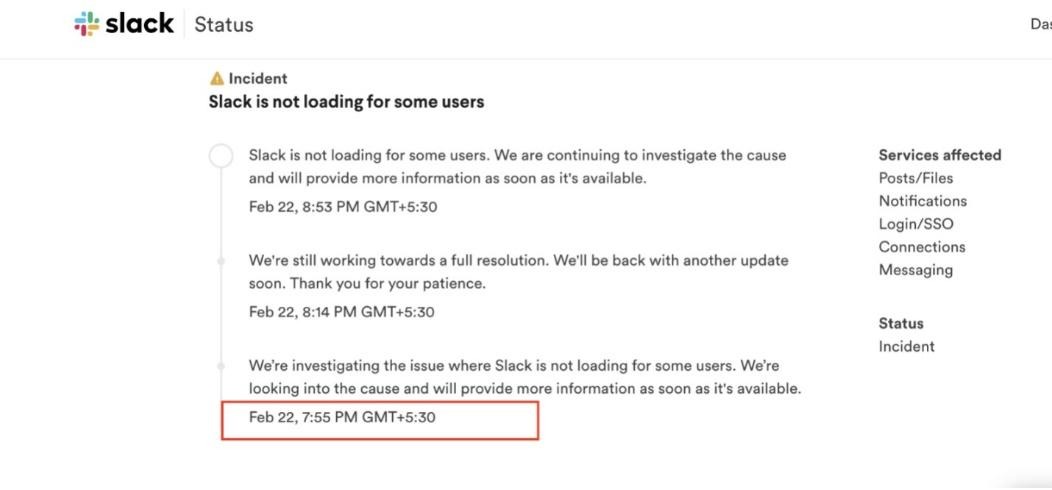
Slack immediately admitted to the problem on its official status page. At 1:26 p.m. Eastern Time, the company updated its status, stating that some users would experience difficulties connecting or loading Slack.
It promised the users that engineers were researching the issue and would update them again in 30 minutes. In the afternoon, Slack indicated that it had identified the root cause and implemented remedial actions.
At 2:51 p.m. Eastern Time, the company’s health metrics began to improve, and the number of users complaining about the company started to decrease dramatically. Slack reported that our work on this issue is still ongoing, and our health metrics continue to indicate improvement, which may mean that the situation is slowly stabilizing.
Responses from users and broader implications 🔗
As usual with most significant online failures, customers resorted to sites like X then Twitter to vent out their feelings and make jokes about the unexpected disruption to their jobs. One participant called it a coffee break that had taken place accidentally, and some expressed their worries about project delays.
The event served as a reminder of the level of reliance modern workplaces have on real-time communication tools.
Although Slack outages are sporadic, they highlight the fragility of large-scale digital systems. In the event of the failure of such platforms, even in the short term, the wave may damage thousands of businesses and millions of workers.
Resolution and Takeaways 🔗
Slack was able to recover normal operations by the end of the afternoon, as reported by most of the users. Although the firm failed to disclose the exact technical reason for the failure, it confirmed that surveillance would continue to provide stability.
The event highlights the importance of having backup communication channels and training for eventual digital failures in highly interconnected workplaces.
Although the outage on Monday was brief, it clearly demonstrates that even the most reliable tools may experience downtime.
In the meantime, Slack users could continue their operations, but in the future, they would pay closer attention to the application’s status page.