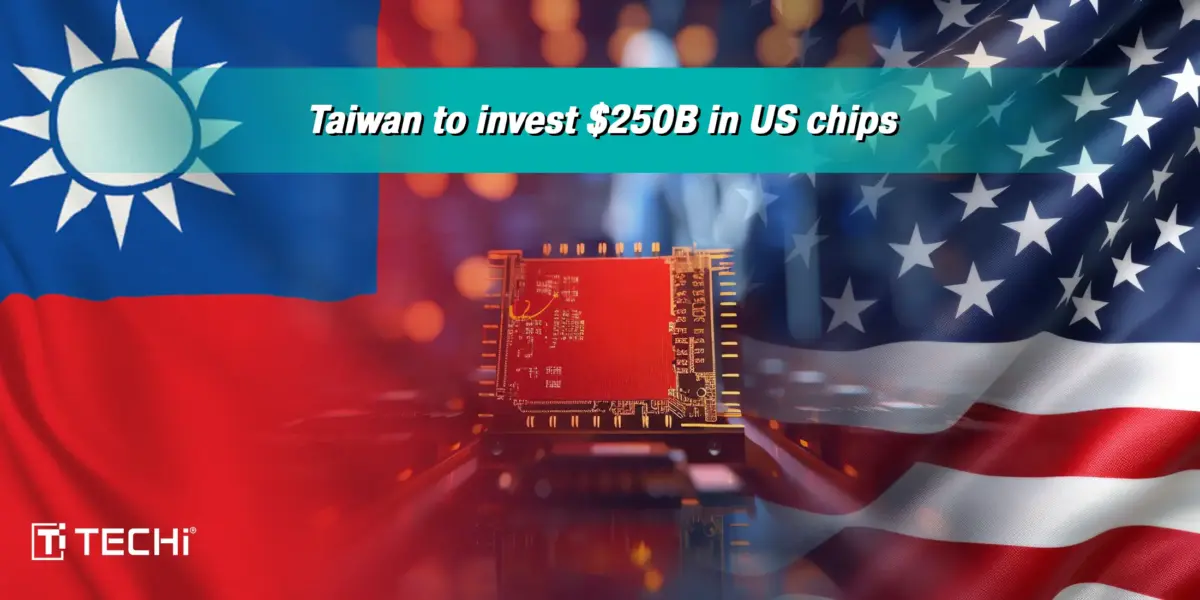
Taiwan has agreed to invest a mind-boggling $250 billion in U.S semiconductor manufacturing, which is in an act that can only be described as go big or go home. The agreement, which is signed under the Trump administration, is aimed at equipping the United States with the capability to regain its domestic chipmaking strength, which is a sector where it has for a long time relied on foreign production. Not to mention that there’s already a significant friend’s gesture involved as well, where Taiwan manufactures over half of the world’s semiconductors, it’s still a move of strategic power with global consequences.
$250 Billion Commitment to Chips, AI, and Energy
The $250 billion will be allocated mainly to the semiconductor sector, but it will also be distributed to AI and energy projects, as per the U.S Department of Commerce. In case that number didn’t sound big enough, Taiwan is also offering an additional $250 billion in credit guarantees to support further investments from these companies. The timeline for these promises are not clear at the moment, but what seems obvious is that Taiwan is all set to help the U.S ramp up its chip ecosystem.
What is the U.S Offering to Taiwan?
The United States has in turn committed to invest in the Taiwanese semiconductor, defense, AI, telecommunications, and biotech areas. While the press release did not provide an exact dollar amount for the U.S side of the bargain, the reciprocated nature of the deal indicates a long-term strategic partnership, instead of a special transaction. It is better to think of it as a mutual insurance policy in an increasingly fragile global tech supply chain, rather than a purchase order.
National Security Issue
The announcement was not made without reason, in fact it was timed perfectly. It came a day after the Trump administration again emphasized upon the plan to relocate semiconductor manufacturing back to America, along with admitting that the procedure would take time. At present, only about 10% of chips are made in the U.S, which is a figure that has turned into a warning signal in policy-making circles. In a direct manner, the administration explained that dependence on foreign sources for chips not only posed an economic risk, but was also a national security risk, considering the fact that chips are integral to a wide range of applications from consumer electronics to missile defense systems.
The proclamation stated,
This dependence on foreign supply chains is a significant economic and national security risk. Given the foundational role that semiconductors play in the modern economy and national defense, a disruption of import-reliant supply chains could strain the United States’ industrial and military capabilities.
Tariffs, Trade Talks, & Caution
The announcement additionally imposed a 25% tax on certain advanced AI chips, which ultimately revealed the government’s intention to impose tariffs on the semiconductor industry further, once the trade talks with the allies are over. The agreements such as the one with Taiwan seems to be a mixture of incentives and a sort of punishment, where they persuade the allies to take the U.S manufacturing route now or risk being on the side of high tariffs later. It is a case of industrial policy, where it has put on a polite smile while firmly holding onto the chips.
Bottom Line
The agreement is a clear indication that chips have moved from being a hidden and crucial ingredient in the tech world to being a decisive factor in the geopolitical arena. With AI, military applications, and high-performance computing all competing for the same advanced chips, partnerships like this might determine the location and methods of the world’s most vital technology.
Taiwan’s huge investment of $250 billion in U.S semiconductor manufacturing is not only a matter of production and financing, but also a bold move regarding global supply chain resilience, safeguarding partnerships, as well as the acknowledgment of the power that chips represent in the present day economy. The complete effect of this collaboration will take some time to unfold, however the race for semiconductor dominance is already very open and very loud at a global level.