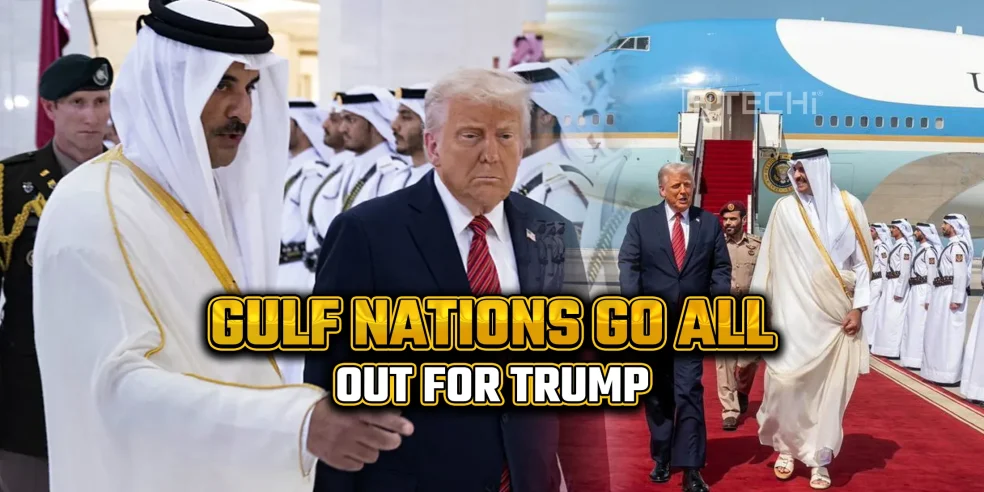
In a display that blurred the lines between opulence and strategic diplomacy, U.S. President Donald Trump received a royal welcome across the Gulf Cooperation Council (GCC) states during his three-day tour. From cyber trucks and camel parades to trillion-dollar investment pledges, Gulf leaders spared no expense in signalling their political alignment and economic ambitions.
Trillion-Dollar Promises and Strategic Pacts 🔗
The ceremonial fanfare wasn’t just for show. Massive investment pledges highlight the seriousness of Gulf intentions. It includes
- Qatar: Announced a staggering $1.2 trillion “economic exchange” agreement with the U.S.
- Saudi Arabia: Committed $600 billion in U.S.-bound investments, including a record-setting $142 billion arms deal.
- UAE: Reaffirmed its $1.4 trillion, 10-year investment roadmap in America, signed earlier this year.
While questions remain about the feasibility of such enormous figures, especially amid fluctuating oil revenues, the announcements are being seen as strategic positioning for long-term tech, defence, and economic collaboration.
The “Trump Effect”: Business Over Politics 🔗
“Trump represents a transactional style of politics the Gulf understands and prefers,”
said Tarik Solomon, chairman of the American Chamber of Commerce in Saudi Arabia.
“He still symbolizes fast money, big defence, and gateway access to American innovation.”
This sentiment is not new. Gulf nations have historically found more synergy with business-focused U.S. presidents. Trump’s unapologetically pro-business posture makes him a natural partner in a region that is pivoting from oil-based economies to tech-driven futures.
Symbolism or Strategy? A New Geopolitical Theater 🔗
While critics call the extravagant visit “political theater,” experts argue that these gestures reflect genuine strategic intent.
“There is clearly a competition,not among Gulf countries, but between global blocs like Europe and Asia,for stronger U.S. alignment,”
said Dr. Ahmed Rashad, an Abu Dhabi-based economist.
“The GCC states see Trump’s return as a golden opportunity to deepen bilateral ties on favorable terms.”
Trump’s Ritz-Carlton Summit: A CEO Power Table 🔗
Elon Musk, Nvidia‘s Jensen Huang, and BlackRock’s Larry Fink were among the American executives who attended the U.S.-Saudi Investment Summit in Riyadh. The Kingdom hosted the summit, which may be referred to be the American business Mecca. At its core, the message is clear: Gulf states court power while investing cash.
Revolutionary Technology Contracts 🔗
The UAE, which is already emerging as a hub for technology and artificial intelligence, reportedly has an initial agreement with the US to import 500,000 Nvidia H100 chips annually. These AI processors are essential for large-scale data centers, which are a major part of the region’s ambition to become a leader in artificial intelligence.
Oversaturation is a concern raised by skeptics. “What is the true number of data centers required in the region?” Rahim enquired. “Overcapacity is a possibility, especially if these massive projects surpass real demand.”
However, as Tarik Solomon stated,
“It’s half the game to show ambition in the Gulf.”
The regional order is being reshaped even if only half of these pledges are fulfilled.
Trump’s return to the Gulf revealed more than lavish receptions and trillion-dollar commitments; it spotlighted a geopolitical realignment where access, optics, and ambition are converging. Whether this is a diplomatic spectacle or a new era of U.S.-Gulf cooperation, one thing is certain: the Gulf isn’t just welcoming Trump; it’s betting big on his legacy.