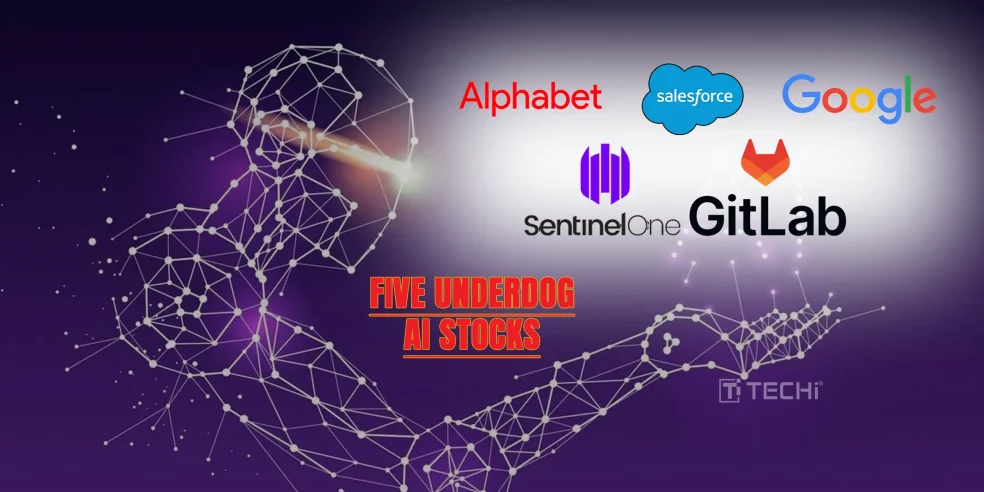

The Motley Fool in their recent weekly stock predictions has made an unpopular prediction by identifying five AI based stocks that have struggled in the first financial half of 2025 to make a comeback in the second half of the year as the real winners of AI stocks.
According to the report, the first underdog might be the most misunderstood Alphabet’s (GOOGL/GOOG) stock. While the company’s shareholders and investors are sweating upon ChatGPT disrupting their industry dominance, they’re not keeping Google’s advantage; the habitually go-to tool of people.
With occupying over 65% browser share and Android’s 70% smartphone penetration, the company creates hassle-free AI delivery. The reports suggest that 82% of users go for Google’s AI-powered search mode against traditional search. This trend presents proof that users prefer enhanced versions of a familiar app rather than going for a new one.
Likewise, GitLab (GTLB), another major AI-based stock, flipped the narrative of “AI would replace coders”. While most of the developers only spend 20% of their time writing code, GitLab is set to expand its market to the remaining 80% slot. Hence, the company’s now-in-motion 27% revenue growth suggests enterprises are buying this broader AI-enhanced workflow vision.
With Salesforce (CRM) making the boldest bet with Agentforce, already boasting 4,000+ customers. Their ADAM framework positions Salesforce as the operating system for digital workforces, with outcome-based pricing showing confidence in AI agent effectiveness.
SentinelOne (S), being the most ruled out stock, is now on the rise. Its collaboration with Lenovo signifies one of the world’s largest PC-using companies is going to pre-install SentinelOne’s platform on every new computer. Combined with 23% revenue growth, this could be transformative.Last but not least, ServiceNow (NOW) represents the stealth AI winner enterprises actually need. AI-driven Pro Plus deals quadrupling year-over-year validate that companies pay premium prices for AI that demonstrably reduces operational friction across IT, HR, and finance.