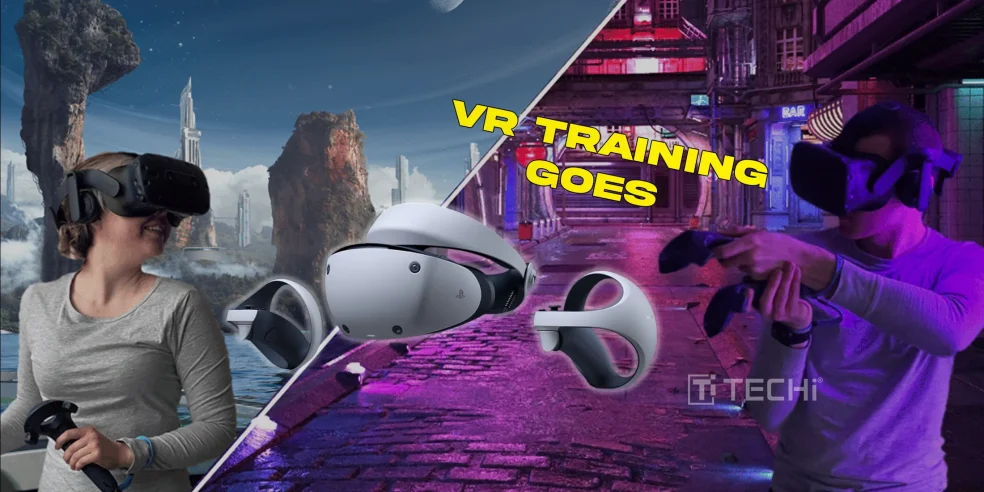
Imagine practicing brain surgery without actually touching a real patient or walking through ancient Rome during a history lesson. Well, these aren’t imaginary scenarios anymore because it’s literally happening in classrooms and hospitals right now.
Virtual Reality training has quietly revolutionized how we learn the most critical skills. What started as expensive and clunky experiments have now become the secret weapon for everyone from high school students to heart surgeons. Here’s why VR training is changing everything and what it means for you.
The Astonishing Numbers 🔗
Before we dive in, let’s talk about the results because VR training isn’t just some new cool tech. It delivers considerable improvements:
- Medical students that trained with VR scored higher in diagnosis, surgical methods and overall performance
- Surgeons using VR simulators show significantly better agility and operating room performance
- Students make fewer errors and complete tasks faster when trained through VR
- Training costs drop dramatically, so no need for expensive equipment, cadavers or travel
These are no small improvements. We’re talking about HUGE changes that save lives, money and time.
Where It All Started 🔗
Walk into a modern high school and you might see something remarkable – students exploring molecular structures by grabbing and controlling them with their hands, or practicing conversations in Spanish with virtual native speakers in a simulated Madrid café.
VR labs are blowing up in schools worldwide and here’s headline is, you don’t need expensive equipment. Teachers are using simple Google Cardboard viewers with smartphones to take students to ancient civilizations, inside the human body or even to the surface of Mars.
Moreover, it doesn’t matter if students use a $20 cardboard viewer or a $500 headset. The learning benefits are visually identical.
Why Traditional Learning Falls Behind 🔗
Think about how you learned history. Long, comprehensive textbooks, lectures that felt like forever, maybe a documentary if you were lucky. But what if you could be walking through Pompeii before Mount Vesuvius erupted, witnessing the signing of the Declaration of Independence or even standing on the deck of the Titanic. Wouldn’t that make everyone a fan of history?
Today, students aren’t just learning about these events. They’re literally experiencing them and the results speak for themselves. You’ll notice visibly higher engagement, better retention and most importantly, genuine excitement about learning. This is the most important cause when it comes to anything in life, be it a job, your education or even a relationship, being passionate about it (with moderation of course) makes all the difference in the world.
The Life and Death Impact 🔗
One of the major reasons for VR training to get serious was the COVID wake-up call. We’re talking about preparing people to save lives.
When the pandemic hit in 2020, medical training nearly went into hibernation. Social distancing and penalized distance markers meant students that couldn’t crowd around patients. Clinical teachers were overwhelmed. Traditional training methods simply couldn’t adapt. VR training stepped in as the hero. Medical schools speedily deployed virtual simulations and to their surprise, this approach was even better than in-person learning as students showed significant improvements in the way they learn.
The ‘See One, Do One, Teach One’ Problem 🔗
For decades, medical training followed a simple but arduous pattern. How does it go? Watch a procedure once, do it on a real patient, and then teach someone else. This system has obvious flaws:
- Limited learning opportunities (you can’t practice heart surgery repeatedly)
- High stakes (mistakes affect real patients)
- Resource hungry (need cadavers, expensive equipment, expert supervision)
- Unequal access (not every student gets the same quality experience)
VR builds a bridge over these limitations.
Real Results from Real Doctors 🔗
The evidence is overwhelming. In one amazing and revolutionary study, medical students practiced laparoscopic (a minimally invasive surgical technique used to examine and operate on the abdominal organs through small incisions) surgery using VR simulators. The results were, startling:
- Significantly better performance compared to traditionally trained students
- Quicker completion times for complex procedures
- Reduced cognitive load. They learned with less mental strain.
- Fewer errors in real world applications
But here’s the most impressive part. These improvements transferred directly to actual operating rooms. VR trained surgeons performed even better on real patients.
The World’s First Virtual Surgery 🔗
In June 2022, medical history was made. Pediatric surgeons in London and Brazil collaborated in a ‘virtual reality room’ to separate conjoined twins. The lead surgeon in London guided his colleague in Brazil through the complex procedure using VR technology.
This wasn’t merely a publicity stunt. It was proof that VR can enable global collaboration on the most challenging medical cases.
Also Read: Google’s New XR Smart Glasses: Martha
Unexpected VR Training Applications 🔗
NASA’s Secret Weapon 🔗
NASA has been using VR training for decades but not just for the obvious reasons. Yes, astronauts practice spacewalks and zero gravity maneuvers, but they also use VR for something more practical which is tool training with cheap mock ups instead of expensive space equipment.
The result? Astronauts arrive at the International Space Station already expert in using tools that they’ve only touched virtually.
Corporate America’s New Favorite 🔗
Companies are discovering that VR onboarding is both cheaper and more effective than traditional training. New employees can learn dangerous procedures, practice customer interactions and master complex equipment. Why is this amazing? They can do it all without the costs and risks of real world training and the highlight is everyone gets identical, high quality training regardless of location or schedule. This also became a solution for a number of social issues such discrimination, nepotism, favoritism and more.
The Mining Industry’s Safety Revolution 🔗
Mining is one of the world’s most dangerous professions and inadequate training causes many accidents. VR training now allows miners to experience realistic and hazardous scenarios without any real danger.
They can practice emergency procedures, learn to operate complex machinery and also understand safety protocols in environments that would be technically impossible to recreate safely in real life.
The Technology That Makes It Work 🔗
Here’s what makes VR training truly a game changer. You don’t need cutting edge technology to get cutting edge results.
Recent studies compared expensive systems like Oculus Rift with budget options like Samsung Gear VR and discovered that even though the expensive systems were more comfortable, the cheaper alternatives delivered almost the same learning outcomes. This basically means that effective VR training is now affordable for schools, small businesses and also for developing countries.
What Makes VR Training So Effective? 🔗
The magic happens because VR training offers something that traditional methods can’t.
- You can practice brain surgery without risking a patient’s life. Learn to defuse bombs without explosive consequences. Master dangerous industrial procedures without workplace accidents.
- Say you mess up a procedure, you can start over instantly. Need to practice the same scenario 50 times? no problem, you get as many do-overs as you need.
- AI is generally analytical as well so it can adjust difficulty, provide targeted feedback and recognize exactly where each learner needs improvement.
- Built-in analytics track every movement, decision and mistake. This provides data-driven insights that are impossible with traditional training.
- You can learn at your own pace without the pressure of performing in front of experts or peers.
What Could Go Wrong? 🔗
VR training isn’t perfect, and being honest about limitations is crucial.
One of the most common issues is motion sickness. Some users experience nausea, dizziness, and discomfort. Studies show that up to 40% of users with certain systems report these issues. However, technology is rapidly improving, and most people adapt quickly.
Another aspect is the distraction. Ironically, VR can be so engaging that users focus more on the technology than the content. Some studies found that while students were more excited about VR lessons, they retained slightly less information because of the novelty distraction.
Obviously, there are physical safety concerns as well. When people are immersed in virtual worlds, they can forget about the physical one. There have been injuries from users walking into walls, tripping over objects or hysterically colliding with furniture. Proper safety protocols and supervised environments are really necessary.
Philosopher David Pearce raises an important point regarding keeping a reality check. Even the most sophisticated VR can’t fundamentally change human nature or guarantee happiness. VR training is a tool, not a magic solution to all learning challenges.
What This Means for You 🔗
Whether you’re a student, parent, professional or business owner, VR training will likely impact your life. Students can expect more engaging and more effective learning experiences. Complex subjects will become easier to understand because of the hands-on virtual experience.
For parents, children will have access to learning opportunities that were unimaginable just a few years ago. Geography, history, science and even social skills can be developed through super immersive experiences.
In the professional world, regardless of your field and what you do, VR training will likely become part of continuing education. From sales simulations to safety training, virtual practice will become the norm.
In the field of business, VR training offers competitive advantages through better trained employees, lesser training costs and improved safety records.
The Future Is Already Here 🔗
VR training has moved from experimental to essential. The evidence is kinda overwhelming. It’s safer, more effective and usually cheaper than traditional methods. Moreover, we’re witnessing the biggest transformation in education and professional training since the invention of books. The difference is that this transformation is happening in real time and you can be part of it.
The question isn’t whether VR training will become mainstream, because it already has. The question is how quickly you’ll embrace it.
From the classroom to the operating room and from the factory floor to the flight deck, VR training is rewriting the rules of human learning. I’m positive that the future belongs to those who can adapt, learn and practice in virtual worlds that prepare them for real-world success.
Also Read: Can Synthetic Biology Feed the World by 2030?