Smartphones are eliminating inpatient visits and resulting in fewer deaths thus turning personal hand held devices into powerful health resources.
About 72% of American adults said they had used a digital health device to schedule medical appointments, which was followed by 47.1% who used digital platforms to consult with a physician and 42.2% who checked test results.
Table of Contents 🔗
Telehealth Surge
Telehealth Videoconference consultations enabled by technologies like Teladoc surged dramatically after the COVID-19 pandemic.
It enables 24/7 availability by phone, video, or app lets patients consult board-certified U.S. doctors from home, ideal for after-hours or travel.
The Virtual Events Market size is estimated at $15.14 billion in 2025, and is expected to reach $25.06 billion by 2030, at a CAGR of 10.6% during the forecast period (2025-2030).
However, the financial sustainability of telehealth programs continues to be a major obstacle for rural hospitals, despite the obvious clinical advantages of this technology.
For small rural hospitals with tight budgets, the initial cost of setting up telehealth infrastructure, such as telemedicine equipment, high-speed internet access, and training, may be a barrier.
Remote Monitoring Boom
Wearable devices can be used in combination with smart phones, which synchronise and monitor cardiovascular and glycaemic parameters in a continuous mode, allowing them to recognize pathological deviations as soon as possible.
For instance, a collection of metabolic disorders known as diabetes mellitus (DM) are typified by insulin resistance and insufficiency, which frequently lead to hyperglycemia.
- The estimated direct medical costs associated with DM were $307 billion in 2022, an increase from $237 billion in 2017, 31% of those costs were attributed to hospital inpatient care and 11% to office visits.
There is mounting evidence that digital interventions can help with the problems of lowering the clinical and financial burden of type 2 diabetes.
People with diabetes mellitus now have more opportunities to manage their condition and enhance their health-related quality of life thanks to the development of digital technologies that enable personalized intervention.
AI Diagnostics Rise
With the help of artificial-intelligence-mediated apps, dermatological lesions and electrocardiograms can be assessed with a diagnostic accuracy, which approximates the club of clinical specialists and mitigates the differences in care provision.
DERM was able to detect melanoma lesions in a study of more than 1,500 lesions, more than half of which were in the early stages of the disease.
Melanoma is the primary cause of skin cancer deaths, and its incidence is rising more quickly than that of any other type of cancer.
Patients in whom melanoma is diagnosed at stage I have more than a 95% chance of survival compared with 8-25% with a stage IV diagnosis, highlighting the importance of early and accurate diagnosis.
The fact that over half of the melanoma diagnoses in this study were either “in situ,” or stage 0, or less than 1 mm deep, highlights the potential importance of AI in the crucial identification of thin or early-stage lesions.
Additionally, Guy Boersma, the AI Lead for the national AHSN Network and Managing Director of Kent Surrey Sussex Academic Health Science Network, stated:
“AI offers lots of promise to the health and care sector, with a clinical workforce struggling to keep up with demand from a growing and ageing population. Image recognition technology is particularly promising, offering ‘augmented insight’ and what Eric Topol calls ‘the gift of time’ to busy clinicians. Increasing the research evidence-base for AI generally, and image-recognition diagnostics in particular, is a national and international priority which will bring the potential benefits of AI technology to NHS patients faster.”
Medication Mastery
The data of the Journal of Medical internet Research published in 2025 claim that mobile apps promote medication adherence among patients with chronic conditions by acting as reminders, thus increasing the rate of medication adherence by half.
The barcode scanning systems are used to document the pharmaceutical ingestions and these help to reduce errors related to pharmaceutical misuse.
- Studies have shown that BCMA can reduce medication errors significantly, ranging from 23% to 56%, by ensuring correct patient identification and proper medication administration.
The likelihood of continuous therapeutic usage is thus flawlessly maintained through smartphones, which transform lapses in memory into perfect compliance.
Fitness and Mental Boost
It can be argued that the current activity trackers and affective state monitoring applications serve billions of users around the world, thus initiating significant changes in lifestyle behaviors.
- By 2032, the fitness tracker market is poised to surpass $187.2 billion.
It is estimated that fitness bands alone will bring in $81.06 billion.
A survey on wearable fitness trackers’ perceived vulnerability to hacking was carried out in Europe in 2015, specifically by a worker at a media company that streams videos on demand.
The findings showed that respondents were very concerned. 46% believe that such a breach is somewhat likely, while 24% think it is very likely.
The risks, however, do not outweigh the overall benefits, as is demonstrated by a 16.6% decrease in the prevalence of obesity and the decrease in anxiety in millions of participants due to therapeutic interventions.
Bright Horizon Ahead
It is projected that in 2030, with a convergence of 5G connectivity and artificial intelligence, predictive health care will be possible where telephony-based warnings can potentially prevent myocardial infarctions.
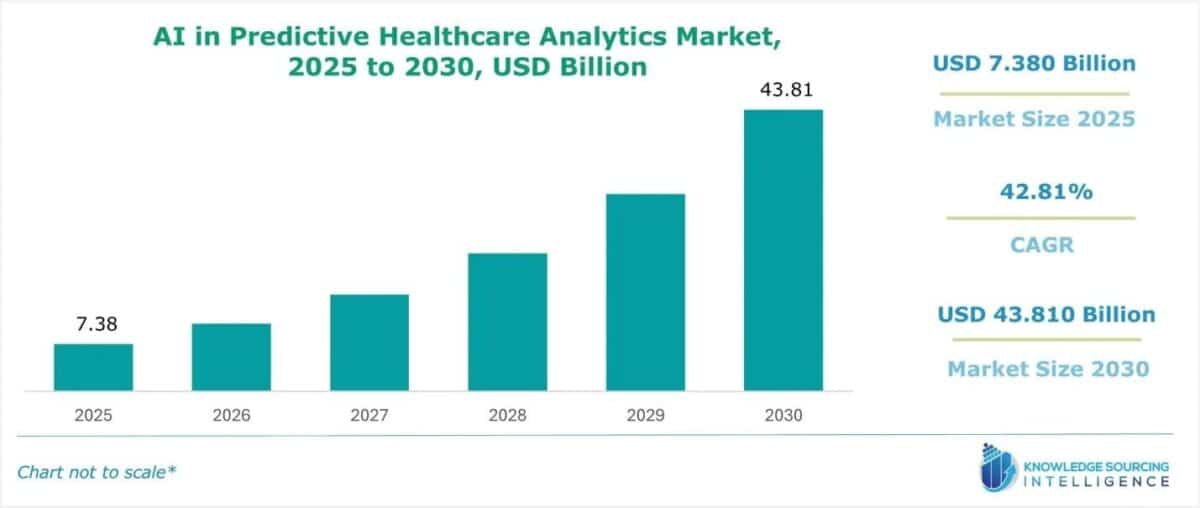
Artificial Intelligence (AI) In The Predictive Healthcare Analytics Market is expected to grow at a CAGR of 42.81%, reaching a market size of $43.810 billion in 2030 and $7.380 billion in 2025.
It is expected that in the future, there will be blockchain-protected health records and augmented-reality-compliant surgery organized through handheld devices.
Smartphones are not simply changing the paradigms of healthcare in the modern world; they are transforming the whole system to make it smarter, fairer, and faster, thus, regaining control over the patients.