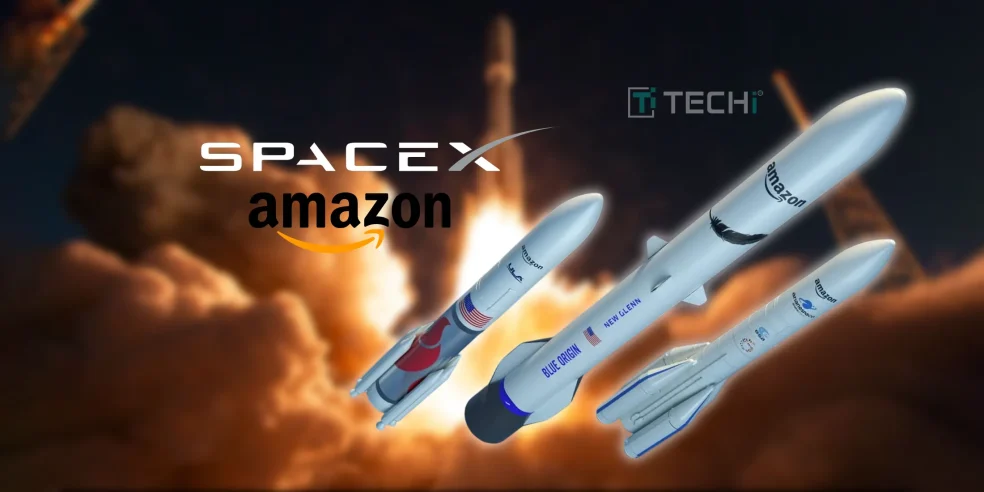

SpaceX Boosts Amazon Kuiper With Falcon 9
A visual fusion of SpaceX and Amazon branding atop rockets—symbolizing their rare collaboration as Falcon 9 gears up to launch Kuiper satellites.

Amazon’s Kuiper satellites to get boost from rival SpaceX

TECHi's Author Rabia Tayyab
Opposing Author Techcrunch Read Source Article
Last Updated
TECHi's Take
Rabia Tayyab
Rabia Tayyab
  • Words 324
  • Estimated Read 2 min

Amazon’s decision to rely on SpaceX, despite being a direct competitor, shows the urgency behind Project Kuiper. Amazon had already signed contracts with several launch providers like ULA, Arianespace, and Blue Origin (which is also owned by Amazon founder Jeff Bezos). But most of these rockets are either delayed or flying rarely. Blue Origin’s New Glenn rocket hasn’t flown yet. Arianespace’s Ariane 6 just completed its first mission in July 2025, and ULA’s Vulcan Centaur has limited flights.

In this situation, SpaceX’s Falcon 9 rocket was the only option that could provide fast and reliable access to orbit. Falcon 9 has completed hundreds of successful launches and is currently the most reliable rocket system in the world, according to SpaceX. This move also signals a change in Amazon’s execution strategy. Project Kuiper is no longer moving slowly. Amazon now needs to move quickly to meet important rules and stay competitive with SpaceX’s Starlink.

Starlink already has over 7,855 working satellites in space, according to Jonathan McDowell’s satellite tracker. Compared to that, Kuiper is just getting started. But Amazon has bigger plans. It wants to use the Kuiper satellite network as a base to expand Amazon Web Services (AWS) and improve cloud access across the globe. The company says that small-scale testing of Kuiper internet service will begin in early 2026, and full operations are expected soon after. The total cost of the project is over $10 billion (Amazon’s most ambitious move into space).

So, by choosing SpaceX, Amazon has taken a serious step to make Kuiper real. It’s not just an idea anymore. The system is launching, growing, and aiming to compete. This one mission won’t close the gap with Starlink, but it shows that Amazon is now playing to win. The question is not just whether Kuiper will succeed, but how fast Amazon can build, scale, and deliver. The pressure is on and Falcon 9 is just the beginning.

Techcrunch

Techcrunch

  • Words 180
  • Estimated Read 1 min
Read Article

Amazon will soon launch the next group of its Project Kuiper satellites using a SpaceX Falcon 9 rocket. This is unusual because Amazon and SpaceX are major competitors in the satellite internet market.  The mission, named KF-01, is scheduled for July 16, 2025, from Cape Canaveral, Florida. It will carry 24 Kuiper satellites into space. This will help Amazon get closer to meeting its requirement for building a working global satellite internet network. Project Kuiper is Amazon’s plan to spend billions of dollars to provide fast internet to people in remote areas. It will do this using a group of low Earth orbit (LEO) satellites. Even though Amazon and SpaceX are direct competitors, Amazon still chose to use SpaceX’s Falcon 9 rocket. The Federal Communications Commission (FCC) license says that at least half of Kuiper’s planned 3,236 satellites must be in orbit by July 2026. That means that Amazon has to launch 1,618 satellites in one year. Until now, Amazon had only launched two test satellites in 2023 using a ULA Atlas V rocket. After the Falcon 9 mission, the number will rise to 78, according to TechCrunch.

Source

NOTE: TECHi Two-Takes are the stories we have chosen from the web along with a little bit of our opinion in a paragraph. Please check the original story in the Source Button below.

Balanced Perspective

TECHi weighs both sides before reaching a conclusion.

TECHi’s editorial take above outlines the reasoning that supports this position.

More Two Takes from Techcrunch

James Cameron’s Caution on Generative AI Reflects Industry Concerns and Future Challenges

James Cameron, the acclaimed director known for pioneering visual effects in movies like Avatar, has expressed strong reservations about generative…

ChatGPT Voice Mode Now Integrated for Natural Conversations and Better User Experience

ChatGPT's voice mode has been integrated directly into the main chat interface, making it easier and more natural to use. …

X New About This Account Feature Reveals Account Details including Country Location but it faces Trust Issues

X has rolled out a new ‘About This Account’ feature showing when an account joined, username changes, and importantly, geographic…

WhatsApp is Getting its Own Version of a Status Update Feature, Similar to Instagram Notes

WhatsApp has relaunched its "About" feature, which functions similarly to Instagram Notes, allowing users to post short text updates visible…