During the 2026 Consumer Electronics Show (CES), AMD also made a direct competitor to Nvidia through the introduction of the Helios AI Rack, which it sold as the best in the world.
It has 72 MI455X chips built into its rack, and is aimed at competing with the Nvidia Vera Rubin NVL72.
This achievement highlights the aggressive expansionary move by AMD to penetrate the commanding market capitalization of Nvidia in the leading AI data-center industry, where Nvidia controls an estimated $4.5 trillion and AMD along with the $359 billion.
According to Su, that kind of performance jump will be necessary over the coming years. During her keynote, the CEO said
AMD believes some 5 billion people will be using AI every day in the next 5 years, and to meet that demand, technology companies will need to increase global computing capacity by 100 times in the coming years.
Helios Rack Threatens Nvidia supremacy
In its launch, its CEO Lisa Su presented a large Helios Rack resembling the 72-gpu setup within a GPU-to-gpu setup that Nvidia uses.
The next MI500 series offered by AMD is expected to provide the gain of almost 1,000 times in the performance as compared to MI300X.
To achieve this goal, then it will require a 100 fold increase in global computational capacity.
Nvidia achieved 30% stock growth in 2025, giving it the ability to stay ahead; however, in the same period, AMD data-centre revenue was up by 122% year-over-year, according to its earnings releases, reaching $3.5 billion.
PC Powerhouse and Robotics Push
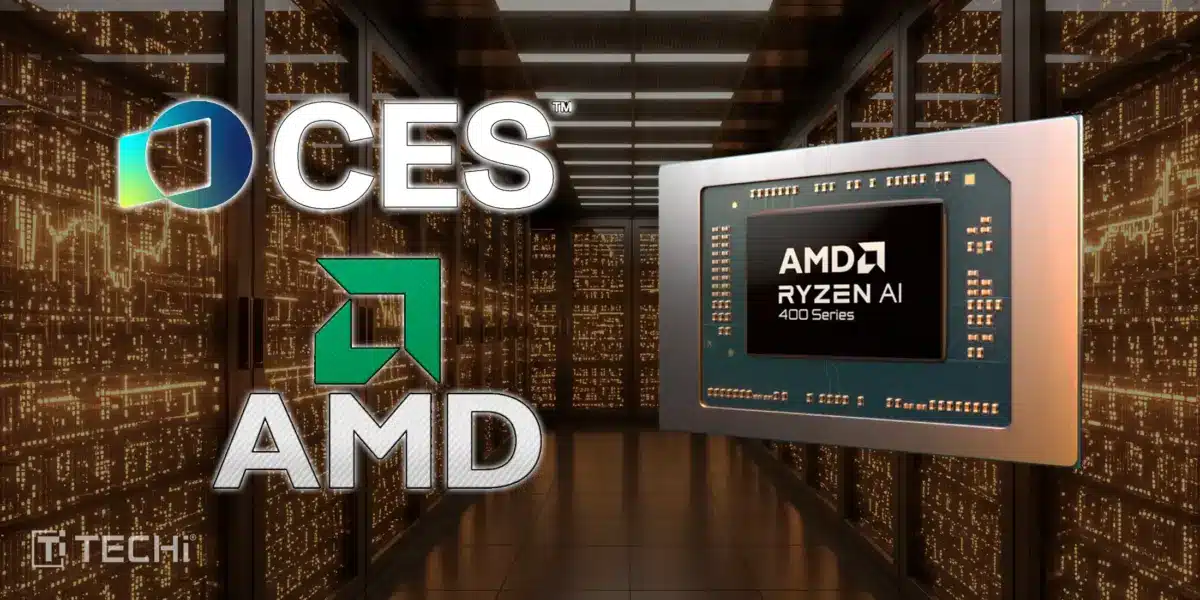
The Ryzen AI 400 Series and Pro 400 variant offer up to 12 central processing units (CPUs), Radeon 800M graphics cores, and 60 teraflops per second (TOPS) neural processing units (NPUs) in the portable computing segment to provide a wider battery life in both gaming and artificial-intelligence workloads.
These features will be competing directly with the Core Ultra 3 platform manufactured by Intel using an 18-nanometer process. Ryzen AI Max+ is positioned at the high-performance workstation segment, and AMD has a Halo developer platform aimed as a similar entry to the $3,999 DGX Spark system of Nvidia when it comes to training local models.
Moreover, AMD has ventured in the robotics field through a partnership with Generative Bionics to present the GENE.01 humanoid robot of industry which is powered by AMD processors.
Jack Huynh Said, senior vice president and general manager, AMD Computing and Graphics Group.
“The PC is being redefined by AI, and AMD is leading that transformation,”
Bright Road Ahead
It is projected that AI will be the main focus of AMD, making it one of the top companies with an increase of AI revenues, which will be as a result of the deployment of Helios.
The deployment of Helio is expected to boost competition between the two companies and will potentially cut the cost of AI hardware, as the market share of Nvidia (declined 3.82%) and AMD data-centers dropped (11.9%) in value in December 2025, and hence open the way to increased use of AI.
As such, the strong shipment performance will be realized in the first quarter of 2027, as AMD envisions the data center total addressable market to hit $1 trillion by 2030, suggesting a CAGR of more than 40% from roughly $200 billion estimated in 2025, amid a successful performance.