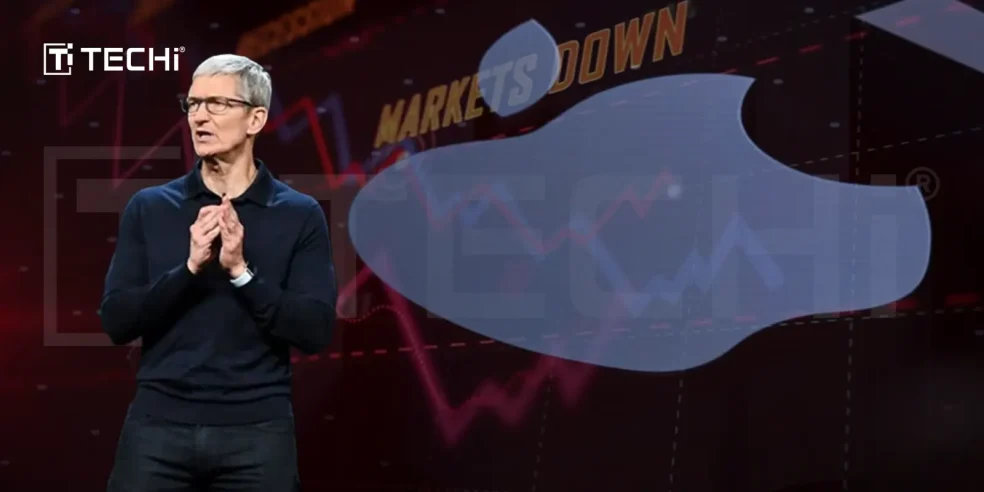
Just as Wall Street took a deep breath and sighed, Tariff-shaped grenades dipped into the markets once again by President Trump. The tech elite, also known as the “Magnificent Seven” once flying through the skies like superheroes over economic storms, are now crashing. Apple’s stock is approaching a one-year low, Tesla is taking hits not only from the tariffs but also from Elon’s political tantrums, and an investor is probably screaming into their toast. If this is what Trump was talking about when he said we were economically “winning”, the stock market sure didn’t get that memo.
The “Magnificent Seven“, a group of stocks that once helped carry Wall Street’s upbeat run, now find themselves stung again by brutal tariff tensions, setting off a panic storm among investors. About $2 trillion in combined market capitalization has evaporated over a matter of days, with Apple and Tesla leading the decline. This chart seems to suggest that investors are increasingly worried about the forthcoming global tariff war by U.S President Donald Trump transforming into a major economic disaster.
$2 Trillion Disappeared As Investors Worry
The steep selloff follows Wall Street’s most optimistic tech analyst, Dan Ives, whose price target cuts for both Apple and Tesla, and warned of a “tariff economic Armageddon,” to which the markets seemed rather agreeable. At $223, the price per share for Tesla sank by 7%, while that of Apple was also pushed down by 4.8%, towards a one-year low. Alphabet and Microsoft were also staggering on 52-week low ground, with the other Magnificent Seven falling in the middle of 1.5% to 4.8%. The companies have collectively shed more than $6 trillion in market value since their peak in late 2024.
The comments by Ives came after Trump again doubled down on tariffs, dismissed the possibility for immediate trade talks with China, and encouraged investors to prepare for economic fallout. This seems like a war for the future of American manufacturing.
Apple and Tesla
As Apple sells itself as a U.S tech giant with huge dependence on the Chinese manufacturing machine, it carries a significant risk. Indeed, most of the iPhones are assembled in China, and analysts say that the exemptions from earlier rounds of tariffs may no longer be on the table, thus higher U.S prices for the iPhones to protect margins are expected. Ives slashed his Apple price target by $75 to $250, calling the tariffs a “complete disaster” for the iPhone maker.
Tesla has even worse challenges, as Ives lowered his target for the newer Tesla from $550 to $315 by taking into account the trade war piling more pressure on the already difficult path of the EV maker. First-quarter deliveries figures for Tesla are disappointing, and several politicians in Europe have so far smeared the brand with political contamination. Such stain, according to Ives, would drive away Chinese consumers and accelerate the move towards home grown electric vehicle brands such as BYD. Ives said,
“The trade tensions could push buyers in China to domestic rivals. The backlash from Trump tariff policies in China and Musk’s association will be hard to understate and this will further drive Chinese consumers to buy domestic such as BYD.”
AI & Trade War Despair
Within the domestic picture, scrutiny on high AI-related expenses now affects broader high-tech industries. While America threatens tariffs that will cut profit margins and choke global supply chains, analysts say the diminishing fortunes among the Magnificent Seven, that are responsible for so much of the S&P 500’s meteoric rise in recent years, disproportionately drag down the index. In the two most recent sessions, the S&P 500 has lost $5 trillion or more from its value.
While the AI revolution remains as one of the most significant long-term drivers, something threatening stands ahead in the immediate future. Apple is supposed to invest $500 billion in the United States over the next four years, which would help insulate it from political reaction, but there are no guarantees about the tariff exemptions this time. Ives said,
“The concept of making iPhones in the U.S is a non-starter in our view at $1,000. Price points would move up so dramatically it’s hard to comprehend.”
The Magnificent Seven have always been said to be untouchable, free from global shocks and the worst of policy mistakes. With geopolitical tensions, economic nationalism, and boardroom controversies colliding, these giants are no longer invincible. Their resurrection or longer path to reckoning will be determined not just by their quarterly results, but also by their ability to operate through the current scenario. As the trade war enters a new and volatile phase, the market’s once great giants now experience the very new reality.