
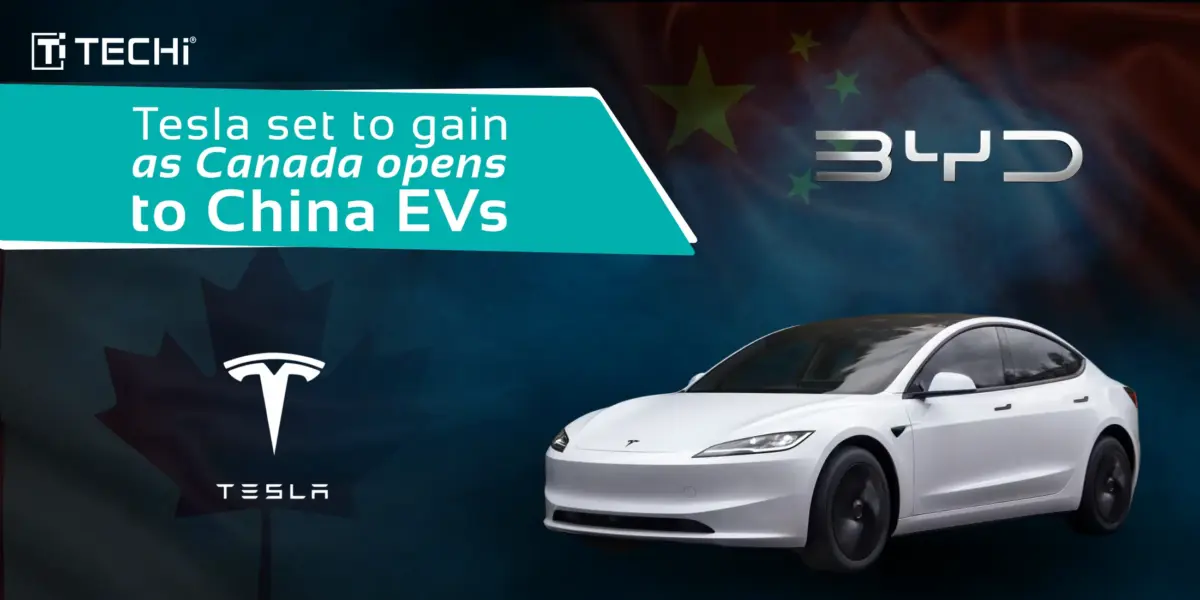
Tesla just regained a powerful edge in Canada’s fast-changing electric vehicle market. A new tariff deal on Chinese-made EVs is set to reopen the door for low-cost imports, and Tesla is first in line to walk through it. Canada will now allow up to 49,000 Chinese-built vehicles a year at a 6.1% tariff, replacing the 100% duty that effectively froze imports in 2024.
Prime Minister Mark Carney has signaled the quota could rise to 70,000 vehicles within five years, underscoring Ottawa’s push to keep EV prices in check while hitting ambitious climate targets.
Tesla had already reconfigured its Shanghai Gigafactory in 2023 to build a Canada-specific Model Y, fueling a 460% jump in Chinese auto imports before the tariff shock. With the policy reversal, analysts say those exports could restart quickly, supplementing current shipments from Tesla’s Berlin plant.
Price cap twist and Chinese brands
The proportion of the country-specific quota reserved for affordable EVs with an import price of $35,000 CAD or less will reach 50% by 2030, kickstarting the availability of more affordable electric vehicles in Canada.
This carve-out creates a natural opening for Chinese automakers such as BYD and Nio, which specialize in aggressively priced compact EVs and are scaling exports across Europe, Southeast Asia and Latin America.
Tesla’s strategic advantage
Despite the price cap, Tesla still starts from a stronger position than its Chinese rivals. It operates 39 stores across Canada and sells a focused lineup of four core models, allowing faster marketing execution and leaner inventory management than multi-brand Chinese groups with dozens of nameplates.
Shanghai remains Tesla’s most cost-efficient plant globally, giving the company room to defend margins while potentially adjusting trims or feature sets to narrow the price gap with upcoming Chinese entries.
said Yale Zhang, managing director at Shanghai-based consultancy AutoForesight.
Tesla indeed has an advantage with its offering of a few models, versions and simple production lines so that it can be flexible to sell cars produced in any country in any markets to achieve the best cost efficiency.
Policy risks and US pressure
The move also sharpens a policy divide within North America. The former Biden administration quadrupled tariffs on Chinese EVs to 100% in 2024, effectively shutting them out of the U.S., and senior Trump officials have already criticized Ottawa’s opening to Chinese-built cars as “problematic” for the continental auto ecosystem.
Washington worries that subsidized overcapacity from China could leak into the U.S. market via Canada, especially if local content rules or re-export monitoring prove hard to enforce.
At the same time, Canada is courting joint ventures with Chinese EV makers, aiming within three years to produce a Canadian-branded electric vehicle using Chinese technology, according to a senior official quoted by public broadcaster CBC. BYD already runs an electric bus assembly facility in Ontario, giving it a local manufacturing and political footprint that most rivals lack.
What comes next?
It is anticipated that Tesla will hasten the relocation of Shanghai export and consolidate its position in Canada at the same time preserving its price and supply elasticity. The Chinese, then, will tend to see Canada as a strategic entry point, as they can deploy cheaper vehicles faster and as a means of strengthening the brand presence.
Companies that are already in operation face increased competition levels; cheap imports force them to implement tough price and product strategies. At the same time, the policy remains uncertain, and the questioning of the United States and domestic partisan trade-off shapes the level of openness of Canada to foreign automobile trades.
In turn, this has resulted in the market being characterized by greater segmentation. Tesla is located in the high-end segment, Chinese brands develop within the framework of volumetric growth, and Canada becomes a laboratory of the future direction of electric-vehicle commerce in North America.