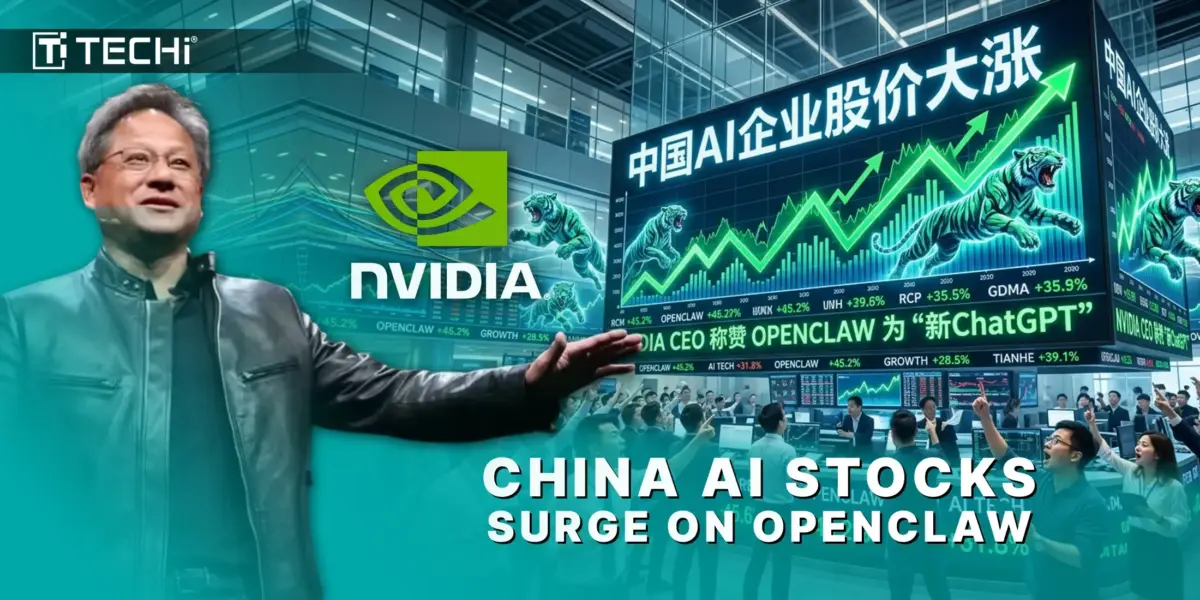
On Wednesday, the Chinese artificial intelligence stocks witnessed a massive change in an AI agent, OpenClaw. These remarks were demonstrated by Jensen Huang, the head of Nvidia. He further called OpenClaw “definitely the next ChatGPT” and claimed that it has the potential to expand.
OpenClaw is an open-source AI-based system that has massively gained popularity across China. Numerous tech companies are using this AI-based system to build their own AI tools. Minimax and Zhipu are two well-known companies that have gained benefits from OpenClaw, with Minimax gaining 22% attention and Zhipu jumping to 14% in Hong Kong. Both these companies have released a few AI tools powered by OpenClaw.
Minimax and Zhipu are among China’s rising group of AI innovators; they are referred to as “AI tigers”. They are widely known for developing large language models so that they compete with bigger AI platforms such as OpenAI and Anthropic.
GLM-5 was recently launched by Zhipu, designed as a new open-source model for coding-related tasks. The company claims that its performance closely matches Anthropic’s Claude Opus 4.5 and also assures it to be better than Google’s Gemini 3 Pro. Although these claims are not verified by any sources, they show how confident the company is in its model.
Another well-known tech firm in China, SenseTime, also switched from facial recognition to AI software platforms and has also implemented an AI assistant with OpenClaw, resulting in an 2.43% jump. UCloud Technology, a cloud computing firm in Shanghai, also grew 13%.
Moody’s claims that China’s quick adoption of AI is making it among the world’s leading AI markets. The implementation is not equal among all organisations and industries, as tech companies integrate AI more deeply, whereas the industrial sectors are selective during the implementation.
In conclusion, it can be demonstrated that this positive change specifies how important AI is and how it is creating great progressive opportunities for companies.