Are you tired of bulky phones weighing down your pocket? Samsung got you covered. There are rumours all around that Samsung is going to launch the Galaxy Z Fold 7, with a thinner frame, lighter build, and more familiar feel on July 9, 2025, at Galaxy Unpacked (Brooklyn, NY). They are directly targeting the market that has long been hesitant to adopt foldable.
Foldables have hovered on the edge of mainstream for quite a while now. They look cool, but on top of being expensive, they aren’t really ergonomic for daily use. Now with the launch of the Z Fold 7, Samsung has trimmed the weight without compromising on the traditional foldable design. Samsung’s senior vice president of mobile product management, Drew Blackard, told CNET in an interview:
“More than ever, these devices will very much resemble that traditional form factor.”
Back in 2019, Samsung launched its first Galaxy Fold. It was groundbreaking, but far from perfect. It was bulky, thick, and clearly a first-gen experiment. Customers reported issues such as screens breaking, flickering, and bulging after just a few days of use. Reviewing the situation, Samsung delayed the release. Then, after more testing phases, the phone was released again and gained a positive reaction from the crowd this time. Every beginning comes with challenges, but Samsung never let that be a reason to quit.
Over time, Samsung addressed these early design flaws. In 2020, the Galaxy Z Fold 2 was released with a “sweeper” hinge mechanism, specifically designed to push away debris. It adopted ultra-thin glass (UTG) instead of pure plastic for increased durability. Following this, Fold 3, Fold 4, and Fold 5 launched between 2021-2024.
However, with improvements, Samsung keeps on going and what began as a fragile experiment in 2019 has evolved into a refined, confidence-inspiring product. Over the last few generations, Samsung has consistently worked to make the Fold slimmer, shedding about 29% of its thickness and dropping nearly 37 grams in weight compared to its original form. The Fold journey shows that genuine user feedback and technical determination can reshape the future of smartphones.
Is This Just a Smarter Phone? 🔗
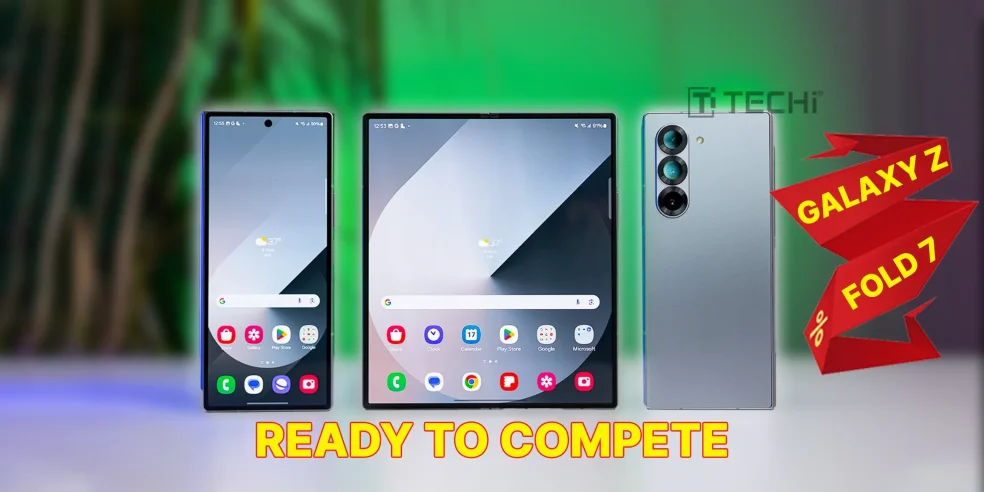
Samsung is not just selling the Galaxy Z Fold 7 as some gadget; they’re pairing innovation with consistent improvements and having a little fun along the way. This is the smartest move they have made in years. When you close the phone, it feels like a regular phone, lightweight and comfortable in your hand. But when you open it, it gets into a full-screen tablet. This balance is what Samsung’s been chasing since the first Fold launched in 2019.
Generally people don’t avoid foldables because they hate the idea; they avoid them because they’re not sure if the phone will fit into their daily habits. The Fold 7 aims to remove that hesitation. It’s difficult to switch from things we are used to in our daily lives, Samsung is trying to make the transition from a simple phone to a foldable one as smooth as possible so people can enjoy the more features within one device.
Samsung has not revealed every exact spec yet, but based on industry trends and previous leaks, the Fold 7 is expected to carry flagship-level camera tech, which will contain S25 Ultra’s 200MP sensor. Considering the lag behind in photography, this is a significant upgrade. Samsung claims it listened to real user feedback: 33% of Fold users wanted better portability, and 28% said camera performance needed to improve. In other words, Samsung is not just innovating blindly; it’s building on actual users’ demand. The result is a device that might finally satisfy both the power users and the hesitant newcomers.
A challenge that Samsung faces with its latest mobile is battery life. As the thinner phones usually mean less space for large batteries, and Samsung’s recent S25 Edge, also a slim device, manages about a day’s worth of charge. However, we can expect that this upgrade will include smarter battery optimization and AI-driven efficiency. But until hands-on reviews show that battery life remains one of the few areas of concern. If Samsung manages to maintain or even improve battery duration in this slimmer frame, it’ll be a serious win.
Price remains a major hurdle. The Fold 6 launched at $1,900, and it’s unclear if Samsung will lower the Fold 7’s cost. However, the rumours showed that Z Flip 7 FE could offer a more affordable option to attract budget-conscious buyers. By diversifying price points, Samsung aims to make foldables more accessible and encourage broader adoption.
Is Apple a Threat? 🔗
There is a rumour that Apple is also working on foldable devices, and it is expected to launch its first iPhone flip in 2026. Kuo’s report shows that this flip will have a 7.8-inch crease-free inner display and a 5.5-inch outer display, which will make it look like a foldable book. On the flip side, Samsung doesn’t seem worried. In fact, Blackard said,
“Competition will come… and we welcome that.”
It’s a confident tone, and maybe rightfully so. Apple’s entry might legitimize foldables in the eyes of more conservative users, but Samsung has already built the foundation.
Final thoughts 🔗
With the Z Fold 7, Samsung is trying to conquer the 2-in-1 battle. This phone isn’t just for tech people or early adopters anymore. It’s being built for the everyday smartphone user who wants more screen space, premium features, and comfort, without sacrificing the feel of a normal phone. This is the place where Samsung’s message, “feeling is believing,” really feels comfortable.