



Apple is lining up one of its most aggressive MacBook Pro roadmaps in years, with two upgrades planned for 2026 instead of the usual single-cycle refresh.
In the first half of the year, Apple is expected to roll out new 14-inch and 16-inch MacBook Pro models powered by M5 Pro and M5 Max chips, alongside updated MacBook Air, Mac Studio and Studio Display hardware.
The most successful quarter in Apple's history has been reported. $42.09 billion in net profit and $143.8 billion in revenue, up 16% from the previous year.
An analysis of the numbers shows:
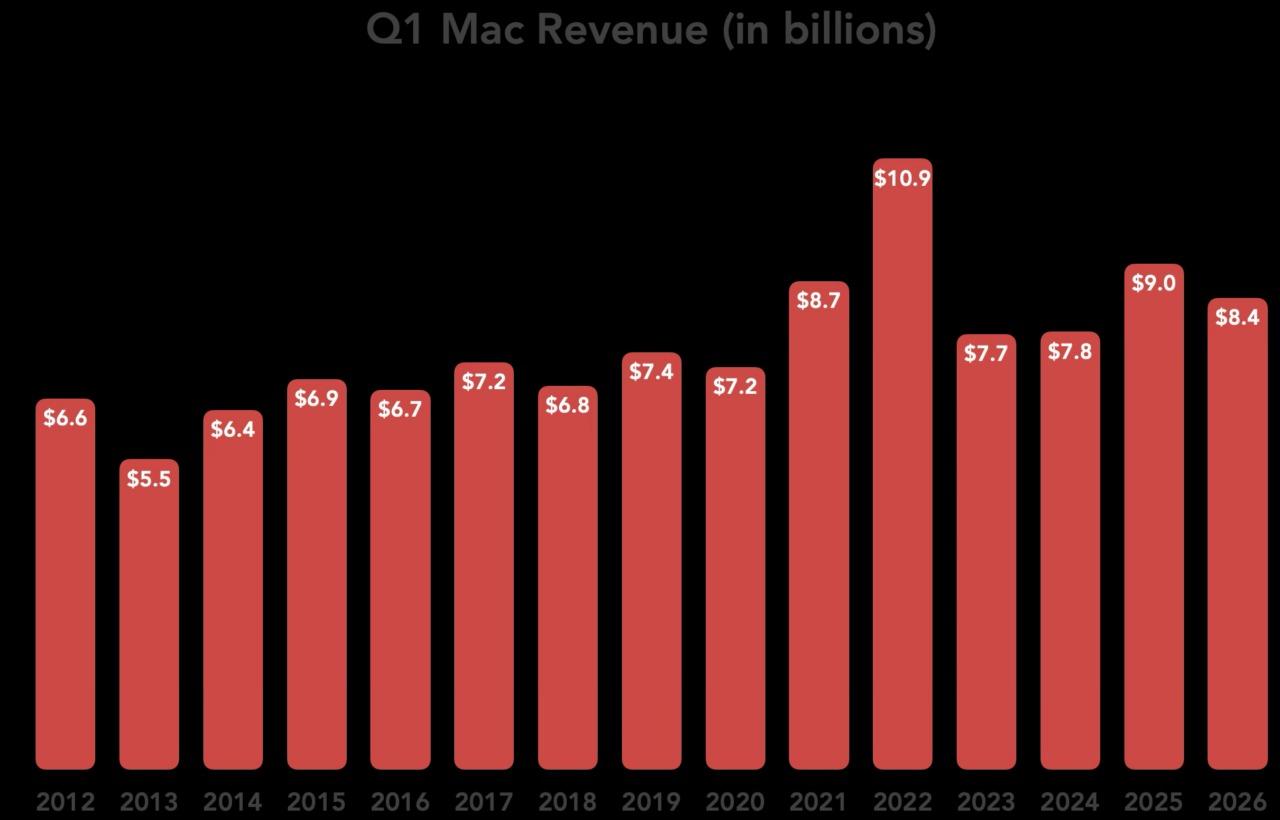
iPhone: $85.27 billion (up 23%) $30.01 billion (+14%) in services iPad: $8.5 billion (up 6.7%) Mac: $8.39 billion (-6.7%) Home & Wearables: $11.49 billion (-2.1%).
Late 2026: Big redesign
The real disruption is slated for the end of 2026, when Apple is targeting a full MacBook Pro redesign with M6 Pro and M6 Max chips and a move to OLED panels on high-end models. Rumors point to thinner chassis, built-in cellular connectivity, touch support and a hole-punch camera with an iPhone-style Dynamic Island, marking the first touch-enabled MacBook in Apple’s history.
We'll reportedly see new MacBook Pro, MacBook Air, and Mac Studio computers in the "first half of the year," wrote Gurman, adding that Apple is also working on a new display.
Outlook for power users
If Apple hits the rumored timeline, 2026 becomes a decision year for creators, developers and enterprise buyers who skipped the last Intel and early M-series generations.
The risk is upgrade fatigue: two MacBook Pro launches in one year could freeze purchases in mid-2026 as users wait for the OLED redesign, similar to what happened ahead of the M1 transition.
Disclaimer
This article is for informational purposes only and does not constitute financial, investment, tax, or legal advice. Market data, tax rules, and prices can change after the article date. TECHi and its authors may hold positions in securities or digital assets mentioned. Always conduct your own research and consult a licensed financial, tax, or legal professional before making decisions.
About the Author

Warisha Rashid covers AI stocks and crypto markets for TECHi. Recent work explains what changed when Worldcoin cut its WLD token unlock, how AMD's rack-scale Helios design fits an asset-light strategy, and how Nvidia, Alphabet, Palantir, AMD and Broadcom compare as AI businesses.

Comments