
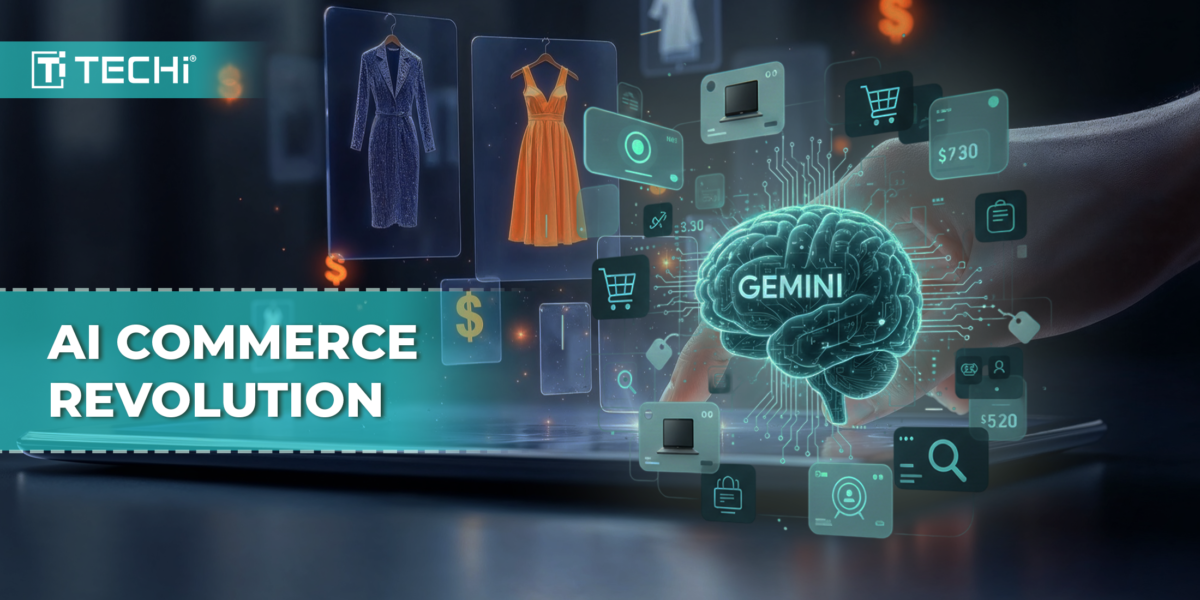
The online retail utilizes Google Gemini AI, which has made Internet usage remove various applications. Its Universal Commerce Protocol (UCP), which was presented on 11 2026 January, allows users to search, buy and track orders either fully within the application or in its AI Search mode.
The Shopping Revolution
The agentic AI is now rapidly spreading through e-commerce. In 2026, AI agents will start 20% of e-commerce transactions, predicts Gartner. According to a McKinsey report published in October, agentic commerce and AI-powered tools could make the retail market a $3 trillion to $5 trillion global opportunity by 2030.
By 2030, global retail AI spending is predicted to reach $40 billion, of which 35% will go toward autonomous agent technologies, and the market in the field of AI-based e-commerce is $9.9 billion globally.
Google currently struggles with competitor products like the April 2025 retail release by ChatGPT, the Rufus-Alexa+ upgrades by Amazon, and the Copilot checkout by Microsoft that was launched at the beginning of January.
UCP develops uniform APIs and they allow a smooth flow of AI conversations to the back-end system of the retailer to reduce the complexity of integration that has traditionally haunted fragmented platforms. Google adds.
UCP was co-developed with industry leaders including Shopify, Etsy, Wayfair, Target and Walmart, and endorsed by more than 20 others across the ecosystem like Adyen, American Express, Best Buy, Flipkart, Macy’s Inc., Mastercard, Stripe, The Home Depot, Visa and Zalando.
How Does It Work ?
A customer who queries a leather strap bag with silver chain will be provided options to make purchases that can be done through a single-tap shopping with the help of GooglePay or, in the nearest future, PayPal.
Google Wallet provides shipping and payment details automatically and does not need any extra logins, even when sellers are making their first interaction. The protocol has more than twenty partners such as Shopify, Walmart, Target, Etsy, Wayfair, Stripe, Visa, Adyen, and Salesforce, where loyalty incentives and custom shopping carts are possible.
The customers of Walmart, especially, get personalized recommendations based on what they have bought previously, which they can add to their carts.
Expert Backing
said John Furner, President and CEO of Walmart U.S. and incoming President and CEO of Walmart Inc.
The transition from traditional web or app search to agent-led commerce represents the next great evolution in retail. We aren’t just watching the shift, we are driving it.
What’s Ahead ?
The global deployment is expected by the end of 2026, and multi-agent swarms are set to be deployed to provide hyper-personalization.
According to a recent report by IDC Research, global IT spending is expected to increase by almost 32% per year between 2025 and 2029.
This will be greatly aided by agentic AI, which is expected to generate $1.3 trillion by 2029.
Retailers that become technologically backward in not embracing this technology stand to lose out on invisible AI-powered display shelves but those that successfully embrace this technology will thrive in frictionless business environments.