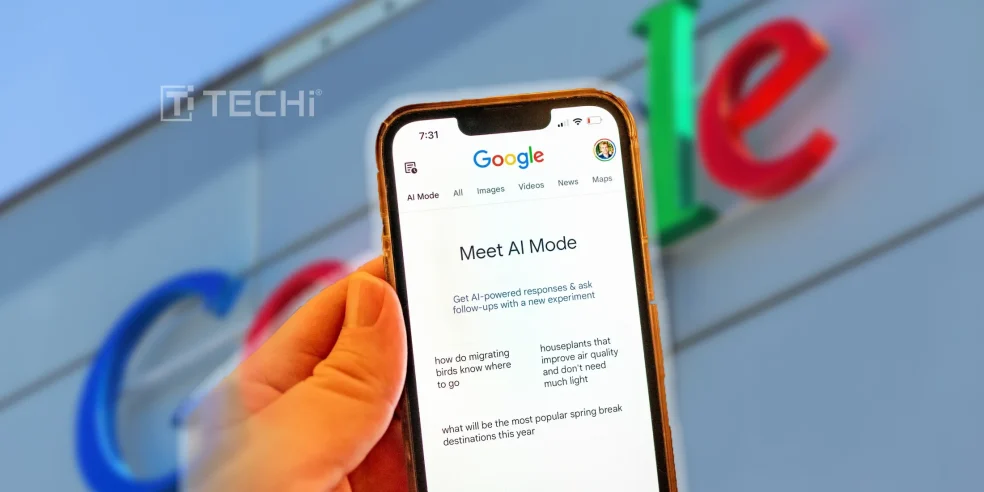

Google is not replacing its traditional search engine, but this new feature marks a serious shift in how people will find and interact with information online. AI Mode moves away from the structure that has defined search for over two decades. Instead of scanning through a ranked list of websites, users are now met with a generated summary. These responses include fewer direct links and place traditional sources further down the page. This might save users a few clicks, but it raises a big question, what happens to the websites that depended on those clicks?
For publishers and online businesses, this is more than a user interface update. This is a change to the very pipeline that drives their traffic. One of the clearest signs of that came from the Daily Mail, which said its traffic from Google Search has dropped by about 50 percent on both desktop and mobile. While that figure has not been confirmed independently, it shows how some media outlets are already feeling the effects of AI-generated answers.
Google has acknowledged the concerns but is pushing forward. Hema Budaraju, one of the product leads for search, says AI Mode opens the door to new kinds of questions and makes information seeking easier. She gives the example of a user who might now ask a detailed question like how to remove a coffee stain from a specific kind of carpet using a pet safe product. This is a real improvement in usability. It helps people express their questions in a way that feels human, not keyword-based.
Still, the big challenge is not what users ask. It is what they see. Right now, AI summaries often include a few links to websites, but those links are buried underneath paragraphs of generated text. For companies that rely on being in the top three search results, that could mean disappearing from view.
There is also uncertainty about the business model. Google has not yet explained whether companies will be able to pay to appear in AI responses the same way they do in sponsored search results. Without clarity on that, some advertisers might start looking elsewhere.
It is not just media and businesses that are worried. Campaign groups like Foxglove say AI Mode could hurt journalism by keeping readers on the Google page instead of pushing them to the original source. Others point out the environmental cost. AI models like Gemini need large data centers that consume both energy and water.
Google says it is committed to sustainability and ethical AI deployment, but that promise will need to be backed by evidence over time. So far, the tool is not active in the European Union, where regulatory rules around data and competition are stricter. That has kept AI Mode from being rolled out in some of Google’s most closely watched markets.
There is one more issue. Accuracy. AI summaries are not always right. And when people trust the box at the top of their search page, they may never check the source. That could have serious implications in areas like health, finance, and news.
In some ways, AI Mode is an answer to ChatGPT. Many users already go to AI tools to find fast summaries instead of clicking through websites. Google is trying to pull that behavior back into its own platform. But in doing so, it is changing the balance of power on the web.
For now, AI Mode is optional. But its growth will be closely watched by users, publishers, and regulators. What began as a helpful feature may end up reshaping the entire digital economy. The only question is whether the people behind the content will still be seen. Read more about what else has been going on with Google. Are they going to keep introducing new models like Opal and AI Mode?