

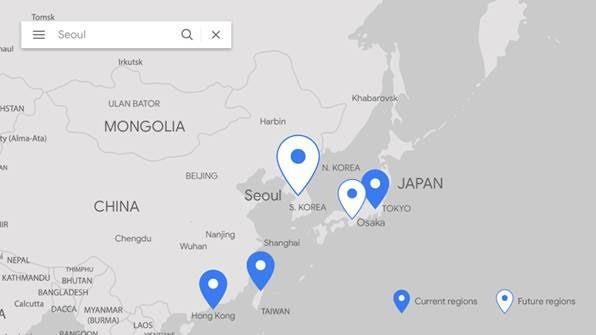
South Korea has just opened access to a protected market. The country approved Google’s program to sell high-precision maps to other countries. After twenty years of refusals, the approval on 27 February 2026 fast-tracks the US tech giant’s entry into a market once dominated by native apps, including Naver and Kakao Maps.
Fading Security Fears
In the 2007 and 2016 quarters, Seoul banned Google, among other reasons, based on the concern that 1:5,000- scale cartographic drawings; 50 meters of physical terrain abridged into 1-centimeter arduous area could make it easy to detect military bases during the North Korean standoff. In the current scenario, the increased American pressure over perceived technological favoritism has also led regulators to relent, with adequate conditions such as video covering of sensitive areas, tracking down of accurate coordinates in the international Google Maps and Google Earth imagery, and limiting the processing of raw data to Korean servers before any outflow.
On 5 February, the officials at the Ministry of Land, Infrastructure, and Transport (MOLIT) confirmed that the newly introduced changes in Google had met all of the requirements as stipulated, and put an end to an extended saga of delays that had been experienced since May that year until November 2025.

Potential Market Shock
This event is not only a success of Google, but a massive innovation in the $10-billion-dollar navigation market of Asia, with a market share of 85% in 2025, as per Statista statistics. Being already limited to Korea, Google Maps can now be used to support autonomous driving projects and logistics operations, and thus capture a share of the 1.2 million daily active users that are currently monopolized by rivals.
Dr Ji-hun, an analyst in technology at the Korea Advanced Institute in Seoul, notes that this levels the playing field of the international innovators and at the same time, safeguards the national interests. However, residual risks still exist, since after review, export allowances will be limited to navigation necessities.
Predicted Pathway
It is expected that the trajectory of Google will present augmented services in the middle of 2026, thus proving the effect of competition and innovation. Since Korean semiconductor exports are expected to grow by fifteen per cent in the early part of 2026, according to Reuters ‘ analysis, the situation can strengthen the links of advanced-vehicle technology with some of the largest corporations like Samsung and Hyundai.
One critical caveat is a departure from the laid-down security protocols, under which an instant reversal will follow in the policy, thus ensuring a balance between the commercial growth and the geopolitics in this region.