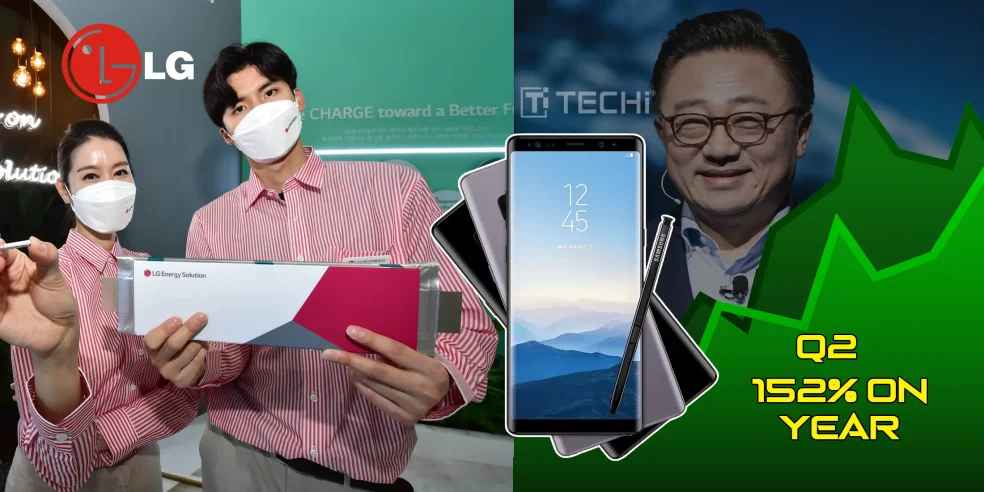
What does it take for a battery maker to bounce back from losses and dominate in a market stacked with giants like Tesla? On July 7, 2025, LG Energy Solutions announced a 152% increase in its quarterly operating profit. They explained that their operating profit is 492 billion won in Q2, which is much more than the 192 billion won profit a year earlier. A 142 billion won profit without the U.S. tax credits shows a deep structural strength.
LG Energy Solutions is one of the world’s biggest lithium-ion battery manufacturers South Korean Company. It specializes in making batteries for electric vehicles, energy storage systems, and consumer electronics.
Today, LGES is considered a global leader in EV battery tech, competing with Chinese giant CATL, Japan’s Panasonic, and fellow Korean firms like Samsung SDI and SK On.
During late 2023 and early 2024, LG Energy Solution went through a tough phase. The demand for electric vehicles decreased due to changes in the U.S. tariffs and subsidies. Companies’ orders also decreased, and they couldn’t cover their expenses.
In Q4 of 2024, LGES lost 226 billion won (around $170 million USD) in just three months, for the first time losing money from operations since 2021. Because of this big loss, they cut their capital expenditures by 30%. That means they decided to spend less on new projects, factories, or upgrades in order to save money. Then, again in Q1 of 2025, the company has seen a 138% rise in its quarterly operating profit, but due to tax credits under the U.S. Inflation Reduction Act and it faces a loss of 83 billion won ($56.52 million).

What’s Driving the H2 Turnaround 🔗
One of the biggest reasons behind LG’s resurgence is its localization strategy in North America. The company has been expanding its manufacturing areas across Michigan, Tennessee, and Ohio to qualify for U.S. subsidies and reduce logistics costs.
One of its major steps towards progress was the launch of a new LFP battery plant in Holland, Michigan, which is dedicated to energy storage systems with a capacity of 16.5 GWh combined with 5GWh; the site has a total capacity of 21GWh. This step improved their cost efficiency and positioned them as a competitor in the ESS supply.
Alongside localization, they are also working on the mass production of LFP batteries by advancing their 46-series cylindrical cells, which are more efficient and lighter.
Recently, the company secured a long-term supply deal with Chery Auto, which aims to cover 8 GWh over six years. That’s enough to power approximately 120,000 electric vehicles. The exact amount of the contract has not been disclosed, but observations show it can exceed 1 trillion won ($734 million).
Kim Dong-myung, CEO of LG Energy Solution, said,
“This deal marks a pivotal step in scaling up global adoption of our new 46-series batteries and securing a dominant market leadership.”
Finally, LGES has shown a profit without relying solely on these subsidies, while the U.S. Inflation Reduction Act (IRA) tax credits, especially the Advanced Manufacturing Production Credit (AMPC), have supported the rebound. This combination of regional production and strategic incentives has driven the company’s growth in the second quarter of 2025.
The periods when LGES shows significant growth, its rivals, SDI and SK On, are stuck in a downturn. In Q2, SDI is expected to post over 200 billion won in operating loss, and SK On may lose around 100 billion won.
The key reason for LGES’ growth lies in its LFP battery installations and localization in North America. In contrast, Samsung SDI and SK On have lagged behind in LFP battery strategies and localization efforts, making it harder for them to recover in the current market.
Whether this rebound becomes a long-term lead will depend on how well LGES adapts to a fast-evolving battery market, where innovation, regional independence, and political agility now matter as much as product quality.