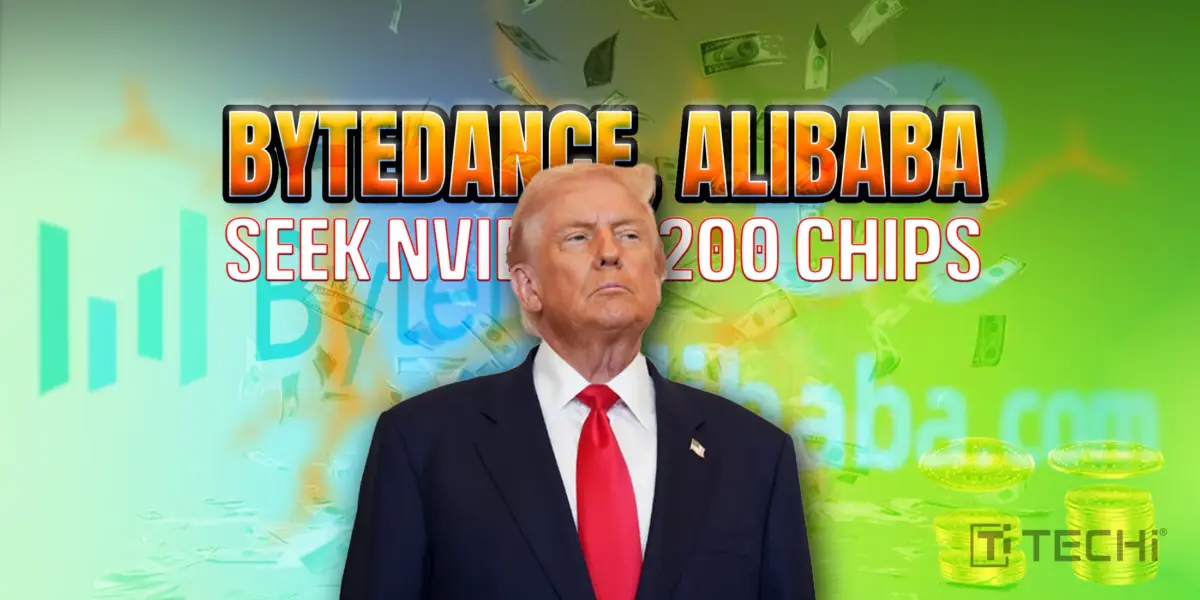
The biggest tech companies in China have started to take some action. Just a couple of days after the United States government gave approval for the export of Nvidia’s advanced H200 AI chips to China, the two companies, ByteDance and Alibaba, have allegedly contacted the chip giant to express their interest in ordering substantial quantities of the product.
The talks, which were disclosed by informed sources, indicate the significance of the H200 in the global AI competition. However, the demand is shaky because China has not yet made an official reaction to the U.S announcement, and companies in China are dealing with opportunity, caution, and geopolitical uncertainty.
Why Has the H200 Become the Star? 🔗
For firms like ByteDance and Alibaba, the H200 is much more than just a performance increase; it is almost six times more efficient than the previously approved H20. The difference is huge in a situation where training advanced AI models is hardware-intensive and is a speed-critical process. Nevertheless, companies still want the chip but are not very eager to obtain it.
Supply is still a huge concern, particularly as Nvidia has been focusing on its Blackwell and upcoming Rubin chips, so only a limited amount of H200 is currently being made.
However, the approval has also led to a situation that is somewhat contradictory. The sale of older and less powerful Nvidia chips, such as the A100 and H100, is still prohibited, while the advanced H200 has been unbanned, at least under Trump’s conditions.
So, Chinese companies are calling for clarification not only from Nvidia but also from local regulators, who are looking at their own priorities, including the Chinese government’s drive for local chip consumption.
The Next Move of China Will Determine Everything 🔗
China’s approval is still necessary for the H200 to enter the country even when Trump gives it his nod, and so far that approval hasn’t come. Reports from the last week indicate that Chinese authorities have called tech leaders from Alibaba, ByteDance, Tencent, and other major players for a meeting to evaluate demand, while the government considers its next step.
It is believed that they will analyze the number requested, the use cases and how they fit with national objectives. Their hesitation is rational, as China is looking for the best AI infrastructure no matter where it comes from, and at the same time prefers Chinese chips, from Huawei to Cambricon to be the lasting power behind its AI goals.
hang Yuchun, a Chinese cloud executive said,
“The training of leading Chinese AI models still relies on Nvidia cards. I expect the leading Chinese tech companies to buy a lot although in a low-key manner”.
However, the market signal is obvious.
The research labs, data center operators, top-tier universities, and even military associated institutions have already come close through unofficial grey-market channels for H200 units. There is no doubt about the strong demand, but any purchases that will be allowed in the future will probably be done quietly.
What Will Happen to Nvidia, China’s AI Industry, and Investors? 🔗
Nvidia sees a gigantic opportunity. The company has historically estimated the AI hardware market in China at $50 billion, and a considerable part of that is the high-performance training chips, which includes the H200. However, success is not assured.
If China enforces strict usage or imposes a layer of government approvals, the speed of adoption could slow down. If it opts for domestic semiconductor priorities, then the demand for Nvidia hardware might become secondary to the national strategy.
Besides, if U.S policy takes a different turn as it has done in the past, today’s opening might close overnight. Nevertheless, at least for now, the interest from giants like ByteDance and Alibaba is an indication that when it comes to training world-class AI models, Nvidia is still the only option for China.