

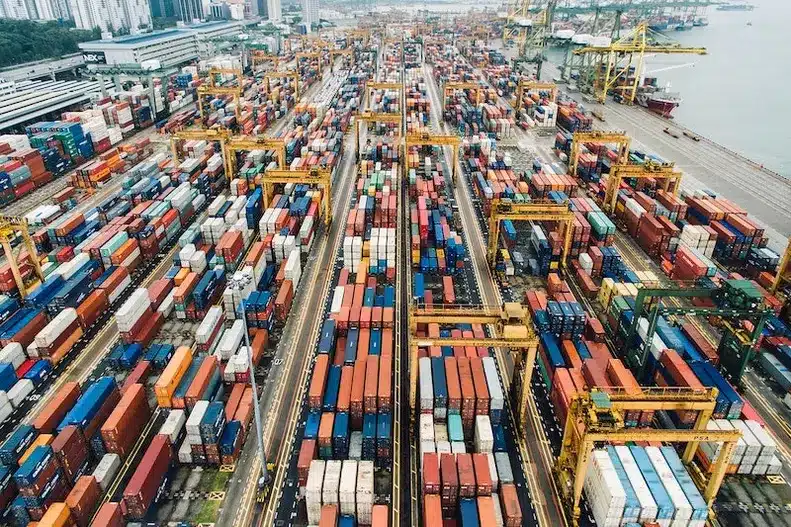
Karachi Port processed 8,313 containers in just 24 days this March — matching its entire 2025 annual volume in less than a month. That is not a rounding error. It is a 1,423% surge that tells you everything about where global trade is heading when the world’s most critical maritime chokepoint goes dark. Pakistan is emerging as a critical node in the new trade architecture forced into existence by the Strait of Hormuz crisis, and the speed of this shift has caught even seasoned logistics operators off guard. With containers stacking up at South Asia Pakistan Terminal, Hutchison Port, and Karachi Gateway Terminal, the question is no longer whether Pakistan benefits from the disruption — it is whether the country can scale fast enough to make this a permanent structural advantage.
Key Takeaways
- Karachi Port Surge: 8,313 containers in 24 days — a 1,423% increase matching all of 2025 volume
- Cause: Strait of Hormuz closure (March 2, 2026) forces global shipping rerouting
- Top Terminal: South Asia Pakistan Terminal handled 5,286 containers; Hutchison Port 1,827; KGTL 1,200
- Policy Reform: Pakistan revised transshipment regulations allowing cargo at both seaports and airports
- CPEC Factor: $62B infrastructure including Gwadar expansion, Karachi-Lahore motorway, Karakoram Highway
- New Route: Dedicated feeder service launched March 11 connecting Karachi to UAE ports Fujairah and Khor Fakkan
In This Article
What Is Happening — The Great Rerouting
The Strait of Hormuz has been effectively closed to commercial traffic since March 2, 2026. The IRGC’s prohibition on vessel passage, combined with the cancellation of protection and indemnity insurance from March 5, has made the world’s most critical maritime chokepoint commercially unnavigable. Every major container line — Maersk, CMA CGM, MSC, Hapag-Lloyd — has suspended transits. Iran has conducted at least 21 confirmed attacks on merchant vessels since the closure began.
Simultaneously, Houthi forces resumed attacks on commercial vessels in the Red Sea on February 28, reversing limited progress made after the October 2025 Gaza ceasefire. For the first time in modern history, both of the Middle East’s major maritime corridors are blocked simultaneously. The result is the largest disruption to global shipping since the 1970s energy crisis, forcing carriers to reroute around the Cape of Good Hope — adding 3,500 to 4,000 nautical miles and 10 to 14 days to Asia-Europe voyage times.
But not all cargo can absorb that delay. Time-sensitive goods, regional trade flows, and transshipment operations need a closer alternative. That alternative, increasingly, is Pakistan.
Record Surge at Karachi Port — 24 Days Equal a Full Year
The numbers deserve a second look because they are genuinely unprecedented. In the full year of 2025, Karachi Port processed approximately 8,300 TEUs of transshipment cargo. In just the first 24 days of March 2026, that figure was exceeded — 8,313 containers were handled, representing a 1,423% increase compared to the prior year’s total. Karachi Port received 8,000 containers and dispatched 3,500, with 4,500 remaining in the port balance.
To put that in perspective: that is like a regional airport suddenly handling Heathrow-level traffic overnight. The infrastructure was not built for this pace. And yet, it is absorbing it — which tells you something about what $62 billion in CPEC investment actually bought.
Port Qasim, Pakistan’s second-largest port located 35 kilometers east of Karachi, is handling 3,485 containers concurrently — reflecting the spillover of activity as Karachi Port approaches operational capacity. The surge extends across Pakistan’s three major ports: Karachi, Port Qasim, and Gwadar, according to data reported by Pakistan Today and Arab News.
Why Pakistan Is Benefiting
Three structural advantages have positioned Pakistan to capture rerouted trade flows — and none of them are accidental.
Strategic geography. Pakistan sits directly adjacent to the Persian Gulf without being inside the conflict zone. Karachi Port is roughly 400 nautical miles from the Strait of Hormuz — close enough to serve as a transshipment alternative for Gulf-bound cargo, but far enough to remain outside the insurance exclusion zones that have shut down ports like Jebel Ali, Dammam, and Hamad Port.
Insurance economics. This is the factor most analysts underestimate. While the Arabian Gulf, Red Sea, and Bab al-Mandab strait are all under active threat, Pakistan’s coastline has remained unaffected by the conflict. The cost of insuring a vessel transiting the Strait of Hormuz has tripled since March 1. By contrast, Pakistan’s ports carry standard commercial insurance rates. For a carrier weighing where to reroute, that insurance differential alone can represent hundreds of thousands of dollars per voyage — a decisive factor that geography alone does not explain.
Port infrastructure. Years of investment under the China-Pakistan Economic Corridor have expanded capacity at all three major ports. Karachi Port handles the bulk of Pakistan’s maritime trade with 30 berths, Port Qasim offers deep-water facilities with 17 operational berths, and Gwadar — developed with $1.6 billion in CPEC investment — adds deep-water capacity on the Arabian Sea coast, with nine new multipurpose berths under construction.
Policy Changes Driving Growth
Regulatory reform has been as important as geography — and Pakistan moved faster than most expected. The government revised its transshipment regulations to allow cargo handling at both seaports and airports, providing flexibility that international trade operators had previously lacked. This policy change, reported by Aaj English, removed a bureaucratic barrier that had historically limited Pakistan’s competitiveness as a transshipment hub.
Additionally, Karachi Gateway Terminal launched a dedicated feeder service linking Karachi with the UAE ports of Fujairah and Khor Fakkan on March 11 — the inaugural voyage of a new route that strengthens connectivity between Pakistan and key Gulf transshipment hubs that remain accessible outside the Hormuz exclusion zone. KGTL CEO Khurram Aziz Khan confirmed the service is designed to provide importers and exporters with reliable alternatives as traditional Gulf routes face disruption.
The speed matters. When Singapore positioned itself as a transshipment hub in the 1970s and 1980s, it took decades of policy consistency. Pakistan is being forced to compress that timeline into months. Whether the regulatory apparatus can sustain this urgency beyond the immediate crisis will determine if the window stays open or slams shut.
Terminal-Level Activity — Where the Containers Are Going
The operational breakdown reveals which terminals are absorbing the surge:
South Asia Pakistan Terminal (SAPT): 5,286 containers — the largest share, reflecting SAPT’s modern infrastructure and deep-water berths capable of handling post-Panamax vessels. SAPT, operated by Abu Dhabi Ports, has been the primary beneficiary of diverted transshipment cargo.
Hutchison Port (KICT): 1,827 containers — Karachi International Container Terminal, operated by Hutchison Ports, has seen significant volume increases as existing shipping lines redirect regional feeder services through Karachi.
Karachi Gateway Terminal (KGTL): 1,200 containers — the newest entrant is leveraging its Fujairah-Khor Fakkan feeder service to capture transshipment cargo that would normally flow through Jebel Ali.
Together, these three terminals account for the 8,313 containers processed in 24 days — a throughput rate that, if sustained, would represent annualized volume of approximately 126,000 TEUs in transshipment alone, compared to 8,300 in all of 2025. That is a 15x annualized increase. Even if volumes moderate by 50% as the initial shock fades, Pakistan would still be handling roughly 7.5x its historical transshipment volume.
The Geopolitical Trigger — Trade Flows Follow Stability
The underlying driver is straightforward: in times of disruption, trade flows toward stability. The UNCTAD analysis of Hormuz disruptions confirmed what logistics operators already know — when a critical chokepoint closes, cargo does not wait. It finds alternative routes, and some of those routes become permanent.
Research examining 10,000 tanker movements between 1,315 ports globally estimates that $1.2 trillion in annual exports from five Gulf nations are at direct risk if Iran maintains control of the waterway for an extended period. That cargo must go somewhere. The vessels carrying it need insurance-friendly ports with available berth capacity. Pakistan’s ports check both boxes.
The dual blockade — Hormuz and the Red Sea — has created what CNBC described as a potential tipping point for the global economy. For Pakistan, it has created a window of opportunity that the country has moved quickly to exploit.
Global Trade Implications — New Corridors Are Forming
The rerouting is not limited to Pakistan. Saudi Arabia is pushing crude exports through its East-West pipeline to Yanbu on the Red Sea coast. Salalah in Oman and Jeddah in Saudi Arabia are absorbing diverted containerized cargo. But Pakistan’s advantage is that it offers a full logistics ecosystem — port infrastructure, road and rail connectivity to Central Asia via the Karakoram Highway, and a growing network of special economic zones along the CPEC corridor.
Here is the part that most coverage misses: this is not just about containers being diverted for a few weeks. Supply chain professionals are accelerating diversification strategies that were already underway after the 2024 Red Sea disruptions. The concept of a “South Asian logistics corridor” — connecting Pakistan’s ports to landlocked Central Asian markets, western China, and Afghanistan — has moved from theoretical planning to active implementation. If the Hormuz closure persists beyond Q2 2026, Anadolu Agency reports that container congestion at alternative ports could reshape freight rate structures for years.
Think about what happened to Egypt after the Suez Canal opened in 1869 — it fundamentally altered global trade geography. Pakistan is not at that scale, but the principle is the same: when a maritime chokepoint fails, the countries positioned to offer alternatives gain structural importance that can outlast the crisis itself.
The Investment Opportunity — CPEC Meets Crisis
Pakistan has spent over a decade building the infrastructure that this moment demands. The China-Pakistan Economic Corridor — a $62 billion initiative connecting Gwadar Port to western China — was designed precisely for a scenario in which traditional Gulf shipping lanes face disruption. CPEC’s infrastructure includes a 1,100-kilometer motorway between Karachi and Lahore, reconstruction of the Karakoram Highway, and expansion of Gwadar Port with nine new multipurpose berths, approach channel dredging to 14 meters (with plans for 20 meters), and a $130 million breakwater.
Pakistan’s Ministry of Maritime Affairs has unveiled plans to expand Gwadar operations by establishing new shipping lines and introducing a ferry service to GCC countries — an initiative designed to lower transport costs and cut transit times for regional trade. If operationalized at scale, the CPEC route could reduce the existing 12,000-kilometer oil transportation journey to China to just 2,395 kilometers.
For investors watching this space, the convergence of crisis-driven demand and decade-long infrastructure investment creates a rare alignment. If I were allocating capital toward emerging market logistics exposure right now, Pakistan’s maritime sector would be on my shortlist — not because of the Hormuz crisis alone, but because the CPEC investment thesis finally has a real-world stress test proving it works. The KSE-100 index has already reflected this optimism, with transport and logistics stocks outperforming the broader market since early March.
The contrarian risk, however, is real: markets have a tendency to price in crisis-driven windfalls as permanent before the crisis is even resolved. If Hormuz reopens in April, the premium baked into Pakistani logistics stocks evaporates overnight. Position sizing matters here more than conviction.
Risks and Sustainability — Temporary Windfall or Structural Shift?
The critical question is whether Pakistan can convert a crisis-driven surge into a permanent competitive advantage. Several risks could prevent that outcome, and investors need to weigh each one seriously.
Capacity constraints. Karachi Port is already approaching operational limits. If container volumes continue at the current rate — an annualized pace of 126,000 TEUs in transshipment alone — congestion could reverse the cost advantages that attracted carriers in the first place. Port Qasim and Gwadar must scale operations rapidly to absorb overflow. There is a real scenario where Pakistan’s success becomes self-defeating if port congestion drives up turnaround times and carriers start looking at Salalah or Mundra instead.
Conflict resolution. If the Strait of Hormuz reopens following Trump’s April 6 deadline — or through successful back-channel negotiations — much of the diverted cargo will return to its original routes. The surge would prove temporary, and Pakistan’s ports would revert to their pre-crisis volumes unless structural changes in shipping patterns have already taken hold.
Regulatory execution. Policy reforms announced during a crisis must be sustained during normal operations. Pakistan’s history of regulatory inconsistency — particularly in customs procedures and port tariffs — could undermine the confidence of international shipping lines considering long-term commitments. Singapore did not become a logistics superpower by having good policy for six months. It took decades of consistency.
Security perceptions. Despite the current stability of Pakistan’s coastline, global insurers and logistics operators factor in broader country risk assessments. Sustained investment in maritime security, transparent governance of port operations, and clear regulatory frameworks will be necessary to overcome these perceptions.
Pakistan is quietly becoming a critical node in global logistics. The biggest mistake would be to dismiss this as a temporary blip — the infrastructure is real, the geography is permanent, and the trade patterns being established now tend to have longer half-lives than the crises that created them. If sustained, this shift could mark the beginning of Pakistan’s transformation from a peripheral port economy into a major global trade hub — one built on geography, infrastructure, and the simple principle that trade flows toward stability.
This remains a developing story as global shipping routes continue to evolve. Last updated: March 28, 2026.
Why is Pakistan’s port activity surging in 2026?
Pakistan’s ports have seen a 1,423% increase in transshipment volumes because the Strait of Hormuz has been effectively closed since March 2, 2026. Global shipping lines have rerouted cargo to Pakistan as it offers insurance-friendly port facilities outside the conflict zone, with modern infrastructure developed under CPEC.
How much cargo is Karachi Port handling?
In just 24 days of March 2026, Karachi Port processed 8,313 containers — matching its entire 2025 annual transshipment volume. South Asia Pakistan Terminal handled 5,286 containers, Hutchison Port processed 1,827, and Karachi Gateway Terminal managed 1,200.
Is Pakistan’s port boom temporary or permanent?
Whether the surge becomes permanent depends on several factors: the duration of the Hormuz closure, Pakistan’s ability to scale port capacity, regulatory consistency, and sustained investment in maritime infrastructure. If the crisis persists beyond Q2 2026, analysts suggest some structural shifts in shipping patterns may become permanent.
What role does CPEC play in Pakistan’s trade growth?
The China-Pakistan Economic Corridor has invested over $62 billion in infrastructure connecting Pakistan’s ports to Central Asia and western China. This includes expansion of Gwadar Port with nine new berths, a 1,100 km Karachi-Lahore motorway, and Karakoram Highway reconstruction — all of which are now supporting increased trade flows.
How does the Hormuz crisis affect global shipping costs?
The closure of both the Strait of Hormuz and the Red Sea has forced carriers to reroute around the Cape of Good Hope, adding 3,500 to 4,000 nautical miles and 10 to 14 days to Asia-Europe voyages. Insurance costs for Hormuz transit have tripled since March 1. Freight rates on affected routes have surged, and Anadolu Agency reports that prolonged disruption could reshape freight rate structures for years.
What is Pakistan doing to maintain the trade surge?
Pakistan has revised transshipment regulations to allow cargo handling at both seaports and airports. Karachi Gateway Terminal launched a feeder service to Fujairah and Khor Fakkan. Gwadar Port is being expanded with nine new berths and deeper approach channels under CPEC. The Ministry of Maritime Affairs is also planning a ferry service to GCC countries to cut transit times.