
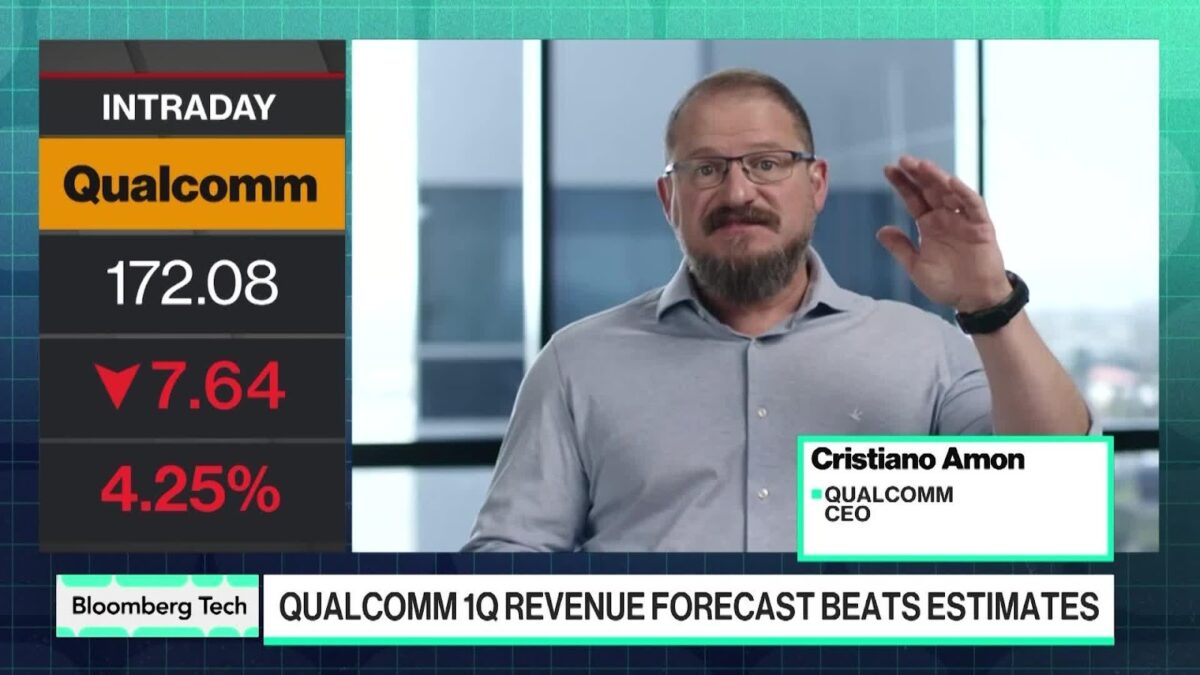
In a keynote speech at the Mobile World Congress, the chief executive officer of Qualcomm, Cristiano Amon, stated that robotics has a bigger potential for the company to grow beyond the smartphone market it has been serving in the last two years Amon, 2026.
Such a strategic shift is an indicator of a clear transition to the new trillion-dollar robotics market, which qualifies Qualcomm as a major player in hardware development in the future.
Robotics Push Heats Up
The announcement by Amon is in the context of a January release of the Dragon wing processor, a flexible SOC by Qualcomm that was intended to drive the spectrum of robotization, including industrial robotic hands and humanoid mobile robots Qualcomm, 2026.
This effort rears the success of Snapdragon in the history of the company, as the chipset is used in billions of mobile devices around the world. In another interview with CNBC in Barcelona on March 3, 2026, Amon estimated that critical mass production and adoption of robotics will be reached in 2027 because of improvements in physical artificial intelligence AIML and physical sensor fusion technologies Amon, 2026.
Massive Market Potential
Qualcomm’s thesis is approved by industry analysts: McKinsey consultants appear to suggest that the global demand for general-purpose robots will be $370 billion in 2040, whereas the RBC Capital Markets team calculates humanoid robot sales alone at $9 trillion by 2050 McKinsey, 2026; RBC Capital Markets, 2026.
By February 23, 2026, the global market of robotics was estimated to be 67billion, reflecting a 12% growth rate on an annual basis, thanks to the augmented demand of AI-enabled processors Statista, 2026. The Dragon wing of Qualcomm thus finds a chance to fight the dominance of Nvidia by providing edge computing solutions that target real-time robotic cognition.
Strategic Edge and Risks
The Dragon wing platform has the potential to make robotics about hardware standardization, like Snapdragon has made mobile analogous, and this has the potential to enable cross-vendor compatibility and faster adoption. However, the level of competition is still high. The Optimus project by Tesla, and Chinese companies like Unitree, are fast-scaling, and more than 50 humanoid prototypes have been announced in development across the world, as of Q1, 2026 IFR, 2026. Other threats are supply-chain limitations and expensiveness of AI training, which costs on average $100 million dollars per model IDC, 2026.
In prospect, it is predicted that financial analysts project the robotic revenue of Qualcomm may be a fivefold growth by 2028, presuming the timeline is projected, with an estimated 15-20% of the market in the rampant animation of physical AI PwC, 2026. Investors are following the current 1.8% drop in the stock of the QUALYQC in the current U.S. Iran tensions, which might be compensated if Qualcomm wins big robotics contracts. The affordable, scalable physical AI required for the future of industrial automation is now in a critical phase, and it might change the factory floor in the future.