
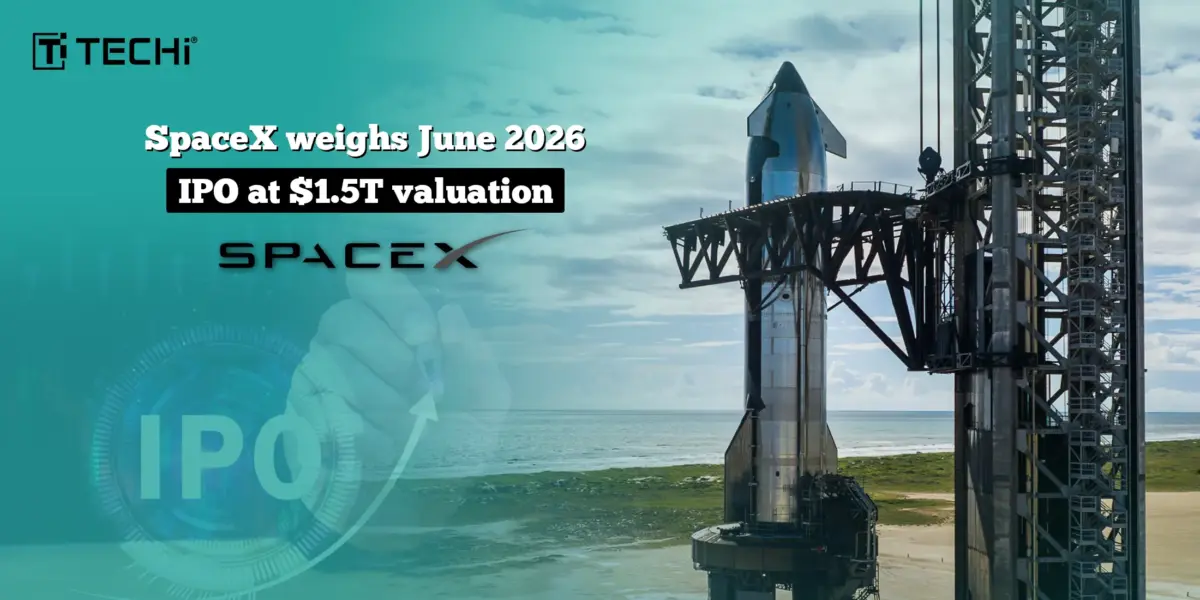
The company is quietly making preparations towards the largest global offering in modern history, and is aiming at a listing into the end of June 2026 which would value it at an estimated $1.5 trillion, and this has been reported by the Financial Times based on any individual with firsthand knowledge of the operations in the company.
What the IPO Would Mean? 🔗
With a post-launch valuation of 1.5 trillion, the venture would be one of the most valuable corporations in the world, in an approximate comparison to current largest technology giants and even beyond Saudi Aramco, which was worth $1.7 trillion when it went public in 2019.
According to reports, SpaceX is moving forward with plans for an IPO with the goal of raising well over $30 billion, setting it up to overtake Saudi Aramco’s 2019 listing as the biggest in history.
Bret Johnsen, the chief financial officer, is quoted as having had consistent communication including teleconferences with current private stakeholders since mid December in order to gauge their interest in an entry in 2026 in terms of a public approach.
Market and Investor Outlook 🔗
Provided that the offering comes to pass on this scale the company will essentially be valuing itself at approximately 100x its 2025 revenue, according to an anonymous analyst in New York who focuses on the space sector.
The analyst reported that, although fierce, such multiples are not unprecedented by a powerful, high-growth platform with near-monopolistic requirements in both launch services and space-based broadband solutions.
Future Path and Risks 🔗
The late-June 2026 window would make the company the largest IPO in the world in the short term, assuming it passes regulatory clearance and continues to be an attractive target by the investors.
The success of being profitable in the long term will depend on the trustworthiness of the Starship platform, the timeline of profitability of Starlink as well as the ratio of the capital invested into research and development.
According to Forbes, Starlink’s subscription income is expected to reach $10 billion in 2025, a 60% increase from 2024 levels and roughly two-thirds of SpaceX’s total revenue. According to reports, Starlink has been profitable on its own since 2024.
An early success may trigger a fresh wave of investment enthusiasm in space-related equities that may push valuations up in the satellite, launch and space infrastructure companies.