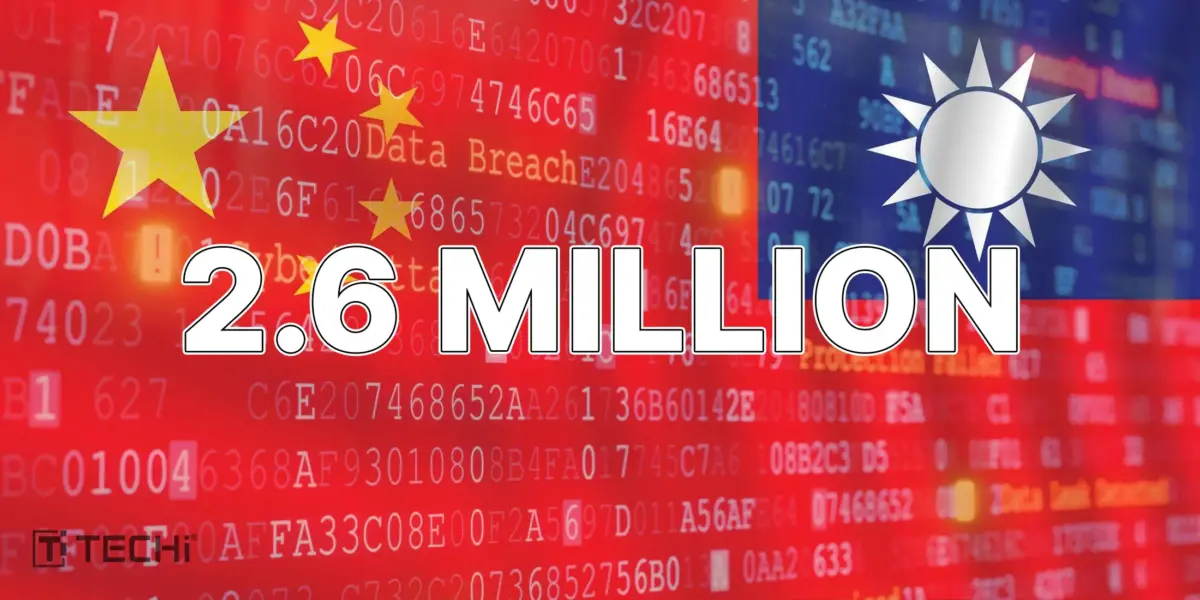
In 2025, Taiwan reported a lengthy cyber offensive by the People’s Republic of China, with an average of 2.63 million malicious cyber operations detected per day.
This number is a 6% rise in 2025 as compared to 2024, among them, energy and emergency rescue/hospitals sectors experienced the most significant year-on-year surge in cyber-attacks from Chinese threat actors.
The Taiwan National Security Bureau considers the campaign to be a type of hybrid warfare which combines information-system intrusions with traditional military exercises, thus attempting to disrupt the military capabilities of the island to marshal its defense needs.
Escalating Targets
The most strongly impacted dependencies were associated with the critical sectors that constitute the essential infrastructure of the country, including the electrical transmission system, medical facilities, and crisis management and response systems.
In these areas, research and development areas where the TSMC plant is situated were also exposed to intensively elaborate probing exercises that were intended to steal the semiconductor design.
Simultaneously, the bureau documented 40 intrusions that were called Chinese joint combat readiness patrols near Taiwan in which the rates of cyber-attacks proliferated on 23 occasions.
Increased levels of geopolitical tension were matched with the Presidential address of Lai Ching-te and the Vice-presidential briefing of Hsiao Bi-khim to European legislatures respectively in May and November.
The Report Noted:
“China’s moves align with its strategic need to employ hybrid threats against Taiwan during both peacetime and wartime,”
The attacks encompassed the distributed denial-of-service (DDoS) surges that were used to disrupt ordinary operations, and man-in-the-middle attacks that obtained telecommunications information.
The bureau warned that such a calculated attack targets creating paralysis of government and social operations and that this can only be attributed to the initiative by Beijing in attaining technological independence in the bigger context of the overall U.S.-China rivalry.
Expert Analysis
Taiwan should regard a cyberattack that causes “real harm or loss of life” as an act of war and respond with armed force, Su Tzu-yun said, a research fellow at the state-run Institute for National Defense and Security Research.
NATO’s Tallinn Manual affirms the right of member states to invoke Article 51 of the UN Charter allowing self-defense if they come under cyberattack, Minister of National Defense Wellington Koo.
In 2019, the US and Japan amended their Treaty of Mutual Cooperation and Security to explicitly state that Washington is obligated to defend Japan, or US forces stationed there, against cyberwarfare attacks, he added.
Future Risks
The refusal of responsibility by Beijing along with a parallel claim of sovereignty over Taiwan, the possibility of the escalation cannot be ruled out.
The prospective U.S. voting year, and the strategic value of TSMC leadership as the main maker of artificial-intelligence chips, has called on Taiwan to have a rise in its defense-technology investment in 2026.
The budget will be allocated over eight years, from 2026 to 2033, and comes after Lai already pledged to raise defense spending to 5% of the island’s GDP, as part of his strategy amid China’s threats of invasion.
According to a critical-analysis opinion, there is an evolutionary possibility that multinational enemy assaults can become more visible as failures in desktop services, e.g., the failure of hospital systems and the inability to supply electric installations, unless multinational collaboration can enhance cybersecurity capabilities.
Constant vigilance is, hence, one thing that cannot be compromised when it comes to preventing military incursion.