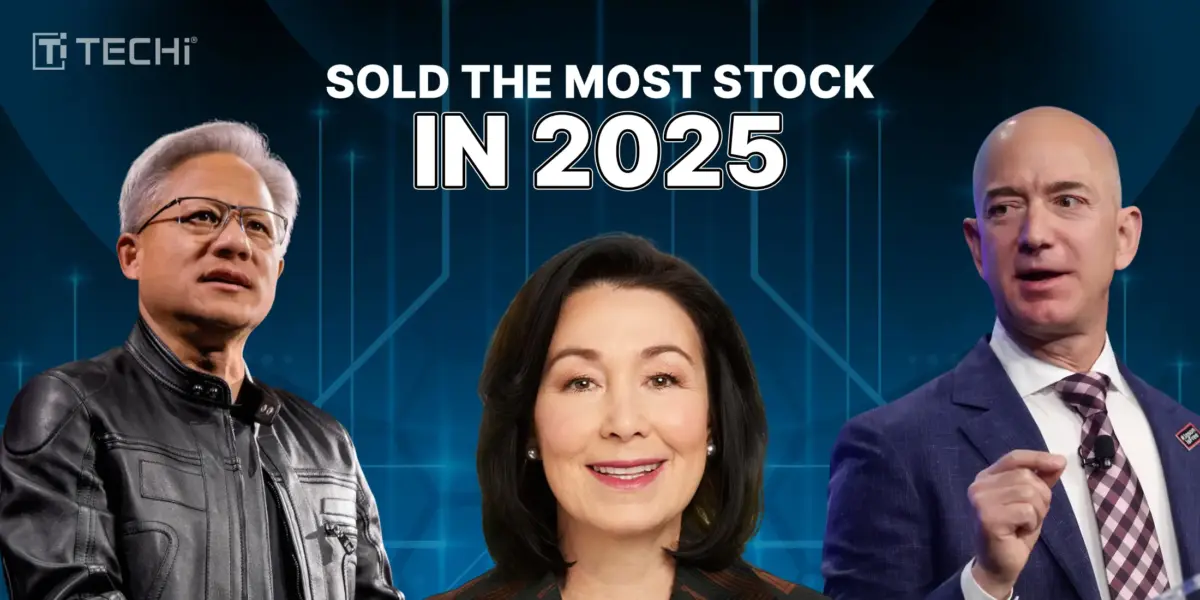
The tech startup founders sold approximately $19 billion of equities by taking advantage of the artificial-intelligence boom before market corrections are expected to take place.
Among the twenty top sales, Amazon founder Jeff Bezos took the lead by selling $5.7 billion shares of Amazon into a net worth of $253 billion.
The reported outflows, obtained through SEC filings, exclude the transactions that are connected with taxes or option exercises, therefore, highlighting the strategic character of those sales in the context of overvalued market conditions.
Record Share Divestitures 🔗
Major technology companies’ top managers had noted significant share sales in the year.
When NVIDIA’s chief executive officer, Jensen Huang liquidated more than $1 billion of his equity, which is a figure out of his total $161.9 billion net worth, this only fueled the speculation about future artificial-intelligence projects.
The greatest percentage turnover would be that of Safra Catz, who is the former chief executive officer of the Oracle and after selling her fortune.
Catz sold a total of 8.7 million shares valued at $1.83 billion. The Chairman & CEO, Michael Dell, made the biggest insider sale in the last 12 months.
That single transaction was for $1.2b worth of shares at a price of $122 each, which he used to transfer a portion of the value to a $6.25 billion charity fund on behalf of children.
Brannin McBee, one of the executives of CoreWeave, who sold off $473 million just after the March initial offering, was able to avoid the loss that could have been as much as 50% in case of leverage issues.
However, Musk and Ellison were ironically not part of the divestiture group; both of them had a borrowing arrangement against Tesla stock as well as oracle share as a tax deferral strategy.
Prospects: Bubble or Growth Prospect? 🔗
Insider selling does not necessarily indicate bearish sentiment, as executives often diversify holdings or execute pre-planned transactions. However, the scale of 2025’s sales has intensified debate over whether the AI rally reflects a valuation bubble or a longer-term structural shift.
In case the Federal Reserve financial-policy changes continue, the additional disposals can be expected; otherwise, long-term need by hyperscale data-center operators can spawn market recoveries.
The investors should examine first-quarter 2026 income to understand the true sustainability of artificial-intelligence demand.