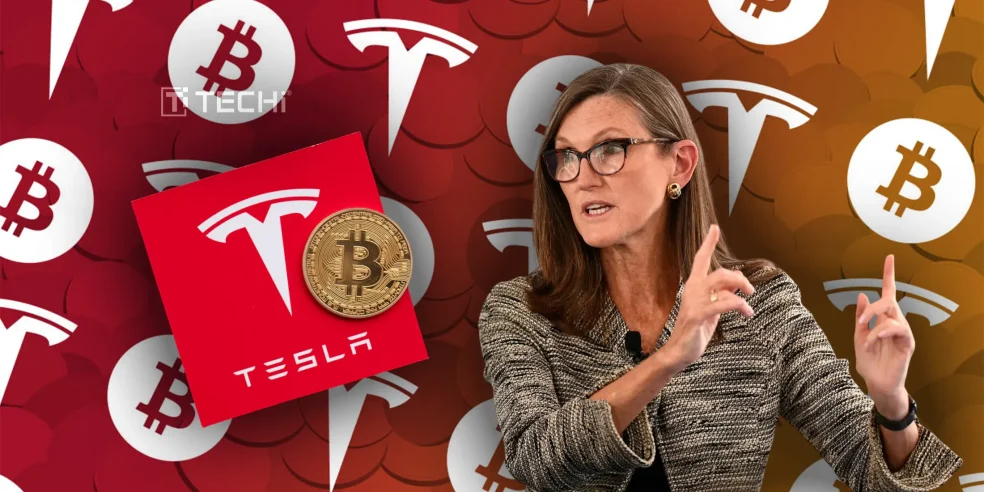
Cathie Wood is doubling down on her most audacious call. The ARK Invest CEO maintains her $2,600 price target for Tesla — valuing the company at over $9 trillion — and says the robotaxi opportunity alone could represent 90% of Tesla’s total value by 2029. In a market where Tesla stock trades around $244, that implies a potential 10x return for patient investors. Her thesis rests on a single conviction: autonomous mobility will become an $8 to $10 trillion global market, and Tesla will own the dominant platform.
The $10 Trillion Robotaxi Opportunity
Wood has been unambiguous about the scale of what she sees coming. “US$8 to US$10 trillion for the entire autonomous taxi opportunity throughout the world, from almost nothing,” she told the South China Morning Post, calling it “one of the most important investment opportunities of our lifetimes.”
The math behind her conviction is straightforward. Platform providers like Tesla, according to ARK’s research, could capture 30 to 50% of total autonomous ride revenue. Unlike traditional car manufacturing — where margins are thin and cyclical — a robotaxi platform operates on a recurring revenue model. ARK projects profit margins above 50% for platform operators, with Tesla potentially achieving margins far higher. Every additional mile driven on the Tesla network costs the company almost nothing incrementally, while revenue compounds.
How Robotaxi Transforms Tesla’s Margins
The numbers that get investor attention are the margin projections. Tesla’s current automotive gross margin sits around 16% — respectable for a carmaker, but not extraordinary. Wood’s projection, detailed by Benzinga, calls for margins approaching 90% once robotaxi becomes Tesla’s dominant revenue stream.
The logic tracks. Software-driven revenue, combined with high fleet utilization and near-zero incremental cost per ride, structurally transforms the economics. ARK’s research indicates that robotaxi could represent as much as 90% of Tesla’s total enterprise value by 2029 — meaning the car business becomes almost a footnote. The comparison that Wood and her analysts reach for is Apple’s services division, which runs gross margins above 70%. A Tesla that earns most of its money from autonomous mobility fees, not vehicle sales, looks far more like a software company than an automaker.
Tesla vs Waymo — The Autonomous Race
The credibility of Wood’s thesis depends on whether Tesla can actually win the autonomy race. Today, the honest assessment is that Waymo holds the technology lead. Waymo operates Level 4 fully driverless robotaxis in select U.S. cities with no human supervisor required. Tesla’s Full Self-Driving (FSD) remains Level 2 — the driver must stay attentive and ready to intervene at any moment.
Wood’s counter-argument, outlined in analysis covered by Motley Fool, is about scalability rather than current capability. Waymo uses lidar sensors, high-definition maps, and expensive hardware configurations that cost far more per vehicle. Tesla uses a camera-only vision AI system that is cheaper to manufacture and already installed in millions of vehicles on the road. That data advantage — real-world miles from a global fleet — is what ARK believes will ultimately produce superior AI, even if Waymo has the head start.
The production comparison is stark. Tesla plans to produce 2 to 4 million Cybercab dedicated robotaxi units annually starting in 2026. Waymo’s current fleet is measured in the thousands. If Tesla achieves full autonomy, the manufacturing scale is simply incomparable. The critical open question: Tesla has the scale, Waymo has the proven technology. Which matters more?
The $2,600 Price Target — How ARK Gets There
ARK Invest’s $2,600 price target for Tesla by 2029 implies a market capitalization exceeding $9 trillion — making it the most valuable company in history by a significant margin. At Tesla’s current trading price of approximately $244 as of March 2026, that represents a roughly 10x return over three years.
The model, as reported by Fortune and Yahoo Finance, attributes 63% of Tesla’s projected revenue to robotaxi operations and 90% of the company’s total value to autonomous mobility. The key assumptions are aggressive: Tesla achieves regulatory approval for unsupervised autonomous operation in major U.S. and international markets, scales Cybercab production to multi-million units annually, and maintains technological competitiveness against both Waymo and Chinese autonomy players.
Wood has addressed the regulatory question directly: “We don’t think technology is the problem anymore,” she has said. “Regulation has to catch up.” That framing positions the remaining risk as political and bureaucratic rather than engineering — a bet that policymakers will ultimately clear the path for commercially viable robotaxi operations at scale.
Why This Matters for Investors
The investment case for Tesla in 2026 is not primarily about electric vehicles. Global EV sales growth has slowed, competition from Chinese manufacturers has intensified, and Tesla’s share of the EV market has declined from its early dominance. At $244 per share, Tesla already trades at a premium that cannot be justified by its car business alone.
What the market is pricing in — and what Wood argues is massively underpriced — is the potential transition from cyclical car manufacturer to AI mobility platform. Recurring revenue replaces lumpy vehicle sales. Software margins replace manufacturing margins. The company joins the ranks of high-multiple technology platforms rather than competing for the 15 to 20x earnings multiples typical of automakers. The same repricing dynamic that transformed how investors value AI stocks broadly could apply to Tesla specifically if robotaxi reaches commercial scale.
The scenario analysis is binary in character. If robotaxi works at the scale Wood projects, Tesla potentially becomes the most valuable company in history. If it does not, the stock is materially overvalued even at today’s price.
The Bear Case — What Could Go Wrong
The bear case against Wood’s thesis is substantial and should be taken seriously. Tesla’s FSD is still Level 2, requiring human supervision, while Waymo already operates Level 4 commercial robotaxis. The gap between supervised assistance and fully autonomous operation is not merely incremental — it represents the hardest unsolved problems in AI.
Regulatory approval timelines remain uncertain and vary dramatically by jurisdiction. Liability frameworks for autonomous vehicle accidents are still evolving. Chinese autonomy competitors — Baidu Apollo, Pony.ai, and others — are advancing rapidly and already operating robotaxi services in major Chinese cities. Nvidia’s role supplying AI compute for autonomous vehicle development also makes clear that the underlying technology race involves deep partnerships and capital intensity far beyond any single company’s internal R&D. The importance of Nvidia to the broader AI and autonomy stack cannot be overstated.
There is also the track record issue. ARK’s previous Tesla price targets have not been met on schedule. Motley Fool has noted that Tesla must scale robotaxi operations far beyond Waymo’s current level to justify the valuation ARK is projecting — a bar that has not yet been cleared. Investors who followed ARK’s previous bold calls have experienced significant drawdowns waiting for the thesis to play out.
The Production Pipeline
Tesla’s manufacturing base gives it a structural advantage that pure-tech competitors cannot easily replicate. The company currently produces over 5,000 vehicles per day across its global factories. The Cybercab — Tesla’s purpose-built robotaxi with no steering wheel or pedals — is planned for production volumes of 2 to 4 million units annually, a scale that would dwarf any existing autonomous vehicle deployment.
A limited, supervised robotaxi service in Austin, Texas is already operational. The full unsupervised rollout timeline, however, remains unclear. Tesla has not committed to a specific date for removing the supervision requirement, and that gap between supervised launch and commercial-scale autonomous operation is where much of the investment risk resides.
What to Watch Next
Several developments in the coming quarters will serve as leading indicators for whether Wood’s thesis is on track. FSD software updates — particularly the transition from v13 toward a version capable of unsupervised operation — will signal whether Tesla’s AI is closing the gap with Waymo. Regulatory approvals in California, Texas, and key international markets will determine the geographic scope of any commercial launch.
Quarterly autonomous miles driven, compared against Waymo’s reported metrics, will provide a direct competition benchmark. Tesla’s earnings calls will eventually need to include robotaxi revenue line items for the market to begin pricing the business on its new economics. And the development of insurance and liability frameworks — currently a significant unresolved legal question — will shape how quickly municipalities permit fully driverless commercial operation.
What is Tesla Robotaxi?
Tesla Robotaxi is an autonomous ride-hailing service that uses Tesla’s Full Self-Driving (FSD) software to operate vehicles without human drivers. Tesla plans to deploy dedicated Cybercab vehicles alongside its existing fleet for this service.
What is Cathie Wood’s Tesla price target?
Cathie Wood’s ARK Invest maintains a $2,600 price target for Tesla by 2029, implying a market capitalization above $9 trillion. ARK projects that robotaxi operations could represent 90% of Tesla’s total value.
How big is the robotaxi market?
According to ARK Invest and Cathie Wood, the global autonomous taxi market could reach $8 to $10 trillion by 2030, making it one of the largest addressable markets in technology history.
Is Tesla’s FSD fully autonomous?
As of March 2026, Tesla’s Full Self-Driving is classified as Level 2 autonomy, which requires human supervision at all times. Waymo, by comparison, operates Level 4 autonomous vehicles that drive without human intervention in select cities.
Fatimah Misbah Hussain covers electric vehicles, autonomous technology, and disruptive innovation for TECHi. Her analysis focuses on how emerging technologies reshape investor expectations and market valuations.
If Tesla successfully deploys robotaxis at scale, it may not just transform transportation — but redefine what investors expect from a car company. The gap between Wood’s $2,600 vision and today’s $244 reality is not just a price target. It is a bet on whether artificial intelligence can replace the human driver — and whether Tesla or its competitors get there first. This is a developing story as autonomous technology continues to evolve.