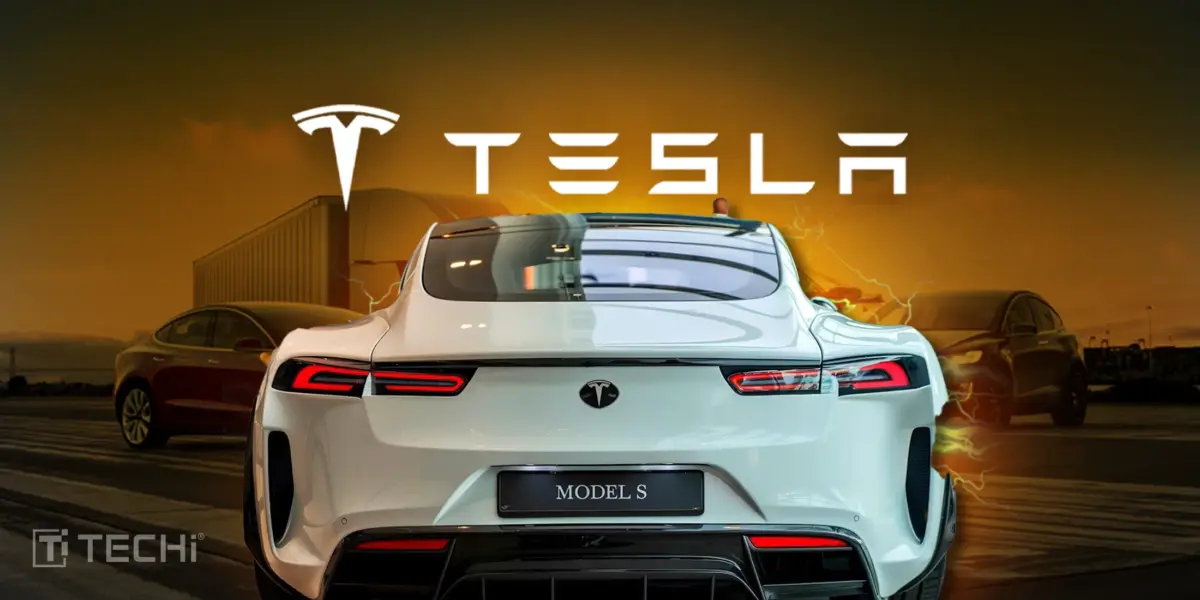
Tesla has always had grand ambitions and never looked back. However, today’s investors are not just evaluating the company as a carmaker, but as a future leader in the field of autonomous transport and humanoid robotics, with products like the Cybercab robotaxi and the Optimus robot.
These are very risky yet high-reward bets that might produce great profits in the end. Unfortunately, Tesla is still living in the present day, and currently the key figures from its core business are sending out warning signals that investors should not disregard.
Tesla’s electric vehicles are still the main support of its business, where its sales contribute to 75% of the total revenue. A failure in the main source of income indicates trouble for the whole company. As for the shareholders, the company in question is Tesla, as the year 2025 delivered the worst news possible.
Largest Sales Decline for Tesla
Tesla undergoes the most drastic plunge in sales ever recorded in their history. In the beginning, it was like a fairytale when Tesla was able to nearly conquer the EV market globally. In 2023, the company even set a new record by delivering a total of 1.79 million vehicles to the global market, and confirmed its status as the number one player in the automotive industry.
However, this supremacy began to lose its shine in 2024, when the annual deliveries were slightly decreased (1% down), which marked the first drop after the introduction of the Model S in 2011.
The decline in demand and subsequent sales were further worsened in 2025. Tesla’s deliveries in the last quarter were 418,227 units, which were below Wall Street’s predictions.
It resulted in total yearly deliveries being cut back to 1.63 million. This is an 8.5% decrease compared to the previous year, and it is also the largest annual sales decline in Tesla’s entire history.
Intense Competition
The competition is getting quite tough in Tesla’s largest markets. In the European and Chinese markets, more consumers are becoming budget-conscious, so they are turning to the cheaper alternatives. The trend of inflation and upper range of living expenses has a negative impact on luxury brands, and EV Chinese giant BYD has seized the moment and is offering a model like the Dolphin Surf at prices that are much lower than that of the model 3 of Tesla.
This ultimately resulted in the shrinking of Tesla’s market in Europe, which decreased from 2.4% to 1.7% in 2025. Meanwhile, BYD reaped a remarkable 28% growth in global deliveries, in contrast to this decline of Tesla’s market presence.
Tesla’s Next-Gen Platform
Cybercab and Optimus are quite promising, but are still very far off. Tesla’s long-term vision rests significantly on its next-generation platforms, but those objectives do not basically bring any immediate action.
The revenues from EV sales create the source of the funds for development of the Cybercab and Optimus. So, a steady dip in the car sector could trigger a declining situation for the entire company.
Musk’s guidance indicates that the mass production of the Cybercab robotaxi has a timeline stretching into late 2026, while the Optimus humanoid robots will take even longer to reach the market.
Although the financial uplift is fabulous, and Ark Investment Management predicts that the revenue from robotaxi alone will touch hundreds of billions ($756 billion) yearly at the end of this decade, the regulatory and technical issues still remain huge.
The full self-driving software of Tesla has not even received any approval for unsupervised usage anywhere across the United States. The Cybercab without clearance from the regulators would face delays in its deployment before it even hits the roads.
At the same time, Optimus is still in the early phase of development. Musk imagines a time when humanoid robots outnumber humans and bring in trillions of dollars through sales, however even in the most optimistic scenarios, the financial contributions would still be many years away.
Tesla’s Valuation
Tesla’s valuation intensifies the risk. Over the last four quarters, the firm reported a profit of $1.44 per share, and the stock has a very high price-to-earnings ratio of about 292. In contrast to other tech companies that are worth over a trillion dollars, Tesla is in its own world, and not necessarily in a good way.
The firm will reveal its fourth-quarter earnings later this month and with the huge drop-off in electric vehicle deliveries, it is probable that profitability will be under pressure even more. Any loss in previous earnings would only give the impression that the price is very high.
With the Cybercab and Optimus still a long way from being able to generate significant revenue, Tesla has hardly any short-term measures to balance the slowing down in its main business.
2026 Could Be a Risky Year for Tesla Investors
Tesla’s long-term story still looks very attractive, but markets do not act only on far-off promises. The firm is going to face a difficult transition period with EV sales going down, the competition getting harder, and the future platforms being still years away from being at its full capacities.
For a perfectly priced stock, even the slightest letdowns can result in big downward movements. Until Tesla’s electric vehicle business is either stable or the next-generation platforms have rich revenue signs in the short term, shareholders might think twice before believing that what happened in the past will definitely happen again in the future.