
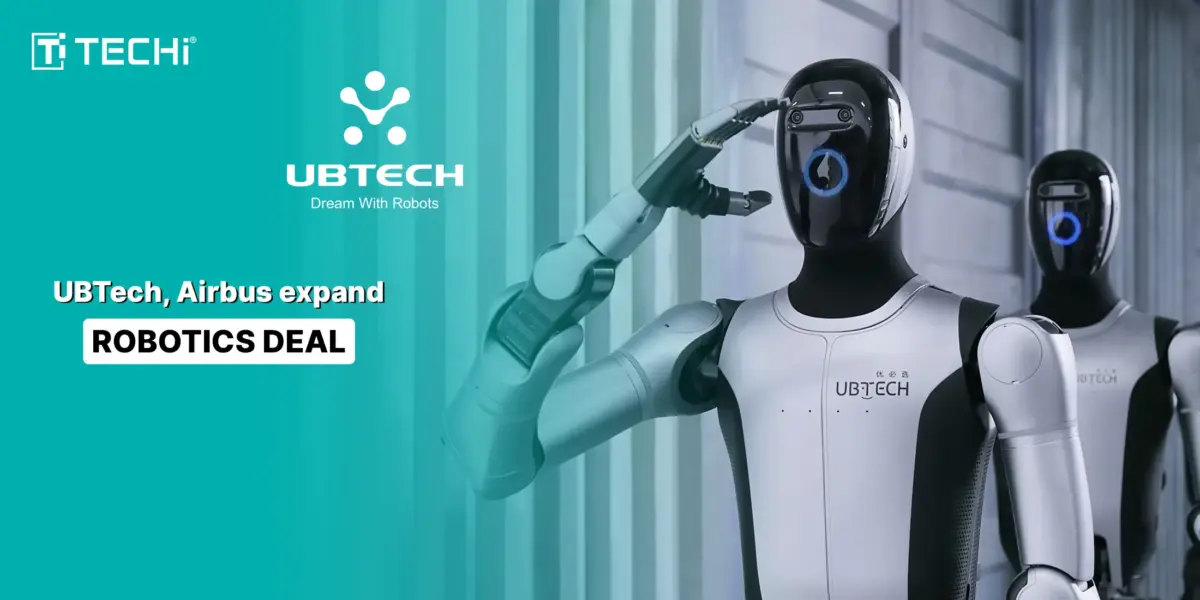
UBtech, the Chinese giant in robotics has signed a historic deal with Airbus, the largest aircraft maker in the world to launch the new high tech humanoid robots to aircraft assembly lines. This partnership was announced on 21 January 2026, and puts the Walker robots, named S2, on the assembly line in the aviation sector, indicating a radical shift in the high-precision manufacturing.
Deal Sparks Global Buzz
Airbus has also obtained the recent Walker S2 industrial humanoid offered by UBTech, and it is starting to validate the potential of the robot in the aerospace industry. The partnership is based on the prior contract of UBTech with the chip giant of the United States Texas Instruments that now thoroughly supplies its semiconductor manufacturing lines with Walker S2 units.
This extension further into aviation, automotive, electronics, logistic and semiconductor industries of China are the five vibrant sectors that will be disrupted.
Humanoid Orders by UBTech Soared to 1.4 billion Yuan
Airbus has already purchased UBTech’s latest industrial humanoid robot, the Walker S2, UBTech said,
The two parties will jointly expand the application of humanoid robots in aerospace manufacturing scenarios in the future.
In 2025, UBTech (customer orders in its humanoid robots) had more than 1.4 billion yuan and through the use of its factory in Guangxi, the company manufactured over 1,000 of the Walker S2 at the end of 2025.
The capacity of the company will cross 10,000 units in 2026, and will enhance China robot race amid the U.S.-China trade tensions.
Robots Flex Real Muscle
These machines which match humans engage in gymnastic maneuvers such as somersaults, half-marathons and even soccer; that is to say, they are not only manual but are also agile which is essential when it comes to small factory areas that no ordinary human could move around in.
Dr. Li Wei, robotics analyst at Beijing Technological Institute.
A humanoid robot that cost $100,000 last year now sells for under $35,000, with prices expected to halve again by 2026.
China’s 123 million manufacturing workers face the most immediate threat. Industry forecasts suggest up to 70% of these positions could be replaced within the next decade, starting with repetitive assembly tasks.
Bold Horizon Ahead
The company is targeting rapid growth, an expected number of tens of thousands of orders in 2026. According to Airbus’ Global Market Forecast for the 2024–2043 period, approximately 42,500 new aircraft will be required by 2043, of which 8,920 will be widebodies and 33,510 will be single aisles.
Additionally, 2,470 deliveries, 940 of which will be new-build, will be demanded by the freighter industry. In order to meet decarbonization goals, replacing outdated or inefficient aircraft will account for about 45% of new deliveries.
Most importantly, the experiment of this venture is whether Chinese technology can invade the strongholds of the West; a success may result in the rebuilding of Chinese manufacturing playbooks, but there are still regulatory challenges.