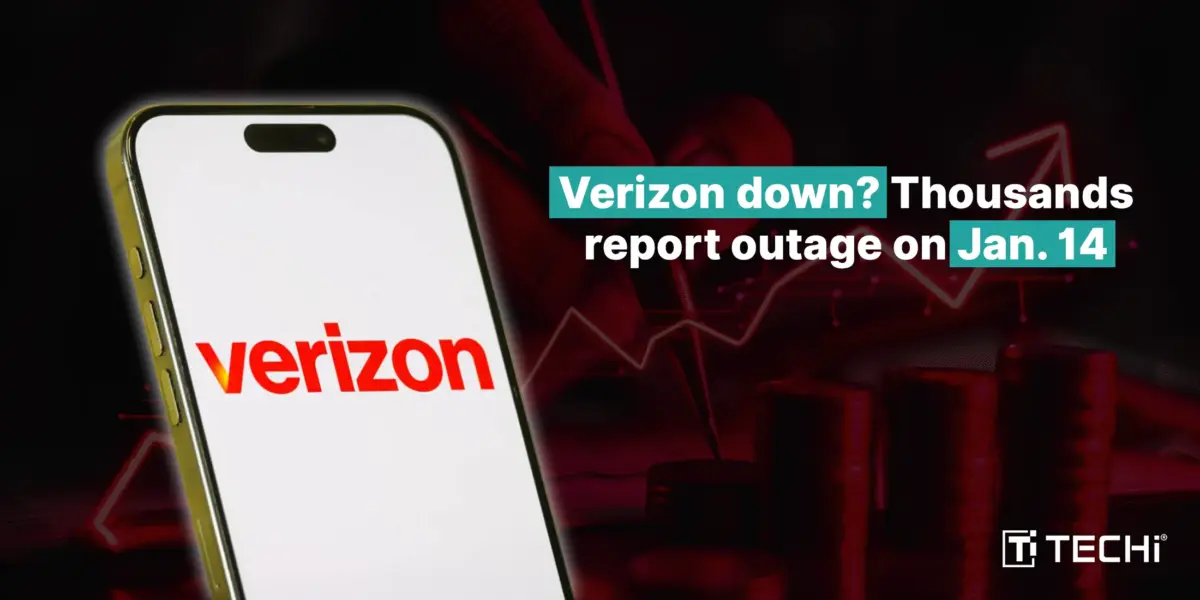
In case your mobile suddenly appeared to be more of an ornament than a tool on a Wednesday afternoon, then you were not the only one. On 14th January 2026, a huge number of Americans turned to their phones only to see the notification “Call Failed” appear on the screen, along with an “SOS” symbol taking the place of the signal bars.
As per Downdetector, the outage was reported by more than 150,000 Verizon subscribers, which turned a normal weekday into a nationwide search for service.
Outage Numbers Spikes before a Gradual Decrease
At the time of 12:37 pm ET, around 157,596 Verizon users had already reported the problem on Downdetector. Downdetector is a website that tracks outages in real-time and acts as America’s unofficial tech therapist in such situations.
The number of cases continued to increase, and reached its maximum of nearly 178,000 reports before a gradual decline. By the time it was 2 pm ET, the number of outage reports had fallen to roughly 110,000, which indicates that Verizon’s tech team at least got something under control if not the whole issue.
Verizon Breaks Its Silence
In a statement, Verizon apologized to USA TODAY and acknowledged that the customers experienced the issue with wireless voice and data services.
“We are aware of an issue impacting wireless voice and data services for some customers”.
The company mentioned that its engineers were working hard to both figure out the problem and fix it, along with also offering apologies for the inconvenience caused.
“Our engineers are engaged and are working to identify and solve the issue quickly. We understand how important reliable connectivity is and apologize for the inconvenience”.
Verizon is not the only one to suffer
Although the disruption mainly hit Verizon, it was not the only telecom operator that had to cope with this situation. Customers from other large carriers reported troubles as well, with more than 1,600 T-Mobile users and about 1,700 AT&T users submitting outage reports on Downdetector.
However, Verizon being the leading wireless provider in the U.S with a subscriber base of over 146 million, Verizon’s issues naturally attracted the most attention.
Social Media & the Outage Signal
Verizon faced the problem of service interruption, and that very quickly became the primary factor that led to it being talked about the most on X. On this platform, the users mainly from places like New York, North Carolina, New Jersey, Louisiana, and Tennessee expressed their discontent.
The situation was rather ironic, as just when the phone service was not working completely, the customers went to social media, using the available Wi-Fi, in order to make sure that the problem was actually not a personal one.
“SOS” Signs and Non-Connecting Call Triggers
The majority of the people that were affected from the outage claimed to see “SOS” appear instead of their usual signal bars, which was an indication that their phones were not able to connect to Verizon’s network.
Calls were interrupted, message delivery got stuck, and internet access became extremely slow, which left the users disconnected from their jobs, families, and the daily routine of scrolling through their phones.
Bottom Line
By the end of the day, reports of outages were getting fewer, which suggested that Verizon was gradually restoring the service. However, the incident was a clear indication of how much the life of people depends on invisible signals and silent towers.
Even if these outages are short-lived, the entire nation is aware of them. Until things are back to normal, Americans are going to keep refreshing Downdetector, staring at their devices, and wondering about the same simple question, is the service back yet?