
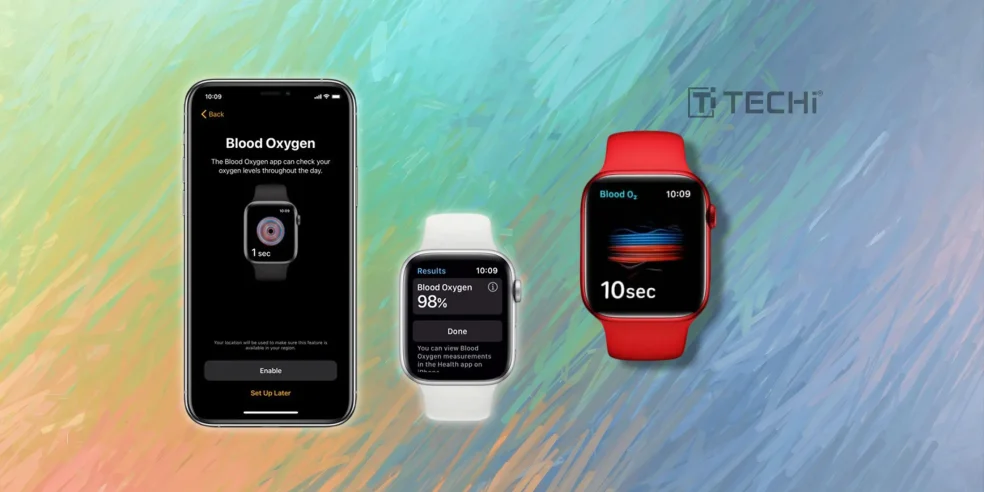
After a long silence over the banned “blood oxygen feature” from their watch models, Series 9, Apple has taken a substantial step and officially filed a request for reconsideration before a U.S appeals court to overturn the ruling of a lower court that led to this ban of the “blood oxygen feature”.
Apple asserts that the ruling has an unfair impact on its millions of health conscious users, whereas, Masimo (the contending party) maintains that Apple is playing over their turf by using its pre-patented blood oxygen technology.
The war of patents 🔗
In late 2023, one of USA’s renowned med-tech firms, Masimo, launched and won a legal battle against Apple. Masimo argued on the basis of patent infringement law, establishing that Apple had employed the same blood oxygen technology in their Series 9 that is patented under Masimo’s ownership.
The US International Trade Commission ruled in favour of Masimo, binding Apple to deactivate the SpO2 blood oxygen monitoring feature through a software update for all in circulation watches of the said model in the U.S, without implicating international users.
Significance of the feature for Apple 🔗
The SpO2 blood oxygen technology means more than just another feature to Apple. In times of bulging “Conscious consumers”, tech giants often come under scrutiny for their broader impact on the environment. In Apple’s defense, they have always labeled themselves as a health-focused brand, carving a justification for their gigantic tech endeavors. In this context, the blood oxygen monitoring features, serves as a tangible proof to prove Apple watches as a health-focused device rather than just a fancy watch.
More significantly, the feature also serves a justification for the Series9 model’s premium pricing of $399. Also, it guards Apple’s reputation for always staying ahead of the game and serving its users with untapped technological conveniences while assisting them in keeping a check on their day to day wellness without doing any extra hassle.
The Numbers Game 🔗
Apple’s wearable division stands out for being a major contributor in the company’s annual revenue estimating at $383 billion, with its share amounting to $18 billion. This enormous share accentuates Apple watches’ significance as one of the key profit engines for the company.
Despite this push to disable the blood oxygen monitoring feature, the series9 has helped Apple retain its customer base, making it even more of a reason for Apple to fight for unlocking an important feature in a key product.
What’s Next? 🔗
As of now, Apple’s legal minds are on this task to uplift the ban, while the industry analysts are predicting that the feature could make a comeback till the late of 2025 at the earliest.
Although, Apple is putting everything to maintain its always evolving innovation philosophy by doubling down on brighter display and improved performance in the watch model. Yet, the absence of this blood oxygen monitoring feature creates a noteworthy gap in the company’s commitment to deliver health-focused wearable devices.
Bottom Line 🔗
This battle over a feature demonstrates Apple’s resilience to stand its ground and keep its key differentiator intact and available for its users. Yes, this ban has boxed the potential and perks of the series9 watch and is holding Apple’ in hot waters until it’s dismissed. Yet, the constant effort to compensate with other added features in the watch for the missing one is still helping Apple maintain its edge over the others.
The prospect of the return of this feature SpO2 monitoring could script an important win for Apple and its loyal consumer base who are impatiently waiting on the sidelines.