
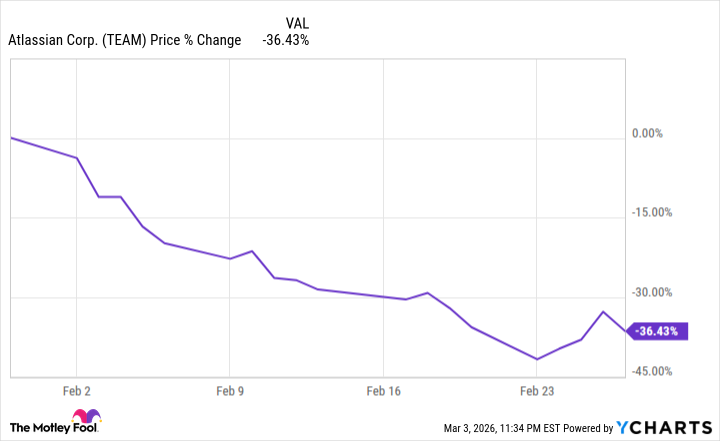
In February 2026, the stock of collaboration software, Atlassian, fell by 36%, which also represents a robust sell-off in the software industry amid the fear of AI-related unrest and shaky economic markets. On March 4, the Nasdaq-traded company TEAM was actually trading at 78.36 after a one-day gain of 6.18, but this was a considerable monthly contraction of the pandemic-induced heights, and the current appraisals had gone down more than 80%. of their pandemic-heights.
Lack of Software Sales Softens the Sand
The problems that face Atlassian can be greatly blamed on systemic volatility of the market. The S&P 500 Software index has dropped 19% of the year since the beginning down to the end of February, and over 90% of its components have limited cumulative returns.
On the assumption that nascent AI solutions could displace stalwart products such as the kanban boards in Jira, investors were selling out of high-valuation Software-as-a-Service companies, including Atlassian. As Atlassian operates mostly in the small- and medium-enterprise market, it will be vulnerable to more close competition as agile incumbents are offering custom AI-integrated services.

These fears Were Heightened By The Company’s Q2 Results, Which Were Released Last Month
The last financial disclosures issued in the second quarter showed that the company had a revenue of $1.59 billion, which is a growth of 25% over the previous year and higher than the estimated amount in the market of $1.54 billion. Adjusted earnings per share increased to 1.22 as compared to 0.96, which is above expectations of 1.14.
However, the Generally Accepted Accounting Principles GAAP values indicated a loss in operations amounting to 47.7 million, which was also mainly due to the share-based compensation totaling 452.6 million, which is almost 40% of revenue. Share repurchase operations alleviated the issue of dilution but did not affect the free cash flow, and that is why it was unstable to the shareholders who were cost-conscious, especially in the face of a sectoral contraction.
AI Fears Fuel Volatility
Michael Wilson of Morgan Stanley recognized Atlassian as a favorable entry point on February 19 and argued that the current AI-related fears overwhelm success stories in the form of cloud-service growth. As of February 23, the stock dropped to a 52-week low and 10% per week, which is indicative of a chief financial officer changeover.
Ahead, Accidental and Optimistic Road
Atlassian has predicted the growth of full-year revenue by 20% and plans to increase share-repurchase programmed to take advantage of low levels of valuation. However, the current budget is projected to result in a loss of $300million under GAAP, which presents the likelihood of a cost cut or downsizing. It can be argued based on a critical appraisal that AI-associated issues are baked in since, through AI integration efforts, Atlassian can reduce these alleged threats.
In the event that margin stability and accelerated growth were realized, equity has the potential to recede by 5076% per the bullish analyst forecasts. Nonetheless, this process, put into practice on a wider sectoral distress, will see managerial determination put to the test in an extremely harsh manner, and critical long-term value acquisition can be found as a price correction by discerning investors.