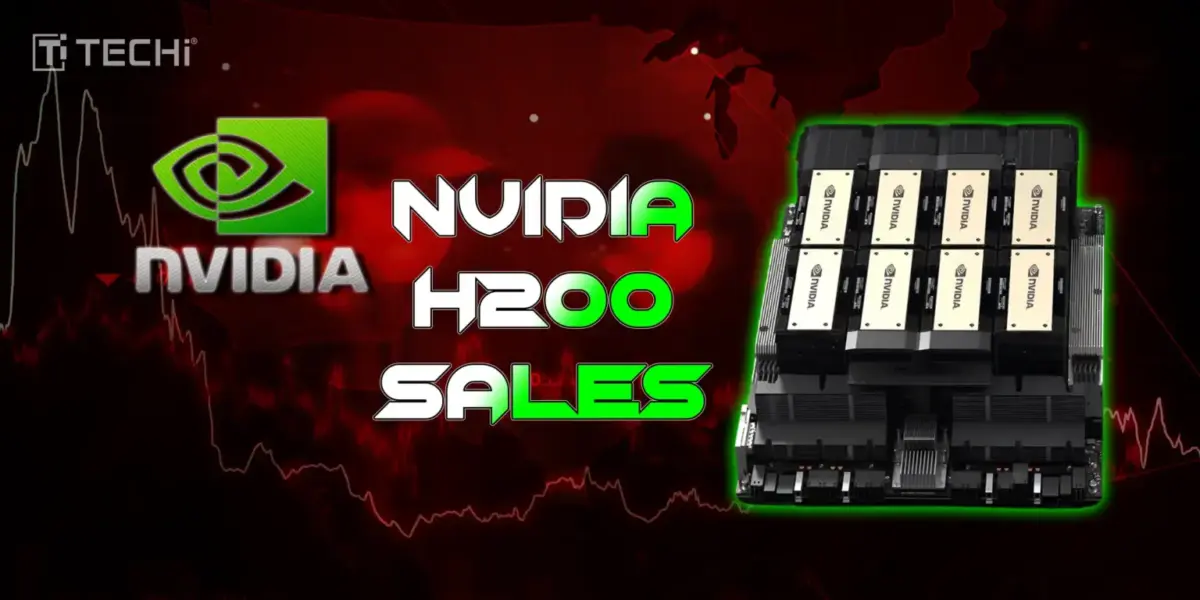
Nvidia’s H200 chip, which is already one of the most exclusive global AI hardware, might see an increase in production soon as the demand for the chip from China grows stronger. When President Donald Trump announced that the U.S would be exporting H200 chips to China through a 25% fee structure, the demand of Chinese technology giants immediately surged.
Alibaba, ByteDance, and other tech giants quickly put in massive orders, which easily exceeded the amount of H200 chips that Nvidia is currently producing. As per the insiders, Nvidia has already begun planning the expansion of their production to provide for the increased demand. However, the whole thing is still very much influenced by politics between the countries, with restrictions on supplies and the changing interests of both the U.S and China.
China’s Urgent Demand Meets U.S. Regulatory Uncertainty
For Chinese tech companies, the H200 is the most powerful AI accelerator that they can currently get their hands on. Whereas the H20, which was designed to meet the earlier export control requirements, is barely a shadow of the H200 in terms of its performance.
The H200 has around six times the power of the H20 and is capable of up to three times of the best AI chips produced in China. In fact, access to high-performance compute is no longer a luxury for Chinese enterprises, but it has become a strategic necessity as they are rapidly investing in the development of foundation models, cloud services, and enterprise AI applications.
But even after Trump’s approval, the decision finally lies with China. This week, the Chinese government held emergency meetings to plan whether to permit the import of H200s. The officials are dealing with the conflicting aims of China’s AI capabilities versus the protection of the already fragile but heavily advertised domestic AI chip industry.
A proposal that is still under review includes a requirement for the Chinese buyers to connect each H200 purchase with a specified ratio of local chips, which is an effort to give a boost to domestic chip suppliers without completely restricting access to Nvidia’s exceptional hardware. This subtle but difficult decision is causing the formal approval to take too long while the demand keeps on increasing at the same time.
High Demand & Tight Supply
Nvidia’s dilemma is not a lack of interest, it is lack of capacity. The company’s production of H200 is already very limited, and the companies are extracting the manufacturing pipeline of H200 to make the new-generation Blackwell and Rubin architecture chips that are going to be launched.
Newer chips are the focus of Nvidia’s strategy, and the competition for the latest TSMC’s 4nm processing technology is very intense. Google and other large cloud service providers are targeting the same manufacturing positions, leaving Nvidia with very limited options if it wants to increase H200 production without concessions.
Nonetheless, the manufacturer has been informing its clients in China about the current stock and has a new manufacturing capacity to supply the Chinese customers’ orders. Increasing H200 production now might produce high revenue in the short run, but it risks decelerating the company’s transition to the next-gen chips, where the company has the best margins, performance and long-term position. The GPU manufacturer needs to consider how much China’s short-term demand is worth in the context of broader strategic moves and competitive pressure.
The Stakes Involved for China’s AI Future
China’s demand for the H200 has made clear a huge challenge, which is that its domestic AI hardware ecosystem is not yet able to compete at Nvidia’s level. Even the most powerful chip manufacturers supported by the state are still several generations behind.
According to Nori Chiou from White Oak Capital, the most sophisticated local accelerators in China still represent only a tiny fraction of the H200’s capacity. He said,
“Its (H200) compute performance is approximately 2-3 times that of the most advanced domestically produced accelerators. I’m already observing many CSPs (Cloud Service Providers) and enterprise customers aggressively placing large orders and lobbying the government to relax restrictions on a conditional basis”.
Allowing the H200 might be a step forward for China in AI, but at the same time it could put a halt to the whole process of developing domestic chips. This contradiction is what lies at the core of China’s indecisiveness, and its eventual outcome will dictate the future of both local AI potential and Nvidia’s short-term sales forecast.
Bottom Line
The possible expansion of H200 production by Nvidia is a sign of a very rare alignment when it comes to the semiconductor market, where huge demand coming from China meets with a policy window of the U.S. However, the issue of going ahead will still depend on the political priorities that are in conflict, which are the limited capacity for manufacturing, and the competition for the next-generation chips.
Whether or not China gives the green light for H200 imports or opts to defend its own industry, and whether or not Nvidia has to switch around production capacity, these are the factors that will be decisive in how much of this sudden chance will become reality. As it stands, the H200 has become the focal point of a geopolitical competition with global AI development, depending on who wins.