New multilingual models were unveiled at the India AI Summit by Cohere, one of the top enterprise AI groups. These architectures, known as Tiny Aya, implement more than 70 language systems and are open source, meaning that any researcher can use them and alter the code they use. They can run on standard computing devices, like laptops without network capabilities.
Model Overview
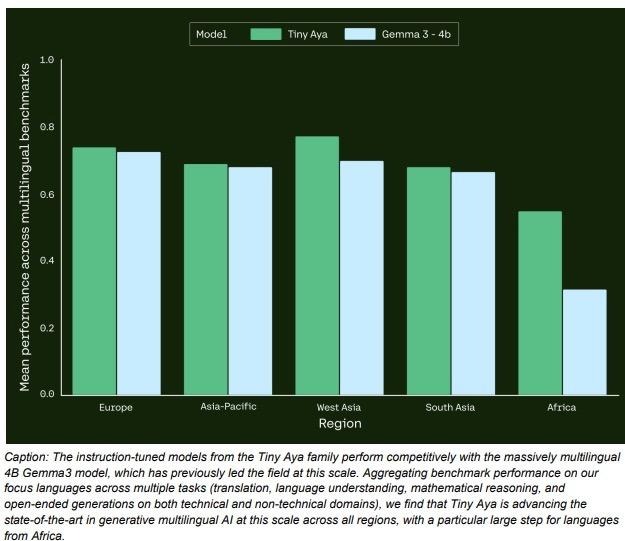
The tiny Aya is a multilingual but engineered and versatile base model. Other regional languages are also supported; like TinyAya-Earth is targeted at African languages.
Similarly, TinyAya-Fire focuses on the South Asian language group, including Hindi, Urdu, Bengali, Punjabi, Gujarati, Tamil, Telugu and Marathi, and TinyAya-Water focuses on the Asia Pacific, West Asia, and European speech areas.
The company said in a statement.
This approach allows each model to develop stronger linguistic grounding and cultural nuance, creating systems that feel more natural and reliable for the communities they are meant to serve. At the same time, all Tiny Aya models retain broad multilingual coverage, making them flexible starting points for further adaptation and research.
Training and Availability
It was trained using a relatively small number of 64 Nvidia H100 GPUs, meaning that it had much lower computational requirements than its competitors and thus allowed developers to come to the resource-limited areas with fewer entry barriers. A technical report and datasets are on the way, and the model is available for free on HuggingFace, Kaggle, and Ollama.
Why Does It Matter ?
In different markets such as India with a population of 1.4 billion speakers of various dialects, the offline system can be used to create applications and chatbots or voice solutions, without requiring constant access to the internet. This strategy should improve better linguistic foundation and culture, increasing the idea of AI communication making it more natural and less robotic, as stated by Coher.
According to CNBC,
the company ended 2025 on a high note, posting $240 million in annual recurring revenue, with 50% growth quarter-over-quarter throughout the year.
Future Impact
Tiny Aya is an example of such a movement to smaller, open-source models that make artificial intelligence more democratic to a subset of under-served languages and outperform more sizable, server-centric models. It is expected to be embraced at a high rate in the emerging markets because most of the world population speaks other non-English languages.
Regional innovations, such as Punjabi e-learning websites or Swahili bots to learn health information might be expected to spring up as a result of anticipated finer-tuning. The proposed approach to efficient training methods on small hardware by Cohere can help create new industry standards of edge AI, forcing large technological companies to become more open.