Indian refiners are settling Russian crude in yuan and dirhams. Iran is charging yuan-denominated tolls at the Strait of Hormuz. BRICS is wiring up alternative payment systems. The petrodollar system — the backbone of US financial hegemony since 1974 — faces its most credible stress test in decades.
In the final week of March 2026, the foundations of dollar-denominated oil trade are fracturing under simultaneous pressure. Indian refiners are settling Russian crude purchases in Chinese yuan and UAE dirhams, bypassing the US dollar entirely, according to Bloomberg. Iran, locked in military confrontation with the United States and Israel since the joint strikes of February 28, has begun charging yuan-denominated transit tolls for oil tankers passing through the Strait of Hormuz — the chokepoint through which roughly 20% of the world’s oil supply normally flows, according to the US Energy Information Administration. And BRICS, now an 11-nation bloc that includes Saudi Arabia, the UAE, and Iran, continues building alternative payment infrastructure through the mBridge cross-border settlement platform.
These are the latest developments in a global shift that has accelerated sharply amid geopolitical tensions. The central question for investors, policymakers, and central bankers: Are these developments wartime anomalies, or do they represent a structural erosion of US dollar dominance in energy markets?
What Is De-Dollarization?
De-dollarization is the deliberate reduction of the US dollar’s role in international trade, foreign exchange reserves, and financial transactions. Since the Bretton Woods agreement of 1944, the dollar has served as the world’s primary reserve currency. Central banks hold dollars, commodities are priced in dollars, and the global financial system’s plumbing — from SWIFT messaging to correspondent banking — runs predominantly through dollar-denominated channels.
That dominance has been declining. According to the IMF’s COFER database, the dollar’s share of global foreign exchange reserves stood at 57.8% in Q4 2024, down from a peak of 72% in 2001. The Q2 2025 COFER release showed a further sharp decline, with the euro emerging as the primary beneficiary.
Central banks have been aggressively diversifying into gold. The World Gold Council reports that central banks purchased 1,045 tonnes of gold in 2024 — the third consecutive year above 1,000 tonnes, and more than double the 473-tonne annual average from 2010 to 2021. Poland led with 90 tonnes, followed by Turkey (75 tonnes) and India.
What is happening in March 2026, however, is not a gradual reserve rebalancing. It is acute.
BRICS Strategy: Building the Alternative Plumbing
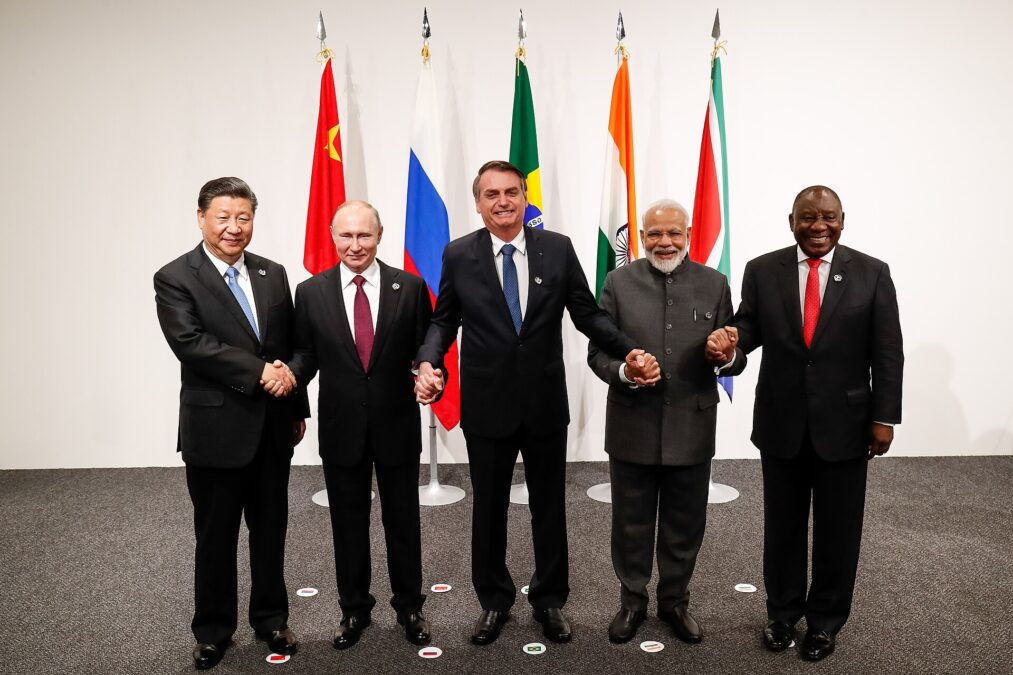
The BRICS bloc — Brazil, Russia, India, China, South Africa, Saudi Arabia, the UAE, Iran, Egypt, Ethiopia, and Indonesia — represents roughly 45% of the world’s population and over 35% of global GDP by purchasing power parity. The addition of Saudi Arabia and the UAE in 2024 gave the bloc direct influence over OPEC dynamics and global oil pricing.
The bloc’s financial infrastructure ambitions center on mBridge, a cross-border central bank digital currency (CBDC) platform originally developed under the Bank for International Settlements (BIS) Innovation Hub with the central banks of China, Thailand, the UAE, and Hong Kong. Saudi Arabia’s central bank joined as a full participant in June 2024, according to CoinDesk.
A critical development: the BIS withdrew from mBridge in late 2024, citing concerns that sanctioned countries — specifically Russia and Iran, both BRICS members — could gain access to the platform. Despite that withdrawal, mBridge has continued operating independently, processing RMB 387.2 billion ($55 billion) in payments, with 95% of transactions denominated in digital yuan, according to Ledger Insights. India, as 2026 BRICS chair, has placed an expanded “BRICS Bridge” interoperability framework on the summit agenda.
China’s Cross-Border Interbank Payment System (CIPS) adds further depth. CIPS processed the equivalent of $245 trillion in yuan-denominated transactions in 2025 — real, operational infrastructure that provides a settlement alternative to dollar-denominated SWIFT channels.
The bloc’s strategy is pragmatic, not revolutionary: build enough parallel infrastructure that the dollar becomes one settlement option among several, rather than the only viable choice.
India’s Rupee-Yuan-Dirham Oil Corridor
India’s currency shift in oil trade is the most consequential de-dollarization development this month. According to Business Standard and Bloomberg, Indian refiners purchased approximately 60 million barrels of Russian crude in March 2026, with similar volumes booked for April. The settlement mechanism: Indian rupees are deposited into special overseas bank accounts held by Russian sellers, then converted into UAE dirhams or Chinese yuan.
Indian Oil Corporation has gone further, making direct yuan payments for two to three Russian crude cargoes — eliminating intermediary currency conversions entirely.
This shift carries particular irony. On February 2, 2026, India signed a trade deal with the United States in which Prime Minister Modi pledged to halt Russian oil purchases in exchange for Trump reducing tariffs from 50% to 18%, according to Al Jazeera and confirmed by a White House fact sheet. Weeks later, after the US Supreme Court ruled Trump lacked authority to impose sweeping tariffs under IEEPA, Indian refiners quietly resumed — and expanded — Russian crude purchases, this time through non-dollar settlement channels.
Russia’s preference for yuan over rupees reveals a structural reality. Moscow runs a massive trade surplus with India, and accepting rupees would mean accumulating a currency with limited international purchasing power. Yuan converts to rubles in a single step and purchases Chinese goods directly — practical utility that rupees cannot match.
Brent crude reached $108.01 per barrel on March 27, up more than 40% since the US-Iran conflict began, according to Trading Economics. The $12.45 Brent-WTI spread reflects the acute premium global buyers are paying for waterborne crude while Middle East shipping lanes remain contested.
Deutsche Bank noted this week that the conflict is testing the petrodollar’s role as the settlement currency for global oil trade, with a potential long-term consequence being a shift toward the yuan.
Iran’s Hormuz Yuan Toll: The Most Direct Challenge Yet
The most provocative development centers on the Strait of Hormuz. Since the US-Israeli strikes on Iran beginning February 28, Iranian forces have effectively controlled transit through the strait. Tehran declared the waterway closed on March 4, and daily ship transits plummeted from approximately 110 to fewer than 10, according to NBC News.
What Tehran is doing goes beyond conventional wartime disruption. It is conditioning access to the world’s most critical energy chokepoint on currency denomination.
Lloyd’s List Intelligence confirmed that the IRGC has imposed a controlled corridor between the islands of Qeshm and Larak. Vessels must contact approved intermediaries linked to the IRGC, provide full documentation — ownership, cargo manifests, crew lists, destination — and receive a clearance code before being escorted through. At least two vessels have paid yuan-denominated transit tolls, brokered by a Chinese maritime services company that also handled payment to Iranian authorities.
An Iranian parliament member told Iran International that tolls have reached $2 million per voyage. The legislature is drafting formal legislation to codify these transit fees. Ships from Malaysia, China, Egypt, South Korea, and India have transited the corridor, with at least 20 vessels passing through as of March 23, according to Al Jazeera and Foreign Policy.
If formalized beyond wartime measures, this represents the most significant challenge to the petrodollar system in its 52-year history. Tehran is not proposing bilateral trade in yuan — it is demanding that passage through the world’s most critical oil chokepoint be denominated in Chinese currency.
Nearly 2,000 vessels remain stranded near the strait. Gold has surged above $4,400 as markets price in sustained disruption.
The Petrodollar System: How It Works and Why It Matters
The petrodollar system traces to 1974, when Secretary of State Henry Kissinger and Saudi Crown Prince Fahd signed a framework agreement establishing joint US-Saudi economic and military commissions. The arrangement: Saudi Arabia would price oil exclusively in US dollars and recycle surplus petrodollars into US Treasury securities. In return, Washington provided military protection for the Kingdom’s oil fields.
A secret component of the deal — revealed by Bloomberg in 2016 through a Freedom of Information Act request — committed the US to military aid and equipment in exchange for Saudi investment of oil proceeds in US government debt. By 1975, all OPEC members had agreed to dollar-denominated oil pricing.
This created a self-reinforcing loop: global oil demand generated global dollar demand, which supported the greenback’s value and allowed the United States to finance persistent trade deficits without the currency crises that would afflict other nations. The petrodollar is not merely an energy arrangement — it is the structural foundation of American financial hegemony.
Until 2023, nearly all global oil trade in yuan or other non-dollar currencies was negligible. By 2023, roughly one-fifth of oil transactions had shifted to alternative currencies. The trajectory in 2026 suggests that ratio is accelerating under wartime pressure.
Symbolic Gestures or Structural Shift?
This is the critical analytical question. Currency dominance does not collapse in a single quarter — it erodes over decades. The British pound’s transition from the world’s reserve currency to a secondary player took approximately 30 years, from the 1920s to the 1950s.
Several factors suggest the current de-dollarization moves carry structural weight beyond wartime improvisation:
The infrastructure exists. CIPS, mBridge, and over 40 bilateral yuan swap lines provide settlement alternatives that were not operationally viable five years ago. China settles roughly half of its foreign trade in yuan, according to People’s Bank of China data.
The motivation exists. Washington’s increasing use of sanctions as a geopolitical weapon — freezing $300 billion in Russian central bank reserves in 2022, restricting Iran’s access to SWIFT — has given dozens of nations a practical incentive to build dollar alternatives. As Russian President Vladimir Putin argued at the October 2024 BRICS summit, the US has “weaponized” the dollar.
The scale is growing. India’s March 2026 oil settlement volumes in yuan and dirhams are not token transactions. Sixty million barrels per month represents meaningful throughput for alternative settlement rails.
Counterbalancing forces are real, though. Analysts quoted by the South China Morning Post note that even Chinese observers urge caution. Iran’s Hormuz toll is a wartime measure, not a peacetime trade framework. Operational feasibility and security risks limit scalability. And China has reason to move carefully — a direct challenge to the petrodollar strains Beijing’s relationship with Washington at a time when trade tensions are already elevated.
Market and Economic Implications
The immediate market impact is visible across asset classes. US equity markets have entered correction territory, with the Nasdaq falling sharply as rising oil prices compress consumer margins and corporate earnings. Bitcoin has declined to $68,888 as risk appetite evaporates, while gold — the ultimate non-dollar reserve asset — has climbed to record levels above $4,400.
The DXY dollar index has weakened as markets digest the possibility that energy trade diversification could structurally reduce demand for greenbacks. Goldman Sachs has characterized current oil pricing as carrying “a geopolitical risk premium over fundamentals,” with OECD crude inventories at critically low levels.
Inflation implications are significant. A weaker dollar means higher import costs for American consumers, potentially complicating Federal Reserve monetary policy at a time when energy-driven inflation is already resurgent. The IEA’s March 2026 Oil Market Report flags sustained supply disruption as a key risk to global price stability.
The Geopolitical Power Shift
De-dollarization is inseparable from the broader realignment toward a multipolar world. China’s role as the architect of alternative financial infrastructure — CIPS, the Belt and Road Initiative, yuan swap lines with over 40 central banks — positions Beijing as the primary beneficiary of sustained erosion in dollar hegemony.
Energy-driven alliances are reshaping the global order. Russia supplies discounted crude to India and China. Iran leverages its geographic control of Hormuz to advance yuan adoption. Saudi Arabia — historically Washington’s most critical Middle Eastern ally — now sits within BRICS and participates in mBridge. These are not random bilateral arrangements. They form an emerging network of energy-based financial relationships operating partially outside the dollar system.
Why the Dollar Is Not Dead Yet
The counterarguments deserve serious weight — and the data supports them strongly.
The BIS 2025 Triennial Central Bank Survey — the most comprehensive measure of global currency usage — found the US dollar was on one side of 89.2% of all foreign exchange transactions in April 2025, up from 88.4% in 2022. Global FX trading hit $9.6 trillion per day, and the dollar’s share actually increased. The renminbi’s share rose to 8.5% — meaningful growth, but still a fraction of the dollar’s dominance.
No alternative currency matches the dollar’s liquidity, the depth of US capital markets, or the legal and institutional trust underpinning dollar-denominated assets. The US Treasury market remains the world’s deepest and most liquid sovereign debt market. The yuan faces fundamental constraints: China maintains capital controls that limit free convertibility, and foreign investors cannot freely move capital in and out of Chinese markets.
BRICS itself lacks strategic unity. India’s February 2026 trade deal with the US — followed weeks later by resumed Russian oil purchases through non-dollar channels — illustrates the bloc’s internal contradictions. BRICS nations have explicitly stated they are not pursuing a common currency. Russia confirmed in January 2026 that talks on a unified currency “have not taken place and are not taking place now.” Brazil, the current BRICS president, echoed that position.
As Brad Setser of the Council on Foreign Relations has noted, coercing countries to use the dollar through tariff threats could actually accelerate de-dollarization — a paradox Washington has not resolved.
Currency dominance is not lost overnight. But it can erode if the incentive structures shift permanently.
What Happens Next
The Strait of Hormuz crisis could function as a tipping point — not because Iran’s wartime toll creates a permanent yuan settlement system, but because it demonstrates that alternatives to dollar-denominated energy trade are operationally viable under pressure.
Key watchpoints:
April 11: India’s US waiver for Russian oil purchases expires. Whether non-dollar settlement channels prove durable without American permission will test the infrastructure’s resilience.
2026 BRICS Summit (India): The mBridge/BRICS Bridge interoperability agenda will signal whether cross-border CBDC settlement advances from pilot to operational scale.
IMF COFER data: The next release will reveal whether central banks accelerated reserve diversification away from dollars during Q1 2026’s geopolitical upheaval.
US policy response: President Trump has threatened 100% tariffs on BRICS nations attempting to replace the dollar — a threat he reiterated in February 2025 when he declared “BRICS is dead.” Whether coercion strengthens or undermines the dollar’s position long-term remains an open question. The Peterson Institute for International Economics projects such tariffs would harm both US and targeted economies through slower growth and higher inflation.
Ceasefire negotiations: Washington has delivered a 15-point ceasefire proposal to Iran through Pakistani intermediaries. Iran’s five conditions include international recognition of its authority over the Strait of Hormuz — a demand that, if met, would formalize Tehran’s leverage over global oil transit.
While the dollar’s dominance remains intact for now, the foundations of the petrodollar system may be facing their most serious test in decades. The question is no longer whether alternatives to dollar-denominated oil trade exist — they demonstrably do. The question is whether they will scale beyond wartime necessity into peacetime infrastructure.
This is a developing story as global trade dynamics continue to evolve.