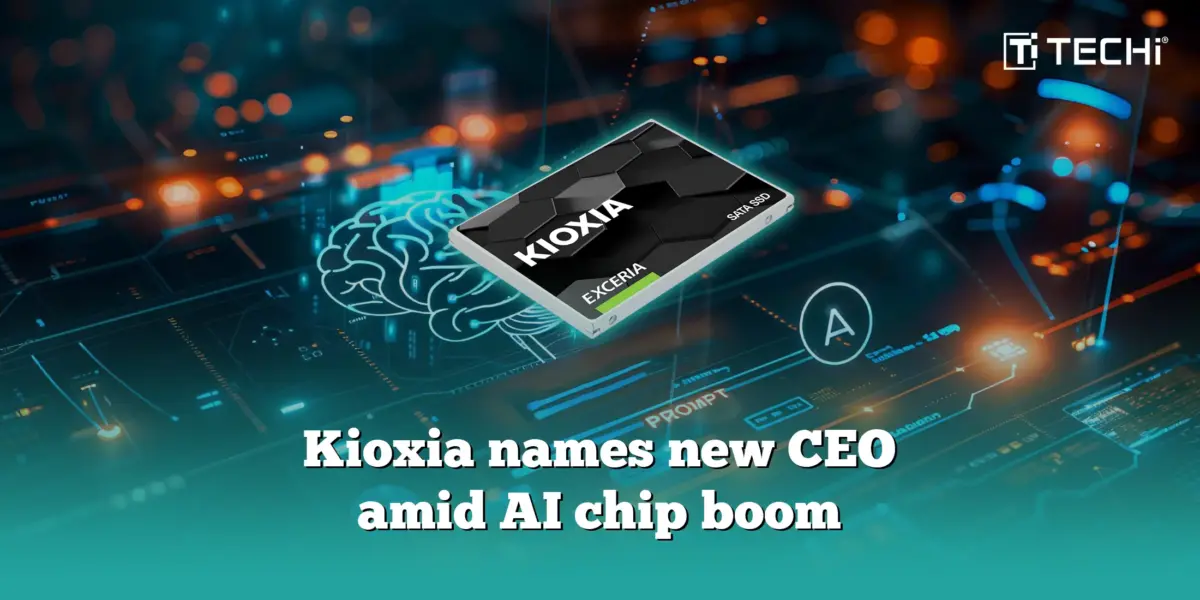
Japanese semiconductor conglomerate Kioxia has proceeded with a major executive restructuring, replacing the chief executive of the company with long-time executive Hiroo Oota.
This reversal represents the heightened focus by the company on realizing its potential market in the growing artificial intelligence (AI) memory market, which was accompanied by the entrance of the semiconductor industry as a whole into a new golden era.
AI Fuels Memory Chip Frenzy 🔗
The world memory market is now in a supply shrink, and the demand of dynamic random-access memory (DRAM) and need-flash expedited by hyperscalers and cloud service providers in its attempts to create AI data centers has surged.
Analysts of Omdia estimate that the price of DRAM can grow by approximately 120% in 2026, compared with a higher growth of NAND by about 90 %, and inventory levels will continue to be low versus the AI-related demand.
Kioxia’s leadership shake-up 🔗
Kioxia, the leading producer of NAND flash memory, solid-state drives (SSDs), will have a new president and chief executive officer, Hiroo Ota, a veteran of its memory unit, who will replace the current president, Nobuo Hayasaka.
The long-term experience Oota offers in leading the memory business, and his recent appointment as an executive vice president makes him a proponent who can further increase the enterprise and server SSD concentration where AI loads are increasing the average selling prices (ASPs) and raising profit margins.
This has been repositioned in a wider industry trend, where even the internal management of Kioxia has recognized that even the supply of NAND flash active in 2026 is generally sold out, highlighting the current tightness and bargaining power in the marketplace.
How Investors Are Reacting And Future Outlook 🔗
Memories manufacturers seem to be being rewarded by the equity markets. SK Hynix has risen more than 7% in early 2026 stock trading sessions, and the stocks of Texas Instruments and Seagate have also recorded strong gains in pre-market, which is an indication of additional investor confidence in the AI enhancements in the data centre expansion.
The change of the CEO at Kioxia is not just a succession process; this is a strategy to keep up with the wave of AI. With the rise of HBM, server DRAM and AI-optimized SSDs as the most profitable areas.
Kioxia is already setting to gain a larger portion of high-value demand, as a supplier with less specialized NAND no longer, but as a strategic AI infrastructure provider.