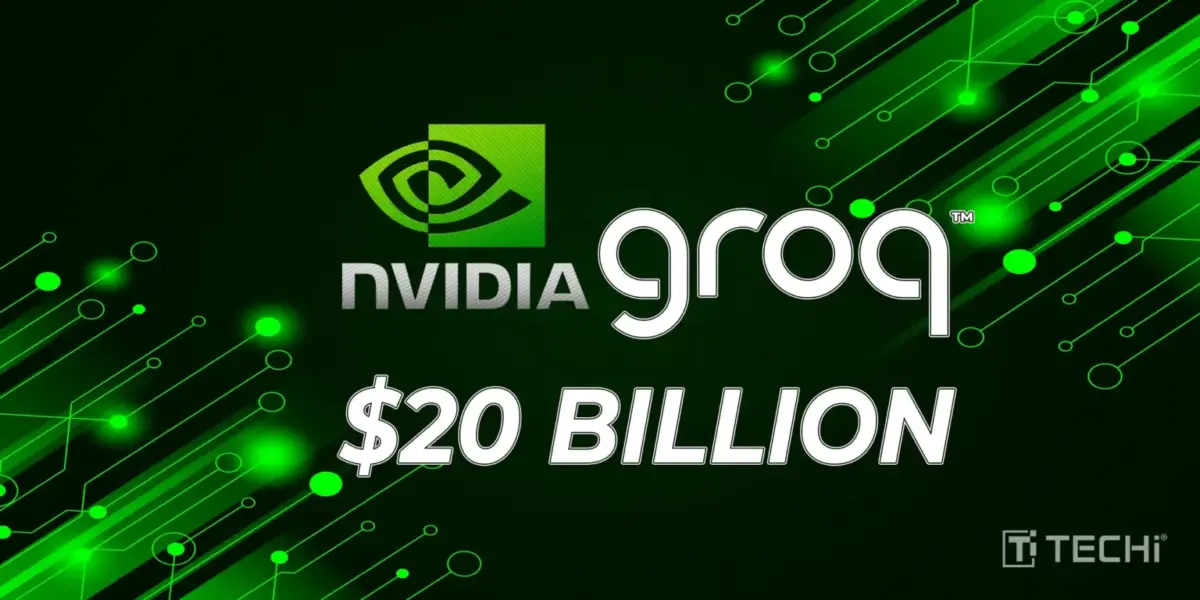
The deal that the chip giant Nvidia publicly revealed with Groq was to bolster its position in artificial intelligence, but it has somehow triggered confusion among the analysts who are unable to make sense of the partnership’s strategic logic. On Wednesday, Nvidia got into a non-exclusive licensing contract with Groq to utilize its inference technology.
Initially, the news gave the impression that Nvidia was expanding its empire of AI, but D.A Davidson’s analyst Alex Platt was not convinced. In a note written on Friday, Platt confessed that he was having a hard time seeing the rationale and he even doubted whether Nvidia’s reasons were technological, strategic or just defensive.
Where is the Advantage for Nvidia?
The fundamental reason for the doubt is Groq’s hardware potential. As per the D.A. Davidson report, the chip of Groq’s present generation has an SRAM of only 230MB, which according to the analysts is “incredibly low” given that Nvidia’s HGX B300 chip possesses 288GB of HBM3E memory. The difference between them is very significant and not minor at all.
The small memory capacity has led Platt to argue that Groq’s chips are restricted to a very small part of inference workloads. Thus, the technology is not suitable for the high-end AI models that are likely to appear next year, and many of them will require several terabytes of memory to function properly.
So, from that point of view, Groq doesn’t look so beneficial to Nvidia in moving ahead in the technical area.
Non-Exclusive Deal With a High Price Tag
The nature of the agreement has sort of increased the confusion. Nvidia is not taking over Groq, nor is it getting the rights to its technology. Rather, the deal permits Nvidia to license Groq’s inference technology, while Groq goes on running its business.
Not just founder Jonathan Ross and president Sunny Madra, but also several Groq executives will move to Nvidia, while the startup itself progresses with the newly appointed CEO Simon Edwards.
Furthermore, despite no exclusivity, various reports claim that the deal could be worth $20 billion in cash. That alone has put analysts in a position to doubt what Nvidia really is getting in return.
Technology Gap or Strategic Insurance?
Analysts at D.A. Davidson had a hard time finding a strong technological explanation. It seems that Groq’s chips will be very effective in some inference tasks like prefill operations, but Nvidia has another generation of its solution coming into the market with Rubin CPX. This makes the argument that how Groq can fill any critical gap in Nvidia’s journey.
All this has led to the thought that the action might be defensive rather than innovative. Platt pointed out that Nvidia’s competitive threats are not that extensive at the moment, and mentioned Google as the only competitor that Nvidia should really pay attention to in the short run.
So in that sense, licensing Groq’s technology could be more about having options than about being in a situation where one cannot help but act.
Bottom Line
Nvidia has always been very clear about its reputation, which is built on strategic clarity, technological leadership, and almost perfect execution. That is just the reason why this deal is so different.
When analysts who are usually the first to point out Nvidia’s excellent aspirations admit that they are confused, it is an indication that this agreement has not easily found a place in the company’s very disciplined AI strategy.
The Groq deal may eventually make sense with time, specifically in an AI market that is evolving fast. However, for the time being, Nvidia’s move looks strangely unclear for a company that is known for its sound and well-communicated strategy.
Until the advantages are more evident, the deal will be one of the rare occasions where Nvidia’s ambiguity has been a disadvantage.