

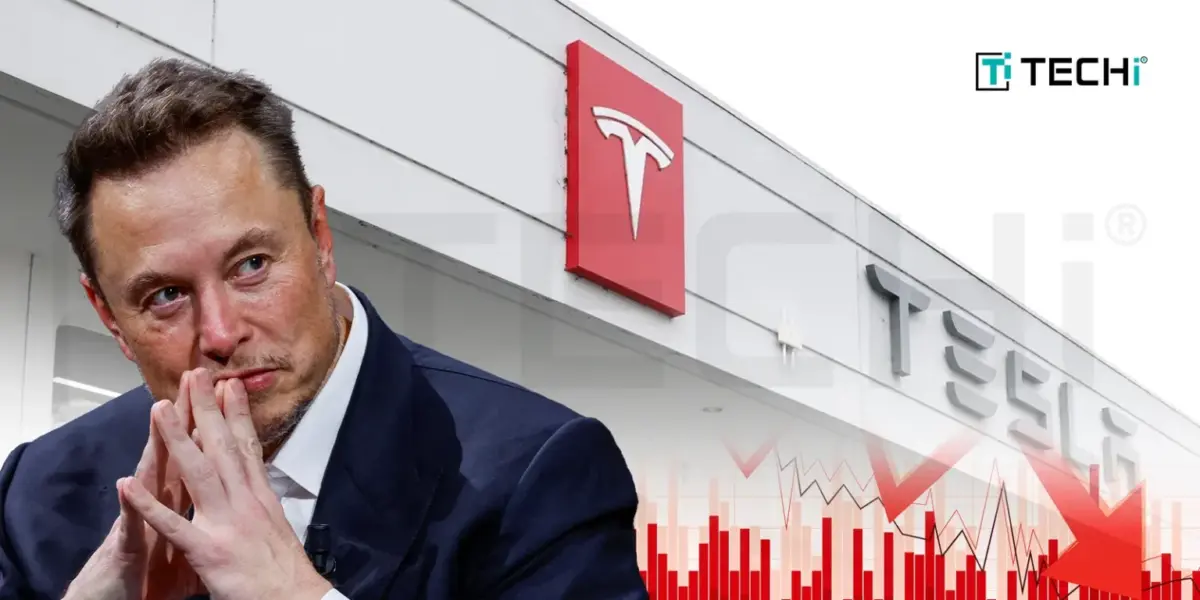
Tesla closed at $381.26 on Wednesday, April 1, 2026, up 2.56% on the session as Q1 delivery fears collided with HSBC’s devastating price target cut to $119. The stock is now 25% below its December all-time high of $498.83, yet still up roughly 58% from the April 2025 trough near $214. With Cybercab production set to begin in April, Q1 deliveries due April 2, and earnings on April 28, the next five weeks could define Tesla’s trajectory for the rest of the year.
Key Takeaways
Why TSLA Dropped 2.8% on March 26
Three forces converged to push Tesla shares from an opening of $381.60 down to a close of $372.11. First, HSBC slashed its price target from $133 to $119 (the lowest among major banks) warning that Tesla’s core automotive business faces structural erosion from BYD and that FSD remains commercially unproven at scale. At current levels, HSBC’s target implies a 68% downside.
Second, growing anxiety around Q1 deliveries weighed on sentiment. UBS trimmed its forecast to roughly 345,000 units, 7% below the 365,645 consensus, while Polymarket bettors assigned a 63.5% probability that Q1 deliveries will land below 350,000. If realized, that would represent a meaningful miss against a quarter that was already expected to be seasonally soft.
Third, the broader market traded lower amid renewed Middle East tensions. Oil prices spiked above $112 per barrel on Strait of Hormuz escalation, dragging risk assets down across the board. Tesla’s 1.91 beta means it amplifies market moves in both directions.
Tesla Stock Snapshot, March 28, 2026
| Metric | Value |
| Previous Close | $381.26 |
| Market Cap | $1.44 Trillion |
| P/E Ratio (TTM) | 346x |
| EPS (TTM) | $1.08 |
| 52-Week High | $498.83 (Dec 22, 2025) |
| 52-Week Low | $214.25 (Apr 7, 2025) |
| YTD Change | -15.4% |
| Short Interest | $16.67B (most shorted U.S. stock) |
| Next Earnings | April 28, 2026 |
| Q1 Delivery Report | April 2, 2026 |
| Analyst Consensus | Hold (19 Buy, 13 Hold, 9 Sell) |
| Price Target Range | $119 – $600 |
Terafab Changes the Game
The biggest development since our last update: on March 21, Elon Musk unveiled Terafab, a $25 billion chip fabrication facility that represents a joint venture between Tesla, SpaceX, and xAI. The Austin-based facility will target 2-nanometre process technology, with Tesla’s fifth-generation AI chip (AI5) among the first products. Small-batch production is expected in late 2026, with volume production projected for 2027.
Musk framed the move as defensive: Tesla needs proprietary chip manufacturing to avoid a supply constraint that he projects will materialize within three to four years. The facility targets 100 to 200 billion chips annually, a staggering ambition that, if realized, would position Tesla as a vertically integrated AI hardware company, not just a carmaker.
The market reaction was mixed. Bulls see this as the kind of first-principles manufacturing play that made Tesla’s Gigafactories so disruptive. Barclays cautioned that Terafab and other AI initiatives could prove “very expensive” and dilute near-term profitability. For a company already burning through roughly $8 billion in near-term cash, the timing is aggressive.
Q1 2026 Delivery Consensus: 365,645 Vehicles
Tesla published its company-compiled Wall Street consensus for Q1 2026 on March 26: 365,645 vehicles, comprising 351,179 Model 3/Y units and just 13,946 units across Model S, X, and Cybertruck. Analysts also expect Tesla to deploy 14.4 GWh of energy storage this quarter.
That 365K consensus represents an 8% increase from Q1 2025’s dismal 336,681, but that comparison flatters Tesla, since Q1 2025 was suppressed by Model Y production line shutdowns across all four factories for the Juniper refresh. The more telling comparison is Q4 2025’s 418,227 deliveries, against which Q1 2026 would mark a 12.6% sequential decline.
The full-year 2026 delivery consensus sits at 1,689,691 vehicles, just 3.3% growth from 2025. For a company valued at $1.4 trillion, that anemic growth rate is the core tension driving the bull-bear debate.
FSD Breakthroughs in Europe
Two positive signals emerged from Europe this month. Tesla’s European registrations rose 11.8% year-over-year in February, snapping a thirteen-month consecutive decline. The refreshed Model Y appears to be reversing the anti-Musk sentiment that crushed European sales through most of 2025.
More importantly, Tesla is reportedly closing in on landmark European approval for FSD Supervised, potentially starting in the Netherlands next month. Amendments to UN R-171 adopted in 2025 now permit hands-free highway lane changes and other automated features, clearing the technical barriers that had blocked Tesla’s advanced driver assistance in the EU. Tesla’s European ride-along program has logged over 13,000 rides since late 2025.
If FSD launches commercially in Europe, it opens a revenue stream that currently generates zero from a market of over 2 million Tesla vehicles on European roads.
What Analysts Are Saying Right Now
The analyst community has rarely been this fractured on a single stock. Across 41 analysts tracked by MarketBeat, the composite rating is Hold with a median 12-month target of $458 and an average of $397.
The bulls: Wedbush’s Dan Ives maintains a $600 target, arguing Tesla could hit a $2 trillion market cap by mid-2026 in a bull case. New Street Research’s Peter Vogel also targets $600, citing robotaxi expansion and Cybercab production catalysts. Stifel carries $508, the highest among traditional sell-side firms. RBC keeps Outperform at $500.
The bears: HSBC’s latest $119 target (cut from $133 on March 20) is the most extreme on the Street, implying Tesla’s entire AI/robotaxi premium is unjustified. Wells Fargo projects 69% downside from current levels. GLJ Research recently downgraded to Sell at $25.28, citing an expanded federal safety probe into FSD.
The middle ground: Morgan Stanley holds Equal Weight at $415, essentially saying the stock is fairly valued. Barclays sits at $360 with an Equalweight rating, calling the risk/reward balanced.
The Bull Case: Why TSLA Could Surge Past $500
Cybercab production starts in April. Musk confirmed at the 2025 Annual Meeting that Cybercab manufacturing begins at Giga Texas in April 2026 using Tesla’s patented Unboxed manufacturing process. The two-door autonomous coupe (with no steering wheel or pedals) targets one unit every ten seconds at full production. Musk warned the initial ramp will be “agonizingly slow,” but the first units rolling off the line transforms Cybercab from concept to reality.
Terafab creates a vertical moat. If Tesla can fabricate its own AI chips at 2nm, it breaks free from TSMC dependency and positions itself alongside Apple and Intel as one of the few companies with captive semiconductor manufacturing. That’s a structural competitive advantage no other automaker can replicate.
Energy storage keeps compounding. The energy segment now represents 13.5% of total revenue at roughly 30% gross margins, more than double the core auto segment’s margins. Megapack demand shows no signs of slowing, and this business alone could justify a significant portion of Tesla’s market cap.
European FSD approval unlocks a new revenue stream. Over 2 million Tesla vehicles are on European roads generating zero FSD subscription revenue. Even modest penetration at $99/month represents billions in high-margin recurring revenue.
The Bear Case: What Could Send TSLA Below $250
346x P/E defies all automotive logic. At a trailing P/E of 346 and forward P/E of roughly 180x, Tesla is priced as if robotaxi, Optimus, energy, and chip manufacturing will all scale flawlessly. History suggests otherwise — every single Musk timeline has slipped by months or years. If Q1 deliveries miss badly and earnings disappoint in April, the valuation premium could compress rapidly.
BYD isn’t slowing down. BYD surpassed Tesla as the world’s leading EV brand in 2025 with 2.26 million units, and its margins are improving while Tesla’s deteriorate. The competitive pressure in both China and Europe is structural, not cyclical.
Terafab is a $25 billion bet with no guaranteed payoff. Semiconductor fabrication at 2nm is among the most technically challenging endeavors in manufacturing. Intel spent $20 billion on foundry ambitions and is still struggling. Tesla is attempting this while simultaneously launching Cybercab, expanding robotaxi, building Optimus, and growing energy storage — all from negative free cash flow.
Regulatory risk remains. California denied Tesla’s robotaxi application in February 2026. The Cybercab’s pedal-less design requires federal exemptions Tesla hasn’t yet applied for. NHTSA’s expanded FSD safety probe could lead to restrictions that delay the autonomous revenue thesis by years.
What to Watch This Week
April 2: Q1 2026 delivery report — the most important near-term catalyst. The 365,645 consensus is the line in the sand. Anything below 350K could trigger a sell-off; above 370K would likely spark a relief rally.
April 2026: First Cybercab units off the Giga Texas production line. Even at low volumes, physical Cybercabs will shift the narrative from “concept” to “product.”
April 28: Q1 2026 earnings. The consensus EPS estimate is $0.41 (range $0.22–$0.67). Guidance on Terafab timeline, robotaxi expansion cities, and Cybercab production ramp will matter more than the headline numbers.
Mid-2026: SpaceX IPO at a roughly $1.75 trillion valuation. While technically separate from Tesla, it will test whether the market can absorb another Musk-led mega-cap, and success could bolster confidence in Terafab’s cross-entity strategy.
For the full deep-dive analysis with historical financials, BYD competition data, and detailed valuation comparisons, see our comprehensive Tesla Stock (TSLA) Investment Guide.
What is the Tesla stock price today?
Tesla (TSLA) closed at $381.26 on Wednesday, April 1, 2026, up 2.56% on the session. The stock is down 13.3% year-to-date and 24% below its all-time high of $498.83 reached in December 2025. Tesla’s market cap stands at approximately $1.44 trillion.
Why did Tesla stock drop on March 26?
Three factors drove the decline: HSBC cut its price target from $133 to $119 (the lowest on Wall Street) citing weakness in Tesla’s core auto business. Growing fears around Q1 delivery numbers (UBS forecasts 345K vs. the 365K consensus) added pressure. Broader market weakness from Middle East oil price spikes also weighed on risk assets.
When does Tesla report Q1 2026 deliveries?
Tesla is expected to release its Q1 2026 delivery and energy deployment numbers on April 2, 2026. The Wall Street consensus is 365,645 vehicles. Q1 2026 earnings are scheduled for April 28, 2026, with a consensus EPS estimate of $0.41.
What is Terafab and how does it affect Tesla stock?
Terafab is a $25 billion chip fabrication joint venture between Tesla, SpaceX, and xAI, announced on March 21, 2026. The Austin-based facility will produce 2-nanometre AI chips, starting with Tesla’s AI5 chip. Bulls view it as a vertical integration moat; bears warn it’s an expensive distraction from near-term profitability challenges.
Is Tesla stock a buy right now?
Wall Street is deeply divided. The consensus rating across 41 analysts is Hold, with price targets ranging from $119 (HSBC, Reduce) to $600 (Wedbush and New Street Research, Buy). The median target of $458 implies roughly 20% upside from current levels. The next five weeks — Q1 deliveries on April 2, Cybercab production start, and Q1 earnings on April 28 — will be critical catalysts.
Disclaimer: This article is for informational purposes only and does not constitute investment advice. TECHi and its authors may hold positions in securities mentioned. Always conduct your own research or consult a licensed financial advisor before making investment decisions. Data sourced from Tesla IR, SEC filings, and analyst reports as of March 28, 2026.