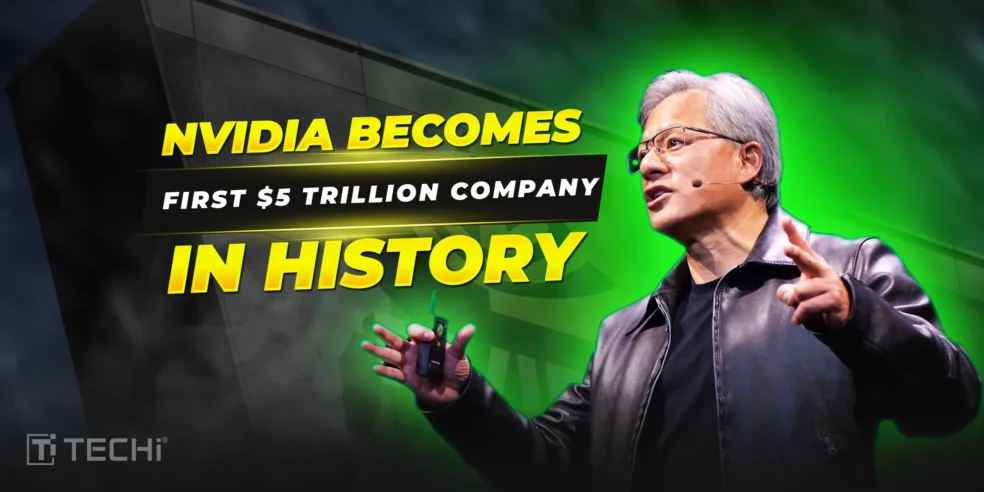
Nvidia (NVDA) has transformed from a gaming GPU company into the $4.5 trillion backbone of the AI revolution. With FY2026 revenue of $215.94 billion, a $78 billion Q1 FY2027 guidance that crushed expectations, and 37 analysts rating it a Strong Buy, Nvidia stock remains the most consequential investment story of the decade. This guide breaks down the numbers, the chip roadmap, what Wall Street is saying, and whether NVDA belongs in your portfolio right now.
NVDA Quick Glance: Key Metrics 🔗
| Metric | Value |
|---|---|
| Current Price | ~$182 |
| Market Cap | ~$4.5 Trillion |
| FY2026 Revenue | $215.94B (+65% YoY) |
| FQ1 FY2027 Guidance | $78B (beat $72.6B consensus) |
| Analyst Consensus | Strong Buy (37 analysts) |
| Avg Price Target | $264 (range $200–$352) |
| P/E Ratio | ~55x forward |
| Gross Margin | ~73% (non-GAAP) |
| Data Center Revenue | $51.2B/quarter (+66% YoY) |
Nvidia’s Unstoppable Rise: From Gaming GPUs to AI Empire 🔗
Nvidia was associated with graphics cards hugely popular among the gaming community only a few years back. Nowadays, it powers the data centers that drive AI, cloud computing, scientific research, and autonomous systems to their deepest levels. The company’s GPUs, once designed to render better visual effects for gamers, are now the foundational hardware for virtually all AI computing on the planet.
The scale of Nvidia’s ascent is staggering. Its share price has climbed more than 1,100% since the start of 2023, and in 2025 it became the first publicly traded company to breach a $4 trillion market capitalization, surpassing Apple and Microsoft to claim the throne. Nvidia’s market cap has not only outpaced individual global indexes such as the UK’s FTSE, France’s CAC, and Germany’s DAX — it has surpassed the combined total of all three.
CEO Jensen Huang’s vision has been the driving force behind this transformation. Under his leadership, Nvidia pivoted from a chip company into the central infrastructure provider for the AI economy. Every major cloud provider, every leading AI lab, and virtually every Fortune 500 company building AI capabilities relies on Nvidia’s technology stack. It is no longer simply a company; it is a pillar of the new economy.
The Journey: Key Stock Milestones 🔗
Nvidia’s stock trajectory over the past three years reads like a highlight reel of financial history. Understanding the key milestones helps frame just how rapidly the company has ascended — and how much of that ascent has been driven by tangible business results rather than speculation.
In January 2023, Nvidia shares traded at approximately $15 on a split-adjusted basis. The AI boom was just beginning to gather steam, with ChatGPT’s November 2022 launch igniting public awareness of large language models. Few investors at the time recognized that Nvidia’s GPU architecture would become the essential infrastructure behind every major AI breakthrough to follow.
By May 2023, everything changed. Nvidia reported blowout Q1 FY2024 earnings that stunned Wall Street — revenue guidance came in 50% above consensus estimates. The stock surged over 25% in a single after-hours session, and within weeks Nvidia became the first semiconductor company to reach a $1 trillion market capitalization. The AI investment thesis had gone from theoretical to indisputable.
The momentum continued relentlessly. In February 2024, Nvidia surpassed Amazon to become the fourth most valuable publicly traded company in the world. Each successive earnings report delivered results that exceeded already-elevated expectations, fueling a self-reinforcing cycle of institutional buying and analyst upgrades.
The summer of 2024 marked a historic peak. In June 2024, Nvidia briefly overtook both Microsoft and Apple to claim the title of the world’s most valuable company. That same month, the company executed a 10-for-1 stock split, making shares more accessible to retail investors and triggering a fresh wave of buying interest. As our coverage of how Nvidia stock outpaced Micron amid surging AI demand detailed, the stock’s momentum reflected real business fundamentals rather than mere sentiment.
In October 2025, Nvidia achieved yet another landmark: it became the first company in history to reach a $5 trillion market capitalization. While the stock has since pulled back from that peak, as of March 2026 Nvidia trades at approximately $182 per share with a market cap of roughly $4.5 trillion — still larger than the GDP of every country on earth except the United States and China.
The Numbers That Matter: FY2026 Financial Performance 🔗
Nvidia has kept up with its breathtaking trajectory, reporting quarter after quarter of much better-than-expected revenues, negating cynics each time. In fiscal year 2026, the company posted total revenue of $215.94 billion, representing 65% year-over-year growth that would have seemed impossible just two years prior. For context, FY2025 revenue was $130.5 billion — itself more than double the previous year’s figure.
The data center segment remains the undisputed growth engine. In FQ4 FY2026, data center revenue reached $51.2 billion — up 66% year-over-year and 25% quarter-over-quarter. This single segment now dwarfs what most Fortune 500 companies generate in total annual revenue.
Revenue Breakdown by Segment 🔗
While the Data Center division captures the lion’s share of attention, Nvidia’s business spans four distinct segments, each contributing to the company’s financial profile in different ways.
Data Center is by far the dominant revenue contributor, generating $51.2 billion in quarterly revenue in FQ4 FY2026. To put this in perspective, Nvidia’s data center revenue in a single quarter exceeds Intel’s entire quarterly revenue of approximately $14 billion. The segment has grown at a compound rate that has fundamentally reshaped the semiconductor industry’s competitive landscape.
Gaming, Nvidia’s original business, continues to generate meaningful revenue through GeForce GPUs and related products. While no longer the growth engine, the gaming segment provides a stable revenue base and serves as a technology pipeline for data center innovations.
Automotive and Robotics is the fastest-growing segment on a percentage basis, with revenue reaching $567 million in Q1 — a 73% year-over-year increase. Nvidia’s DRIVE platform for autonomous vehicles and its Isaac robotics platform are positioning the company for the next wave of AI-powered physical systems.
Professional Visualization serves enterprise customers using Nvidia GPUs for design, simulation, and digital twin applications. While smaller in absolute revenue, this segment benefits from the same GPU architecture investments that drive the data center business.
Cash Flow and Capital Returns 🔗
Looking ahead, management’s Q1 FY2027 guidance of $78 billion blew past the $72.6 billion Wall Street consensus, signaling that the demand acceleration shows no signs of plateauing. Analysts project earnings per share of approximately $8.00 for FY2027, $9.98 for FY2028, and $11.94 for FY2029 — a trajectory that, if realized, would justify much of the current premium valuation.
Non-GAAP gross margins have remained exceptionally strong in the 72-73% range, aided by demand for newer, more efficient architectures. The company generated $13.5 billion in free cash flow in a single quarter and repurchased $14.1 billion of its own stock in Q1, demonstrating management’s confidence in the road ahead. Nvidia’s balance sheet holds $37.6 billion in cash and short-term investments, providing ample flexibility for R&D investment, acquisitions, and continued shareholder returns. For investors tracking Nvidia’s financial trajectory, the trillion-dollar AI chip demand story continues to play out in the earnings reports.
Blackwell, Vera Rubin, and the Chip Roadmap 🔗
Nvidia’s competitive moat extends far beyond current products — it lies in the relentless pace of its innovation roadmap. The company has solidified its dominance in the field of AI computing, and the strength of its product pipeline is beyond parallel.
The Blackwell GPU architecture represents Nvidia’s current crown jewel. Built using a custom TSMC 4NP process with approximately 208 billion transistors per chip, Blackwell GPUs use a high-bandwidth interconnect to link two large dies, dramatically improving speed and data throughput. The architecture includes updated transformer engines optimized for large language models, significant improvements for both inference and training workloads, and features specifically designed to reduce energy consumption.
Manufacturing is already scaling aggressively. Blackwell GPUs are being produced at TSMC’s new Arizona facility as well as Foxconn’s expanded operations in Mexico, diversifying the supply chain away from pure Taiwan dependence. Jensen Huang has stated that the total revenue opportunity from the current AI infrastructure buildout exceeds $1 trillion, with a $500 billion order backlog already in place.
Looking further ahead, Nvidia has already shipped samples of its next-generation Vera Rubin architecture, and announced the Feynman generation beyond that. At GTC 2025, the company also introduced Blackwell Ultra (B300 series) with higher memory, improved interconnects, and PCIe 6.0 support. This multi-year product visibility is critical — investors reward not only current performance but credible future roadmaps. For more on the chip supply dynamics, see our coverage of Nvidia’s TSMC capacity allocation and Vera Rubin chip development.
The CUDA Moat: Why Switching Costs Protect Nvidia 🔗
Hardware performance alone does not explain Nvidia’s dominance. The company’s deepest and most durable competitive advantage lies in its software ecosystem — specifically, the CUDA (Compute Unified Device Architecture) platform that has become the standard programming framework for GPU-accelerated computing.
CUDA was launched in 2007 and has since grown into a massive ecosystem with more than 4 million developers trained on the platform. Every major AI framework — PyTorch, TensorFlow, JAX — is optimized first and most thoroughly for CUDA. The result is a network effect that grows stronger with each passing year: as more developers build on CUDA, more applications are optimized for Nvidia GPUs, which attracts more customers, which incentivizes more developers to learn CUDA.
Beyond the core CUDA toolkit, Nvidia has built an extensive library of specialized AI and machine learning frameworks. cuDNN (CUDA Deep Neural Network library) accelerates deep learning primitives. TensorRT optimizes inference performance for deployed models. NCCL (Nvidia Collective Communications Library) enables efficient multi-GPU and multi-node training. Each of these libraries represents years of engineering investment and optimization that competitors cannot simply replicate overnight.
The switching costs for Nvidia’s customers are enormous. Enterprise AI teams have invested hundreds of thousands of engineering hours building, testing, and optimizing their workflows on CUDA. Migrating to an alternative platform — whether AMD’s ROCm or Intel’s oneAPI — would require rewriting code, revalidating models, and retraining engineers, all with no guarantee of equivalent performance. As ByteDance’s massive Blackwell GPU orders for its Malaysia AI infrastructure demonstrate, even companies with the resources to explore alternatives continue to choose Nvidia.
AMD’s ROCm platform has made meaningful progress in recent years and now supports many popular AI frameworks. However, the ecosystem remains years behind CUDA in maturity, with gaps in library support, debugging tools, and community resources. Intel’s oneAPI faces similar challenges, compounded by the company’s struggles to deliver competitive GPU hardware. For the foreseeable future, CUDA’s ecosystem lock-in remains one of the most powerful competitive moats in the technology industry.
The AI Infrastructure Boom: $700 Billion in Hyperscaler Spending 🔗
No one has taken advantage of the artificial intelligence revolution like Nvidia has. The company’s dominance is fueled not by hype but by the staggering capital commitments that the world’s largest technology companies are making to AI infrastructure.
Alphabet, Amazon, Meta, and Microsoft are collectively spending approximately $700 billion on AI infrastructure. These are not speculative bets — they are long-term capital commitments for data centers, networking equipment, and the GPU clusters that power everything from ChatGPT to enterprise AI applications. For every $50 billion data center that gets built, Nvidia captures roughly $35 billion in revenue.
Hyperscaler Capital Expenditure Breakdown 🔗
The scale of individual hyperscaler commitments underscores the structural nature of this spending cycle. Amazon leads with an announced capital expenditure plan exceeding $100 billion for AI infrastructure over the coming years. Microsoft has committed to over $80 billion in AI data center investments, with a significant portion flowing directly to Nvidia GPU purchases. Alphabet has earmarked approximately $75 billion, while Meta has budgeted $60-65 billion for its AI infrastructure buildout.
Beyond these individual commitments, the Stargate project represents one of the most ambitious AI infrastructure initiatives ever conceived. This multi-hundred-billion-dollar partnership involving OpenAI, Oracle, SoftBank, and others aims to build a new generation of AI data centers across the United States. Nvidia is a key technology partner in Stargate, supplying the GPU clusters that will form the computational core of these facilities. The project reflects a growing recognition that AI computing demands will scale far beyond what existing infrastructure can support.
Sovereign AI: A New Growth Frontier 🔗
A significant and often overlooked growth driver for Nvidia is the emergence of sovereign AI — the trend of nations building their own domestic AI computing infrastructure. Countries including Saudi Arabia, the United Arab Emirates, India, Japan, France, and Canada are investing billions in national AI data centers, and Nvidia’s GPUs are the hardware platform of choice for virtually all of these projects.
Sovereign AI spending is driven by national security concerns, economic competitiveness, and the desire to reduce dependence on foreign computing infrastructure. For Nvidia, this represents a diversification of revenue beyond the traditional hyperscaler customer base. As China’s AI sector developments have shown, the global AI infrastructure race extends well beyond Silicon Valley, and Nvidia stands to benefit from every participant.
What makes Nvidia’s position even stronger is the planning cycle of its customers. AI chips are not impulse purchases. Hyperscalers plan and reserve their orders years in advance, which means Nvidia has one of the most visible revenue pipelines in the entire technology sector. These revenue streams are predictable and extend well into the next decade.
Nvidia is also a key technology partner in the Stargate project — a multi-billion-dollar expansion of AI data centers in partnership with OpenAI, Oracle, SoftBank, and others. The company’s recent $100 billion investment in OpenAI further cements its central role in the AI ecosystem. Beyond pure compute, Nvidia’s networking solutions and software stack (anchored by the CUDA platform) create enormous switching costs that keep customers locked into its ecosystem. As we explored in our analysis of how Nvidia and Broadcom are minting millionaires, the AI infrastructure buildout is creating wealth on a historic scale.
What Wall Street Is Saying About NVDA 🔗
Wall Street’s conviction on Nvidia stock remains overwhelmingly bullish. Out of 37 analysts covering the stock, the consensus rating is a Strong Buy, with an average price target of $264 — implying roughly 45% upside from current levels.
The range of targets reflects varying degrees of optimism: Goldman Sachs and Morgan Stanley sit at $250, Bank of America and Wedbush at $275, and Cantor Fitzgerald holds the Street-high target at $300. Dan Ives of Wedbush has been particularly vocal, projecting 33% upside and calling Nvidia the most important AI infrastructure play available to investors.
Firms including Baird, Stifel, UBS, JPMorgan, KeyBanc, and Oppenheimer have all reaffirmed Buy-equivalent ratings following the most recent earnings results. Even after quarters where the stock dipped on guidance concerns, analysts have consistently used pullbacks as opportunities to reiterate their conviction. As our reporting on Nvidia’s stock action despite record revenue showed, the market’s short-term reactions often diverge from the long-term analyst outlook.
The institutional conviction is backed by fundamentals: Nvidia’s balance sheet holds $37.6 billion in cash, its pricing power remains unchallenged, and its product pipeline provides visibility years into the future. The stock now carries a 7.4% weight in the S&P 500 — meaning when Nvidia shifts, the entire market moves.
Insider Activity and Institutional Holdings 🔗
Understanding who owns Nvidia stock — and who is selling — provides valuable context for evaluating the investment case. Nvidia’s ownership structure reflects its status as one of the most widely held and closely watched securities on the planet.
Jensen Huang’s Systematic Sales 🔗
CEO Jensen Huang has been a consistent seller of Nvidia stock through a pre-arranged 10b5-1 trading plan, which allows executives to sell shares on a predetermined schedule regardless of market conditions. Huang’s sales have totaled approximately $2 billion over the past two years. While these sales can generate headlines and concern among retail investors, it is important to note that 10b5-1 plans are established well in advance and operate automatically — they do not reflect real-time sentiment about the company’s prospects. Huang retains a substantial stake in Nvidia, and his compensation remains overwhelmingly tied to the company’s long-term performance.
Institutional Ownership 🔗
Nvidia’s shareholder base is dominated by the world’s largest institutional investors. Vanguard Group and BlackRock are the top two holders, each owning hundreds of millions of shares through their index funds and actively managed portfolios. Other major holders include Fidelity, State Street, T. Rowe Price, and Capital Group. The depth and breadth of institutional ownership reflects strong confidence in Nvidia’s long-term trajectory and ensures robust liquidity even during periods of market stress.
Nvidia’s 7.4% weighting in the S&P 500 makes it the single largest component of the benchmark index. This has practical implications: every dollar invested in an S&P 500 index fund allocates approximately 7.4 cents to Nvidia. The passive investment flows alone provide a structural bid for the stock, while also meaning that Nvidia’s performance meaningfully influences the returns of virtually every diversified equity portfolio in the world. For more on how AI leaders are generating outsized returns for investors, see our coverage of how Nvidia and Broadcom are minting millionaires.
The Bull Case for Nvidia Stock 🔗
For bulls, the Nvidia story is far from over — it may be entering its most powerful chapter yet. The investment thesis rests on several reinforcing pillars that together suggest the current valuation could still be conservative.
First, AI infrastructure spending is still in its early innings. Nvidia has estimated that capital costs for AI data centers could reach $600 billion in 2025 alone and continue growing to $3-4 trillion by 2030. If even a fraction of these projections materialize, Nvidia’s revenue growth runway extends far beyond what current estimates capture.
Second, the Vera Rubin product cycle promises to sustain upgrade demand. Just as Blackwell drove massive revenue acceleration, the next-generation architecture will create another wave of datacenter refresh spending. Nvidia’s annual roadmap cadence ensures that customers must continuously invest to stay on the technology frontier.
The Inference Opportunity 🔗
One of the most significant and underappreciated growth vectors for Nvidia is the AI inference market. While much of the early AI infrastructure buildout focused on training large models, the industry is now shifting toward inference — the process of running trained models to generate predictions, responses, and outputs for end users. Inference demand is growing faster than training demand because every deployed AI application generates continuous inference workloads that scale with user adoption.
Nvidia’s Blackwell architecture was designed with inference optimization as a primary goal, featuring dedicated inference engines and power-efficient configurations that deliver superior performance-per-watt for production AI workloads. As billions of users interact with AI-powered products daily, the inference computing requirements are expanding exponentially — and Nvidia is positioned to capture the majority of this demand.
Software, Robotics, and Quantum Computing 🔗
Third, emerging markets beyond data center AI present enormous total addressable market expansion. Nvidia’s automotive and robotics segment already grew 73% year-over-year to $567 million in Q1. As autonomous driving and humanoid robotics mature, these verticals could become multi-billion-dollar revenue streams. The company’s Isaac robotics platform is being adopted by leading humanoid robot companies and industrial automation firms, positioning Nvidia as the computational brain of the physical AI revolution.
Fourth, Nvidia’s software and licensing revenue is an underappreciated growth vector. The CUDA ecosystem creates deep lock-in, and enterprise AI software subscriptions — including CUDA Enterprise, AI Enterprise, and Omniverse — could become a high-margin recurring revenue stream that commands a premium multiple. As we covered in our analysis of how AI policy shifts affect Nvidia’s trajectory, the regulatory environment is trending favorably for continued expansion.
Nvidia is also investing early in quantum computing through dedicated research centers in Boston and Japan. While quantum remains a long-term opportunity, Nvidia’s involvement positions the company to integrate quantum and classical computing paradigms — potentially opening yet another massive addressable market in the years ahead.
Some analysts project a path to a $6 trillion valuation within 18-24 months if the current growth trajectory holds. With AI spending accelerating rather than decelerating, the bull case has structural support that distinguishes it from typical momentum narratives.
The Bear Case: Risks Every Investor Must Consider 🔗
Even the most compelling growth stories carry risks, and Nvidia is no exception. Prudent investors must weigh several credible threats before committing capital at these valuations.
Valuation premium leaves no margin for error. Nvidia trades at approximately 55 times forward earnings — a multiple that prices in years of near-flawless execution. If growth slows or margins compress due to competition, cost pressures, or supply challenges, the high valuation leaves little buffer for disappointment. More than $3.8 trillion of Nvidia’s enterprise value represents a bet on cash flows arriving after 2030.
Custom Chip Threats from Nvidia’s Largest Customers 🔗
Competition is intensifying on multiple fronts. AMD is gaining traction with its MI300 accelerators and has already announced the MI400 series as its next-generation AI chip. More importantly, Nvidia’s largest customers — Alphabet, Amazon, and Meta — are aggressively developing their own custom AI chips designed specifically to reduce dependence on Nvidia’s architecture.
Google’s TPU v6 (code-named Trillium) delivers significant performance improvements and is already being deployed at scale across Google’s AI infrastructure. Amazon’s Trainium 3 is designed to offer competitive training performance at a lower cost per FLOP than Nvidia’s GPUs. Meta’s MTIA v3 (Meta Training and Inference Accelerator) represents the social media giant’s most ambitious push yet to build internal AI computing capacity. If these alternatives achieve even 20-30% adoption within their parent companies, it could meaningfully reduce Nvidia’s addressable market at these key accounts.
The Cisco Comparison: A Cautionary Parallel 🔗
Bears frequently draw a historical comparison to Cisco Systems during the dot-com era. In March 2000, Cisco peaked at a market capitalization of approximately $557 billion on the thesis that it was the essential “infrastructure backbone” of the internet economy — a narrative strikingly similar to Nvidia’s current positioning as the infrastructure backbone of the AI economy. Cisco’s stock subsequently lost 80% of its value and has never recovered its dot-com peak, even as the internet did in fact transform the global economy. The lesson: being right about the macro trend does not guarantee being right about the valuation.
Insider selling patterns warrant attention. Jensen Huang’s systematic stock sales totaling approximately $2 billion through his 10b5-1 plan, while structured and pre-arranged, represent a significant ongoing reduction in executive ownership. While this alone is not a bearish signal — executives routinely diversify — the scale of the sales is noteworthy for investors monitoring insider conviction levels.
China export restrictions remain a material risk. U.S. export controls have already reduced Nvidia’s share in China’s high-end AI accelerator market from 95% to effectively zero, as Jensen Huang confirmed. The company took a $5.5 billion charge related to H20 chip inventory, and China revenue fell to just $2.8 billion (5.9% of total) in Q2 FY2026. While the impact has been managed so far, any further tightening of export rules could eliminate billions in potential revenue. Our detailed analysis of how export restrictions affect NVDA explores this risk in depth.
Demand cyclicality is a structural concern. The semiconductor industry has historically been subject to boom-and-bust cycles. The current AI infrastructure buildout may eventually face a digestion period where hyperscalers slow their capital spending to absorb existing capacity. Nvidia’s concentrated dependence on data center revenue — nearly 90% of total sales — amplifies this cyclical exposure.
Power Grid Limitations 🔗
Infrastructure constraints could throttle growth. AI chips are energy-intensive, and America’s power grid has not kept pace with the explosive growth in data center demand. AI data centers now consume more electricity than some small countries, and the gap between computing expansion and energy infrastructure upgrades could become a bottleneck that limits the pace of deployment — even if GPU demand remains strong. Utilities, grid operators, and regulators are scrambling to add generation capacity, but new power plants take years to permit and build. This supply-demand mismatch in electricity could impose a real ceiling on how fast AI infrastructure can scale, regardless of customer willingness to spend. For a broader look at consumer-facing headwinds, see our coverage of the DLSS 5 gamer backlash.
Nvidia vs. Competitors: How NVDA Stacks Up 🔗
Nvidia does not operate in a vacuum. Understanding how the company compares to its key competitors helps investors evaluate whether its dominant position is sustainable or vulnerable to disruption. The table below provides a snapshot of how Nvidia measures up against the three most relevant competitors in the AI semiconductor space.
| Metric | Nvidia (NVDA) | AMD (AMD) | Broadcom (AVGO) | Intel (INTC) |
|---|---|---|---|---|
| Market Cap | ~$4.5T | ~$200B | ~$1T | ~$100B |
| AI Revenue Share | ~80% | ~10% | ~8% | ~2% |
| Gross Margin | ~73% | ~50% | ~65% | ~40% |
| AI Chip Generation | Blackwell / Rubin | MI300 / MI400 | Custom ASICs | Gaudi 3 |
| Key Strength | CUDA ecosystem | Price-performance | Custom silicon | x86 integration |
AMD is Nvidia’s most direct competitor in the discrete GPU accelerator market. The MI300 series has gained traction with cloud providers seeking to diversify their AI chip supply, and AMD’s upcoming MI400 architecture promises further performance improvements. However, AMD’s AI revenue remains a fraction of Nvidia’s, and the ROCm software ecosystem continues to lag CUDA in maturity and developer adoption.
Broadcom occupies a different competitive niche, specializing in custom ASIC (Application-Specific Integrated Circuit) designs for hyperscaler customers. Google’s TPU chips, for example, are co-designed with Broadcom. While Broadcom’s approach offers customers more control over chip architecture, custom ASICs lack the flexibility and software ecosystem of Nvidia’s general-purpose GPUs, limiting their appeal for many AI workloads.
Intel has struggled to gain meaningful traction in the AI accelerator market despite significant investment. The Gaudi 3 accelerator has seen limited adoption compared to Nvidia’s and AMD’s offerings, and Intel’s ongoing financial challenges have constrained its ability to invest aggressively in AI chip development. Intel remains primarily a CPU company, and its path to relevance in the AI GPU market remains uncertain. For a broader look at how AI semiconductor leaders are creating outsized investor returns, see our analysis of how Nvidia and Broadcom are minting AI millionaires.
How to Position NVDA in Your Portfolio 🔗
An investment in Nvidia can serve as a powerful growth engine in a portfolio, but relying solely on one stock — regardless of how dominant it appears — carries concentrated risk. A balanced approach can help capture the upside while managing exposure to the inevitable volatility.
Position sizing matters. Given Nvidia’s current valuation and volatility profile, most financial advisors recommend limiting any single stock position to 5-10% of a diversified portfolio. Overexposure to NVDA, while tempting given its track record, can amplify losses during drawdowns — the stock has experienced 17% pullbacks even during strong uptrends.
Dollar-cost averaging reduces timing risk. Rather than deploying a lump sum at current prices, experienced investors often stagger their entries over weeks or months. This strategy is particularly relevant for a stock like Nvidia, where earnings announcements, geopolitical developments, and product launches can create significant short-term price swings.
Regular rebalancing protects gains. If Nvidia appreciates significantly and begins to dominate your portfolio weighting, gradually trimming the position and reallocating proceeds into more stable or undervalued assets maintains a prudent risk profile. Some investors use options strategies such as protective puts to limit downside while maintaining upside exposure.
Complement with sector exposure. Pairing a direct NVDA position with semiconductor or AI-themed ETFs spreads risk across multiple companies benefiting from the same trends. This approach captures the AI tailwind without concentrating all exposure in a single name.
In short, Nvidia can play a central role in a growth-oriented portfolio, but it should not be the sole vehicle. Disciplined position management, active rebalancing, and strategic hedging allow investors to participate in the upside while protecting against the concentrated risk that comes with any single-stock conviction bet.
Frequently Asked Questions 🔗
Is Nvidia stock a buy in 2026? 🔗
Based on the consensus of 37 Wall Street analysts, Nvidia carries a Strong Buy rating with an average price target of $264, implying significant upside from current levels around $182. The company’s Q1 FY2027 guidance of $78 billion exceeded expectations, and AI infrastructure spending continues to accelerate. However, the elevated valuation means investors should consider position sizing carefully and may benefit from dollar-cost averaging rather than deploying capital all at once. The investment case remains strongest for those with a multi-year time horizon who can withstand short-term volatility.
What is Nvidia’s price target for 2026? 🔗
The analyst consensus average price target is $264, with a range spanning from $200 at the low end to $352 at the high end. Goldman Sachs and Morgan Stanley target $250, Bank of America and Wedbush project $275, and Cantor Fitzgerald holds the Street-high target at $300. Based on projected FY2027 earnings of approximately $8 per share and a normalized P/E multiple of 40-45x, estimates suggest Nvidia could trade between $241 and $270 by the end of calendar year 2026.
Is Nvidia overvalued? 🔗
Nvidia trades at roughly 55 times forward earnings, which is a premium to the broader market and its semiconductor peers. This multiple prices in several years of sustained high growth. Bears argue that more than $3.8 trillion of Nvidia’s enterprise value represents a bet on cash flows arriving after 2030, leaving minimal margin for error. Bulls counter that the valuation is justified by 65% revenue growth, 73% gross margins, and a total addressable market expanding toward $3-4 trillion by 2030. Whether Nvidia is “overvalued” depends largely on whether AI infrastructure spending sustains its current trajectory — something that remains highly debated.
Will Nvidia stock reach $300? 🔗
Multiple analysts have price targets at or above $300, with Cantor Fitzgerald leading the Street at $300 and some bull-case scenarios projecting even higher. Reaching $300 would require a market cap of approximately $7.3 trillion — ambitious but not impossible if AI spending accelerates as projected and Nvidia maintains its dominant market share. Key catalysts that could drive the stock toward $300 include stronger-than-expected Blackwell revenue ramp, positive resolution of China export policy, and sustained hyperscaler capital expenditure growth. The Vera Rubin product cycle launching in late 2026 could provide additional upside catalyst.
What are the biggest risks for Nvidia stock? 🔗
The primary risks include: (1) competition from custom AI chips being developed by Google, Amazon, and Meta, which could reduce Nvidia’s market share over time; (2) U.S.-China export restrictions that have already eliminated Nvidia from China’s high-end AI chip market and could tighten further; (3) demand cyclicality if hyperscalers slow their infrastructure spending to digest existing capacity; (4) valuation compression if growth decelerates, since the current 55x forward P/E leaves little room for disappointment; and (5) infrastructure bottlenecks, particularly power grid limitations that could constrain data center buildout pace regardless of demand levels.
Disclaimer 🔗
This article is for informational purposes only and does not constitute financial advice, investment recommendations, or an offer to buy or sell securities. The information presented is based on publicly available data and analyst estimates as of March 2026, which are subject to change. All investments carry risk, including the potential loss of principal. Past performance does not guarantee future results. Nvidia stock is subject to significant volatility and market risk. Readers should conduct their own research and consult with a qualified financial advisor before making any investment decisions. TECHi and its authors may hold positions in the securities discussed.