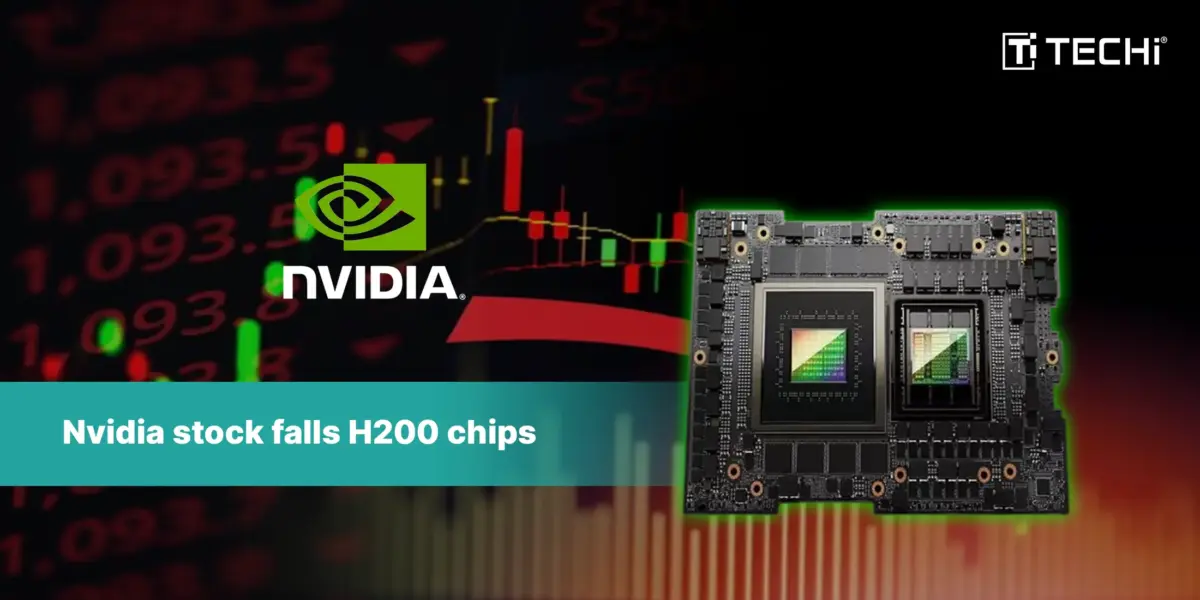
Nvidia stocks went through a tough Wednesday, dropping by over 1% after a report claiming that Chinese authorities had supposedly ordered customs officials to prevent imports of the company’s H200 AI chips. Nvidia fell faster than Nasdaq Composite, among the stocks in a market already in an unpleasant mood.
Approval from U.S Only
The situation becomes specifically awkward because of the timing. Just a day before, the U.S gave a formal nod for H200 exports to China, with imposing certain restrictions. However, as per a report, China reacted by silently guiding domestic technology companies to avoid buying the chips unless they are in dire need. The Information’s report suggested that imports might be permitted only in exceptional cases, such as university research or development labs. Nvidia, which is caught in the middle of this geopolitical competition, chose not to comment right away.
China’s Market Significance for Nvidia
The situation is not without its complications. China was once the second most significant market for Nvidia, at a time when AI chips had less restrictions and the geopolitical landscape was less complicated. Today, the scenario has remarkably changed. Revenue generated from China, including Hong Kong, declined 45% year over year to a little less than $3 billion in Nvidia’s latest quarter. To a company that is used to growth numbers, this is nothing less than a painful cut.
How We Got Here?
The U.S decision to restrict Nvidia’s lowest-end AI chips in April 2025, marked the beginning of this dispute. After a prolonged period of lobbying , and the commendation from the CEO Jensen Huang, President Donald Trump changed his mind and reversed his decision on the condition that he would receive a part of Nvidia’s sales in China. That was an unpleasant development for China, which started to tighten the situation last summer. Even more recently, Trump went to the next level, surrendering to the more potent H200 chip exports in return for the 25% cut of sales, which was made official by an executive order levying a similar tariff.
Nvidia’s Balancing Act
At CES early this month, CFO Colette Kress pointed out how significant China is, with Huang securing it as a possible $50 billion AI market. But when asked about the future of H200 sales, Kress sounded more careful than sure. The message she delivered to the analysts was simply that Nvidia cannot control a lot of it, and the company will be left guessing how the chips will cross the border.
China Bets on Local Chips
The local authorities in China seem to be quite serious about putting domestic chip technology first, even when the local processors are not able to compete with Nvidia’s H200 for training massive AI models. Hedgeye Risk Management analysts have expressed that the performance gap certainly exists, but so does China’s determination. They said, This scenario opens the door for Nvidia to not only contend with its competitors, but also with the state-supported industrial policies.
Officials are prioritizing domestic chip development, even though Chinese processors still lag [the H200s] in training large scale AI models.
Bottom Line
Nvidia’s story in China is becoming more and more like a never ending drama with no probable conclusion. It looks like each regulatory concession results in a new restriction, and every tariff is accompanied by another political drama. Even though the company’s global demand is still very strong, China’s reported action adds yet another layer of uncertainty to a market that was once heavily relied upon by Nvidia. For the time being, investors might have to adapt to the scenario of volatility, and perhaps be cautious whenever geopolitics decides to take a swing at them.