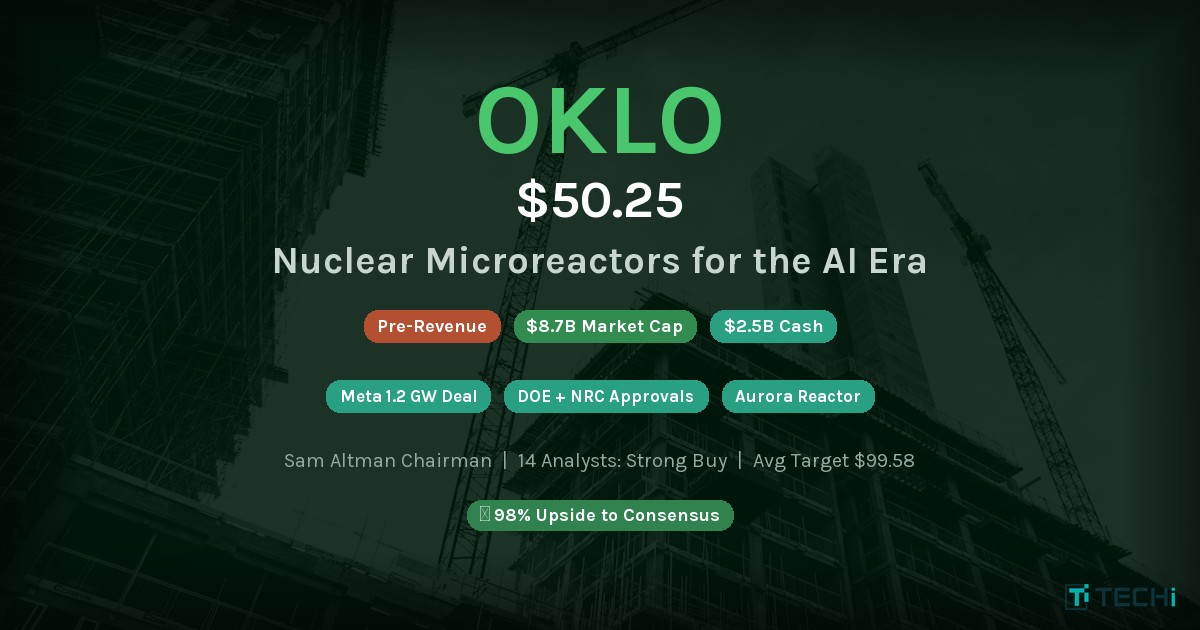
Oklo has never generated a dollar of revenue. Its flagship reactor exists only in regulatory filings and engineering simulations. Its CEO just sold 200,000 shares at $50.35. And 14 Wall Street analysts rate it a Strong Buy with an average price target nearly double the current stock price.
That contradiction sits at the heart of OKLO, a stock trading at $50.25 with an $8.7 billion market capitalization built entirely on the premise that artificial intelligence will consume so much electricity that the world will have no choice but to embrace nuclear microreactors. The question for investors is not whether AI needs nuclear power. The question is whether Oklo can build and deliver reactors before the market’s patience runs out.
Key Takeaways
- OKLO trades at $50.25 with $8.7B market cap and zero revenue, down 70% from 2025 highs. The entire valuation rests on future cash flows from nuclear microreactors that have not yet received final NRC commercial licensing.
- Meta signed a 1.2 GW nuclear deal with Oklo for a power campus in Pike County, Ohio, with pre-construction starting in 2026, first power by 2030, and full capacity by 2034. Meta prepays for power and provides upfront funding.
- $2.5 billion cash after $1.18B January raise provides 25+ years of runway at the guided $80-100M annual burn rate. Q4 2025 EPS of -$0.27 missed the -$0.17 estimate on accelerated hiring.
- DOE and NRC milestones hit in March 2026 including DOE Nuclear Safety Design Agreement for Aurora at Idaho National Lab, NRC materials license for Atomic Alchemy, and accelerated NRC review of Principal Design Criteria.
- 14 analysts rate OKLO Strong Buy at $99.58 average target implying 98% upside, with a range of $60 to $150 reflecting deep uncertainty about whether the first commercial reactor arrives in 2029 or 2032.
Last updated: April 13, 2026 at 6:00 PM ET
What Is Oklo?
Oklo Inc. (NYSE: OKLO) is a nuclear technology company designing, manufacturing, and planning to operate advanced fission power plants. Founded in 2013 by Jacob DeWitte and Caroline Cochran, the company went public via a SPAC merger with AltC Acquisition Corp in May 2024, a deal orchestrated by Sam Altman, who serves as Oklo’s chairman and is also CEO of OpenAI. The Altman connection is not merely symbolic. As the leader of the company building the most power-hungry AI models on earth, Altman has direct visibility into the energy bottleneck that threatens to slow AI development. His willingness to stake personal reputation and capital on Oklo signals a conviction that nuclear microreactors are not a speculative bet but an operational necessity for the AI industry’s next phase.
The company is headquartered in Santa Clara, California, and focuses on compact fast reactors that use metallic high-assay low-enriched uranium (HALEU) fuel. Unlike traditional nuclear plants that require massive cooling towers and decades-long construction timelines, Oklo’s reactors are designed to be factory-built, modular, and deployable at the scale individual customers need.
The Aurora Powerhouse
Oklo’s primary product is the Aurora powerhouse, a fast-fission microreactor designed to generate 15 to 100 megawatts of electrical power per deployment. Multiple Aurora units can be chained together to meet larger energy demands. The reactor uses metallic uranium fuel pellets and operates on a closed fuel cycle, meaning it can recycle and reprocess its own spent fuel. A single Aurora unit is designed to run approximately 10 years without refueling.
The compact design is the key differentiator. Traditional nuclear reactors generate 1,000+ megawatts and cost $10-20 billion to build. Aurora targets the 15-100 MW sweet spot that aligns with individual data center campuses, remote military installations, and industrial facilities that need reliable baseload power without connecting to the broader grid.
Atomic Alchemy: The Isotope Business
Oklo’s subsidiary, Atomic Alchemy, operates a parallel business focused on producing nuclear isotopes for medical, industrial, and defense applications. The NRC granted Atomic Alchemy a materials license in March 2026 to work with Radium-226, Cobalt-60, and Americium-241. This represents Oklo’s first NRC approval of any kind and provides a near-term revenue pathway while the Aurora reactor works through the longer licensing process.
The isotope market is smaller than power generation but carries significantly higher margins. Medical isotopes alone represent a $7+ billion global market with chronic supply shortages, particularly for Molybdenum-99 and Cobalt-60 used in cancer treatment and industrial sterilization.
OKLO Stock at $50.25: The Valuation Reality Check
OKLO closed at $50.25 on Friday, April 11, 2026, with approximately 173 million shares outstanding and a market capitalization of roughly $8.7 billion. The stock is down more than 70% from its 2025 highs and has fallen 20% since the March 17 regulatory approvals.
Traditional valuation metrics are useless here. There is no P/E ratio because there are no earnings. There is no price-to-sales ratio because there is no revenue. The entire $8.7 billion valuation rests on future cash flows from reactors that have not yet received final NRC commercial licensing.
What Oklo does have is $2.5 billion in cash and marketable securities following a $1.182 billion equity raise completed in January 2026. At the company’s guided 2026 operational cash burn rate of $80-100 million, that cash pile provides a theoretical runway of 25+ years. Dilution risk exists but is not imminent. The company also holds the economic rights to used nuclear fuel from the Idaho National Laboratory, a unique asset that could supply decades of reactor fuel at minimal marginal cost.
Q4 2025 results disappointed. Oklo reported EPS of negative $0.27, missing analyst expectations of negative $0.17. The wider-than-expected loss reflected accelerated hiring and R&D spending as the company scaled engineering operations ahead of the Aurora build timeline.
The cash burn trajectory deserves careful monitoring. Oklo guided for $80-100 million in 2026 operational spending, up from $65-80 million in 2025. The increase reflects the transition from paper engineering to physical construction preparation: hiring nuclear engineers, procuring long-lead-time components, and funding site characterization work at Idaho National Lab and the Pike County, Ohio campus. As construction activity ramps in 2027-2028, annual spending could accelerate well beyond $100 million. The $2.5 billion cash position provides ample buffer, but investors should track quarterly burn rates closely for signs that costs are exceeding management projections.
The Meta Nuclear Deal: 1.2 Gigawatts for Data Centers
In January 2026, Oklo and Meta announced an agreement to develop a 1.2 gigawatt nuclear power campus in Pike County, Ohio. The deal makes Meta one of the most significant corporate purchasers of nuclear energy in American history.
The structure matters for understanding Oklo’s financial trajectory. Meta will prepay for power and provide upfront funding to advance project development. Oklo will use those funds to secure nuclear fuel and begin Phase 1 construction. Pre-construction and site characterization are slated to begin in 2026, with the first phase targeted to come online as early as 2030 and the full 1.2 GW campus scaling incrementally through 2034.
The Oklo deal was part of a broader Meta announcement committing to 6.6 GW of nuclear energy across three companies: Oklo (1.2 GW), Vistra Energy (existing nuclear fleet), and TerraPower (Bill Gates’ nuclear venture). The 6.6 GW combined capacity would power Meta’s Prometheus AI supercluster and support the company’s broader data center expansion across the United States.
For Oklo, the Meta deal provides three things no amount of engineering progress can replicate: a guaranteed buyer for its first commercial-scale deployment, upfront capital that reduces financing risk, and the implicit endorsement of one of the world’s largest technology companies. When Meta’s due diligence team selects Oklo for a multi-billion-dollar energy commitment, it sends a signal to other potential customers, regulators, and investors that the technology has passed a serious institutional credibility threshold.
Why Big Tech Needs Nuclear Power
The AI energy thesis is not speculative. It is already straining the global power grid.
The Data Center Energy Crisis
Training a single frontier AI model now consumes as much electricity as a small city uses in a year. NVIDIA’s latest GPU clusters draw 120+ kilowatts per rack, and hyperscalers are building campuses with hundreds of thousands of GPUs. Goldman Sachs estimates that U.S. data center power demand will increase 160% by 2030, requiring approximately 47 GW of new generating capacity.
Meta alone plans to spend $115-135 billion on AI infrastructure in 2026. Microsoft, Google, and Amazon have each committed tens of billions to data center expansion. The constraint is no longer silicon. It is electricity. Multiple planned data center projects in Virginia, Texas, and Ohio have been delayed or downsized because the local grid simply cannot supply enough power.
Why Solar and Wind Are Not Enough
Renewable energy advocates correctly note that solar and wind costs have plummeted. But data centers require something renewables cannot reliably provide: 24/7 baseload power at 99.99% uptime. A data center that loses power for even minutes risks corrupting active AI training runs worth millions of dollars.
Solar produces power roughly 25% of the time. Wind averages 35%. Battery storage helps but remains prohibitively expensive at the scale needed to back up a 500 MW data center campus through multi-day weather events. Nuclear reactors, by contrast, operate at 90%+ capacity factors and run continuously for 18-24 months between refueling cycles. For hyperscalers who need guaranteed, round-the-clock power measured in gigawatts, nuclear is the only carbon-free option that meets all three requirements: scale, reliability, and density.
Oklo’s Business Model: Power-as-a-Service
Oklo does not plan to sell reactors. It plans to sell electricity. The company’s business model operates like a power-as-a-service platform: Oklo builds, owns, and operates the reactor on or near the customer’s site, and the customer signs a long-term power purchase agreement (PPA) at a fixed price per kilowatt-hour.
This model has several advantages over the traditional utility approach. Customers avoid the massive upfront capital cost of building their own power plant. Oklo retains ownership of the reactor and the fuel, creating recurring revenue streams over the 20-40 year asset life. And because Oklo operates the reactor, the customer does not need nuclear engineering expertise on staff.
The closed fuel cycle adds another economic layer. Oklo’s reactors can use recycled nuclear fuel, including the used fuel from the Idaho National Laboratory that Oklo has secured rights to. Fuel recycling reduces both fuel costs and waste disposal expenses, potentially giving Oklo a structural cost advantage over competitors who rely on freshly enriched uranium.
The risk in this model is concentration. Until Oklo has multiple operational reactors, revenue depends entirely on successful deployment of the first units. Any delay in the Aurora timeline pushes the entire revenue recognition schedule back.
Regulatory Progress: DOE and NRC Milestones
Oklo’s regulatory journey has accelerated significantly in 2026. On March 17, the company announced three milestone achievements simultaneously:
The U.S. Department of Energy approved the Nuclear Safety Design Agreement (NSDA) for the Aurora powerhouse at Idaho National Laboratory under the DOE’s Reactor Pilot Program. This agreement covers the design, construction, and operation of Oklo’s first reactor.
The NRC granted Atomic Alchemy its first-ever materials license, authorizing work with specific nuclear isotopes. While this is distinct from a reactor operating license, it establishes Oklo’s regulatory track record with the Commission.
The NRC accepted Oklo’s Principal Design Criteria topical report for review in just 15 days, compared to the typical 30-60 day acceptance timeline. The accelerated review signals that the NRC staff considers the submission complete and well-organized, though acceptance for review does not imply approval.
Oklo’s first Aurora reactor at Idaho National Lab is progressing through DOE authorization before transitioning to NRC licensing for commercial operations. The NRC’s Combined License Application for the commercial Aurora is a separate process that will determine when Oklo can legally operate a reactor connected to the grid and selling power to customers. Final NRC commercial approval remains the single most important milestone for the stock, and the timeline remains uncertain. Optimistic estimates suggest 2028-2029; conservative analysts model 2030-2031.
Competitive Landscape: How Oklo Stacks Up
Oklo operates in a rapidly growing but still nascent advanced nuclear sector. Three primary competitors deserve comparison.
NuScale Power (SMR)
NuScale produces small modular reactors in the 50-77 MW range and is the only company to have received a Standard Design Approval from the NRC for an advanced reactor design. NuScale generates actual revenue from licensing and engineering fees, with analysts projecting revenue to grow from $31 million in 2025 to $287 million by 2028. NuScale’s Romania project and TVA partnership target deployment in the early 2030s. NuScale is further along in the licensing process but targets a different customer segment: large utilities rather than individual data center operators.
TerraPower
Bill Gates’ TerraPower is developing the Natrium reactor, a sodium-cooled fast reactor in the 345 MW class. TerraPower is also part of the Meta 6.6 GW nuclear commitment and received $2 billion in DOE funding for its first Natrium demonstration plant in Wyoming. TerraPower remains private, so direct financial comparison is impossible, but it competes with Oklo for the same hyperscaler customers.
Where Oklo Differentiates
Oklo’s competitive advantage centers on three factors: smaller reactor size (15-100 MW fits individual data centers), fuel recycling capability (lower lifetime fuel costs), and the power-as-a-service model (customers buy electricity, not reactors). The Sam Altman connection also provides a unique distribution channel: OpenAI and its partner ecosystem represent a massive pool of potential power customers who trust Altman’s judgment on technology bets.
The disadvantage is equally clear. Oklo is behind NuScale in the NRC licensing process and behind TerraPower in DOE funding. Every competitor faces the same 4-8 year construction timeline for first commercial units, and execution risk is extreme across the entire sector.
The Bull Case for Oklo Stock
Bulls argue that OKLO at $50.25 prices in none of the upside from successful commercialization. The Meta 1.2 GW deal alone, if fully deployed at competitive power pricing, could generate $500+ million in annual recurring revenue by the mid-2030s. Add the potential for additional hyperscaler contracts with major tech companies racing to secure nuclear power, and the revenue trajectory could justify a market cap multiples of today’s $8.7 billion.
The 14-analyst consensus price target of $99.58 implies 98% upside. Bullish targets reach as high as $150, which would value Oklo at approximately $26 billion. At that level, the market would be pricing in successful Aurora deployment, a growing pipeline of PPA contracts, and the beginnings of the Atomic Alchemy isotope revenue stream.
The $2.5 billion cash position eliminates near-term dilution risk and gives Oklo the financial runway to weather regulatory delays without scrambling for emergency funding. ARK Invest’s Cathie Wood remains a prominent shareholder and has publicly expressed conviction in Oklo’s long-term thesis.
The Bear Case for Oklo Stock
Bears counter with a stark reality: Oklo is a pre-revenue company with an $8.7 billion valuation that will not generate meaningful revenue until at least 2030. The stock has already declined 70% from its 2025 highs, and further downside exists if regulatory timelines slip.
The NRC has previously rejected an Oklo application. In 2022, the NRC denied Oklo’s combined license application for an earlier Aurora design, citing insufficient safety analysis information. Oklo has since resubmitted with a significantly revised application, but the precedent underscores the regulatory risk. Nuclear licensing is not a rubber stamp.
CEO Jacob DeWitte’s sale of 200,000 shares at $50.35 on April 3, while potentially routine, adds a negative data point during a period when the stock is struggling to recover from its 70% drawdown. If the CEO is selling at these prices, the bear argument goes, why should outside investors be buying?
Competition risk is also real. NuScale is further along with NRC licensing. TerraPower has more DOE funding. Established nuclear operators like Constellation Energy and Vistra control existing reactor fleets that can serve hyperscaler customers today, without waiting 4-8 years for new construction. The clean energy sector is crowded with well-capitalized competitors, and Oklo’s first-mover advantage in microreactors is not guaranteed to translate into commercial success.
Perhaps the most underappreciated risk is technology obsolescence. Battery storage costs are declining at 15-20% annually. If grid-scale batteries become cheap enough to provide 24/7 backup for solar and wind installations before Oklo delivers its first commercial reactor, the economic case for nuclear microreactors weakens considerably. Oklo is racing not just against competitors but against the broader trajectory of renewable energy economics.
Analyst Ratings and Price Targets
As of April 2026, 14 analysts cover OKLO stock with an average rating of Strong Buy and an average 12-month price target of $99.58, implying approximately 98% upside from $50.25. The target range spans from $60 at the low end to $150 at the high end, reflecting the enormous uncertainty around commercialization timelines.
The wide target spread tells an important story. The difference between $60 and $150 is not a disagreement about Oklo’s technology. It is a disagreement about timing. Analysts who model first commercial revenue in 2029-2030 arrive at targets above $100. Those who model 2031-2032 timelines, accounting for potential NRC delays, land closer to $60-70. Both camps generally agree on the long-term opportunity; they disagree on when it materializes.
The consensus Strong Buy rating is notable for a pre-revenue company. Most pre-revenue stocks carry Hold or mixed ratings. The uniformly bullish consensus reflects a shared conviction that the AI energy demand thesis is not speculative but structural, and that Oklo’s Meta deal provides a level of commercial validation that de-risks the investment case meaningfully.
Key Risks Every Oklo Investor Must Understand
NRC licensing uncertainty: Final commercial operating approval from the NRC remains the single largest binary risk. The NRC has previously rejected an Oklo application, and the timeline for the current review process is not publicly committed. A rejection or multi-year delay would devastate the stock.
Execution and construction risk: No Aurora reactor has ever been built. Moving from design approval to a functioning, grid-connected power plant involves thousands of engineering, manufacturing, and construction challenges that cannot be fully anticipated in simulations. First-of-a-kind nuclear construction projects have historically experienced significant cost overruns and schedule delays.
Competition from existing nuclear: Companies like Constellation Energy and Vistra already operate nuclear fleets and can sign power purchase agreements with hyperscalers immediately, without waiting for new construction. Oklo must compete against incumbents who can deliver nuclear power today.
HALEU fuel supply: Oklo’s reactors require high-assay low-enriched uranium, which currently has extremely limited commercial supply. The DOE is working to establish a domestic HALEU supply chain, but delays in fuel availability could bottleneck Oklo’s deployment timeline regardless of regulatory progress. The Inflation Reduction Act allocated $700 million for domestic HALEU production, and Centrus Energy began limited HALEU manufacturing in 2024, but current output remains orders of magnitude below what a scaled Oklo deployment would require. This supply chain constraint affects every advanced reactor developer, not just Oklo, but it represents a systemic risk that investors often underestimate when modeling deployment timelines.
Valuation compression: At $8.7 billion with zero revenue, OKLO is priced on forward expectations that extend 4-8 years into the future. Any shift in market sentiment toward valuing near-term cash flows over long-dated promises could trigger significant multiple compression, independent of company-specific developments.
Disclaimer: This article is for informational purposes only and does not constitute investment advice. TECHi and its authors may hold positions in securities mentioned. Always conduct your own research and consult a licensed financial advisor before making investment decisions.