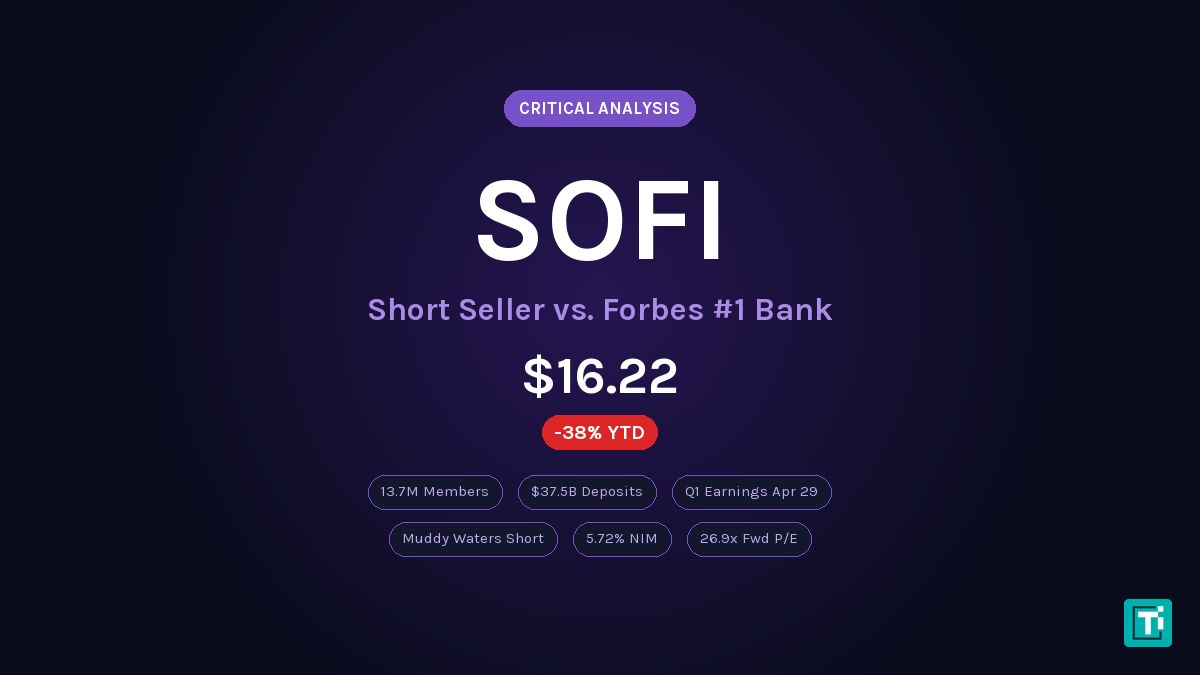
SoFi Technologies (NASDAQ: SOFI) closed at $16.22 on Friday, April 10, down roughly 38% from the $26 range where it entered 2026 and 50% below its November 2025 high of $32.73. Two competing narratives are fighting for control of this stock: Carson Block’s Muddy Waters Research says the company’s adjusted EBITDA is inflated by 90%, while Forbes just named SoFi the number-one bank in the United States. With Q1 2026 earnings arriving on April 29, which story the market believes will determine whether $16 is a floor or a waypoint.
Last updated: April 13, 2026 at 12:00 PM ET
The Muddy Waters Thesis: Financial Engineering or Misunderstanding?
On March 17, Muddy Waters published a short report alleging SoFi’s 2025 adjusted EBITDA of $1.05 billion is closer to $103 million when accounting adjustments are reversed. The specific claims: a $312 million unrecorded debt from a loan package kept on the balance sheet through what Block called “sleight-of-hand financing,” student loan portfolio overvaluation via incorrect discount rates, and a personal loan charge-off rate of approximately 6.1% versus SoFi’s reported 2.89%.
The language was severe. Block compared SoFi to “GE Capital-style loan marks” and “Enron-esque off-balance-sheet structures.” For a company that obtained its bank charter from the OCC in January 2022 and operates under Federal Reserve supervision, those are serious allegations.
SoFi’s response was direct. The company said the allegations were factually wrong, CEO Anthony Noto purchased over $1.5 million in shares on the open market across two transactions (56,000 shares on March 2 for approximately $1 million and 28,900 shares on March 17, the day the report dropped, for roughly $500,000), and SoFi told Muddy Waters it is contemplating legal action for defamation. Mizuho analyst Dan Dolev dismissed the report as having “fundamentally misunderstood key facts.”
The charge-off discrepancy is the most substantive allegation. SoFi reports a 2.80% annualized net charge-off rate on personal loans for Q4 2025, down 57 basis points year-over-year. Muddy Waters arrives at 6.1% by including delinquent loan sales in the calculation. KBW, which maintains an Underperform rating with a $17 target, has noted the market may be missing important nuances in how SoFi accounts for these transactions. The distinction matters: if SoFi is selling delinquent loans before they charge off and not counting them in the NCO rate, the headline figure understates actual credit losses. If those sales are accounted for elsewhere in the financials (which SoFi claims), the Muddy Waters math double-counts.
Short interest stands at 165 million shares, roughly 13% of the float. That is significant but not extreme for a high-beta fintech trading at 2.25 beta.
The Numbers Behind the Number-One Bank
Forbes surveyed over 54,000 consumers and ranked SoFi as the best bank in the United States for 2026, ahead of JPMorgan Chase and Bank of America. That recognition rests on a deposit franchise that barely existed four years ago.
Since obtaining its bank charter, SoFi has grown deposits from zero to $37.5 billion by year-end 2025. The trajectory is striking: $7.3 billion at end of 2022, $18.6 billion at end of 2023, $26.0 billion at end of 2024, and $37.5 billion at end of 2025, adding $4.6 billion in Q4 alone. Over 90% of SoFi Money deposits come from direct deposit members, and more than half of new accounts set up direct deposit within 30 days.
This deposit base funds SoFi’s lending operation at a structural cost advantage that non-bank fintechs cannot replicate. Warehouse facility utilization dropped by $1.3 billion as deposits grew, and the resulting net interest margin of 5.72% far exceeds most regional banks. When SoFi offers 3.8% APY on savings accounts and lends personal loans at yields well above that, the spread generates the kind of margin that explains a $20.7 billion market cap on a fintech with only four years of banking history.
Q4 2025: The $1 Billion Quarter
SoFi’s most recent quarterly results, reported January 30, showed the company crossing the $1 billion revenue threshold for the first time. Adjusted net revenue hit $1.013 billion, up 37% year-over-year. GAAP net income reached $174 million at a 17% margin. GAAP earnings per share of $0.13 beat the consensus range of $0.11 to $0.12.
The segment breakdown reveals where the growth engine is shifting. Financial Services revenue hit $456.7 million, up 78% year-over-year, with a 51% contribution margin. Lending, still the largest segment, generated $486 million, up 15%. The Technology Platform (Galileo and Technisys) added $122.4 million, up 19%. Fee-based revenue across the company reached $443 million, up 53% year-over-year and approaching a $1.8 billion annualized run rate.
Member growth accelerated to 13.7 million total members, a 35% increase, with SoFi adding 1 million members in a single quarter for the first time. Total products reached 20 million with a 40% cross-buy rate, meaning existing members are adopting additional SoFi products at an increasing pace. Loan originations totaled $10.5 billion in Q4, up 46%, with personal loans at $7.5 billion, student loans at $1.9 billion, and home loans at $1.1 billion.
Full-year 2025 delivered $3.6 billion in adjusted net revenue (+38%), $481 million in GAAP net income, and $1.1 billion in adjusted EBITDA. The Financial Services segment alone grew 88% year-over-year to $1.54 billion, a pace that suggests it will overtake Lending as the largest revenue contributor within the next two to three quarters.
Valuation: Premium Justified or Priced for Perfection?
At $16.22, SOFI trades at 26.9x forward earnings based on the company’s $0.60 adjusted EPS guidance for 2026, and 4.3x forward revenue against $4.655 billion in guided revenue. The trailing P/E of 42x reflects the stock’s growth premium over traditional banking peers. For comparison, Upstart trades at 11.3x forward earnings, Ally Financial at 7.6x, and LendingClub at 8.3x.
The premium exists because SoFi is not a pure lender. The Galileo and Technisys technology platform, which serves roughly 158 million enabled accounts for enterprise clients including Southwest Airlines and Wyndham Hotels, carries higher-multiple characteristics. Management has guided for 30%+ compounded annual revenue growth and 38% to 42% compounded EPS growth from 2025 through 2028. If those targets hold, the PEG ratio of 0.70 suggests the stock is actually cheap relative to its growth rate.
If Muddy Waters is right about the EBITDA inflation, none of those multiples mean what they appear to. A company earning $103 million in true adjusted EBITDA on a $20.7 billion market cap is not cheap at any multiple.
The Loan Platform Business: Underfollowed Catalyst
On March 26, SoFi announced $3.6 billion in new Loan Platform Business commitments from three enterprise partners: a leading global bank committing over $1 billion, a financial services and insurance group committing $600 million, and a top-five global private asset management firm committing up to $2 billion. The LPB generated $194 million in Q4 2025 revenue by white-labeling SoFi’s personal loan underwriting and servicing capabilities for institutional clients.
This business line matters strategically because it generates fee revenue without balance sheet risk. SoFi handles the underwriting and servicing; the enterprise partner takes the credit exposure. As this segment scales, it shifts SoFi’s revenue mix further toward fees and away from net interest income, reducing the company’s sensitivity to credit cycles, which is precisely the risk Muddy Waters is flagging.
Analyst Divide: $17 to $37
Wall Street is split. The consensus price target sits around $25, roughly 54% upside from the current price. But recent moves have been bearish: Barclays cut from $28 to $18 on April 6, KBW lowered to $17 with an Underperform rating on April 9, and Wells Fargo trimmed to $18 from $19 on the same day. On the bull side, Citizens upgraded to Market Outperform in February with a $30 target, and Citigroup’s $37 target from October 2025 remains the Street high.
The analyst breakdown from TIKR shows 5 Buys, 3 Outperforms, 11 Holds, 2 Underperforms, and 2 Sells across 23 analysts. That distribution, weighted heavily toward holds, reflects a market that recognizes the growth story but is not confident enough to pound the table while the Muddy Waters allegations remain unresolved and tariff-driven macro uncertainty persists.
Risk Assessment: What Could Break the Thesis
The risk stack is not trivial. Personal loans are unsecured consumer credit, and SoFi’s $7.5 billion quarterly origination pace means the portfolio is growing fast. If unemployment rises meaningfully from the current 4.3%, charge-offs will accelerate whether the true rate is SoFi’s 2.80% or Muddy Waters’ 6.1%. The growing home equity book adds subordinate lien exposure that is sensitive to property value declines. Shares outstanding have increased 13.65% year-over-year to 1.28 billion, and management compensation is tied to the adjusted metrics that Muddy Waters alleges are inflated. The Galileo technology platform saw accounts decline slightly from 160 million to 157.9 million in Q3 2025, signaling some client churn. And the 15% Section 122 tariff surcharge, combined with broader trade uncertainty, has already pushed SOFI briefly below $10 during the early April selloff.
What April 29 Needs to Show
Q1 2026 earnings will function as the first real test of SoFi’s credibility in the post-Muddy Waters environment. Management guided for approximately $1.04 billion in adjusted net revenue, $300 million in adjusted EBITDA, and $0.12 adjusted EPS. Wall Street consensus sits near those figures.
The numbers alone will not settle the debate. Investors will scrutinize the 10-Q for loan sale disclosures, charge-off methodology explanations, and any changes to accounting treatments that address Muddy Waters’ specific claims. CEO Noto’s decision to buy over $1.5 million in personal shares after the report suggests he believes the stock is mispriced. But insider buying is a conviction signal, not a proof of accounting accuracy.
At $16.22, with a 0.70 PEG ratio and $37.5 billion in deposits funding a 5.72% NIM, SoFi has the financial architecture of a company worth substantially more than its current market cap. The Muddy Waters report introduced the possibility that the architecture rests on overstated foundations. April 29 will not fully resolve that tension, but it will determine whether the stock stabilizes here or continues the decline that has already cut the price in half.
Disclaimer: This article is for informational purposes only and does not constitute investment advice. TECHi and its authors may hold positions in securities mentioned. Always conduct your own research and consult a licensed financial advisor before making investment decisions.
Why has SoFi stock dropped 38% in 2026?
SoFi stock has declined from roughly $26 at the start of 2026 to $16.22 due to a combination of factors: Muddy Waters Research published a short report alleging 90% EBITDA inflation, multiple analysts cut price targets (Barclays from $28 to $18, KBW to $17), and broader tariff-driven market selling pushed the stock briefly below $10 in early April.
What did Muddy Waters allege about SoFi?
Muddy Waters alleged that SoFi’s 2025 adjusted EBITDA of $1.05 billion is inflated by approximately 90%, with the true figure closer to $103 million. Specific claims include a $312 million unrecorded debt, student loan overvaluation, and a personal loan charge-off rate of 6.1% versus SoFi’s reported 2.80%. SoFi denied the allegations and CEO Anthony Noto bought over $1.5 million in shares.
When does SoFi report Q1 2026 earnings?
SoFi Technologies reports Q1 2026 earnings on Wednesday, April 29, 2026, before market open with a conference call at 8 AM ET. Management guided for approximately $1.04 billion in revenue, $300 million adjusted EBITDA, and $0.12 adjusted EPS.
What is SoFi’s price target for 2026?
Analyst targets range from $17 (KBW, Underperform) to $37 (Citigroup). The consensus average is approximately $25, implying roughly 54% upside from the $16.22 closing price. Recent revisions have been mostly bearish, with Barclays, KBW, and Wells Fargo all cutting targets in April 2026.
Is SoFi a bank or a fintech?
SoFi is both. It obtained a national bank charter from the OCC in January 2022, making it SoFi Bank, N.A., supervised by both the OCC and the Federal Reserve. It operates as a digital bank with no physical branches, offering lending, banking, investing, and a technology platform (Galileo) that serves approximately 158 million enabled accounts for enterprise clients.