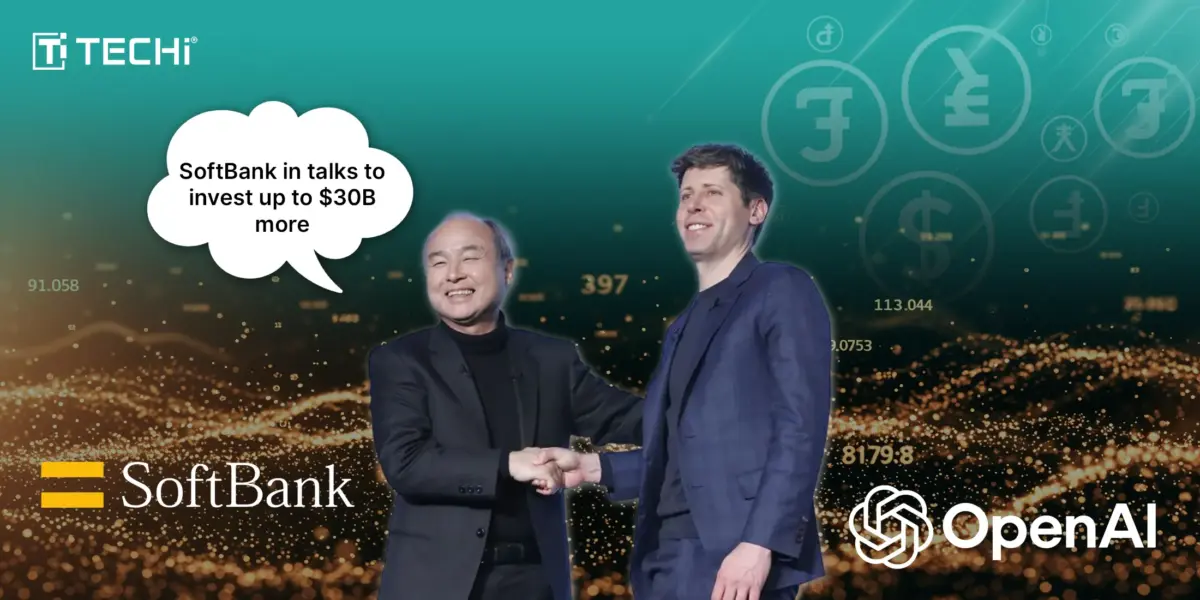
SoftBank Group is actively making one of the largest single-company investments in the high-tech sector, which apparently is expecting to inject $30 billion more capital into OpenAI, as reported by those who have been aware of the discussions.
Such extra funding would be incorporated into a bigger round of finance that would raise round somewhere north of $100 billion, on behalf of the developer of ChatGPT, which in its turn would push the valuation of the latter to already an estimated $830 billion, two times more than the latest major round worth of about half the round of $500 billion conferred in the market in the year 2025.
Chief Executive Masayoshi Son has made an “all-in” bet on OpenAI.
Seeking to improve SoftBank’s position in the artificial intelligence race.
Why Does OpenAI Need So Much Capital? 🔗
OpenAI must find serious funding to ensure that it stays relevant to the competition with such AI-based products and cloud services as Google owned by Alphabet which gains momentum every single day.
The creation and deployment of state-of-the-art models, such as GPT-4 and other models in the future, require capital investment in individual models in the tens of millions of dollars.
OpenAI has also signaled a desire to spend over $1.4 trillion in artificial-intelligence infrastructure in the next 8 years, including in data centers and silicon manufacture.
Two concomitant projects are the SoftBank and OpenAI funding the Stargate project, a $500 billion project aimed to create AI-centered data centers to match the United States strategic objectives compared to China in the broader competition of AI.
What Comes Next? 🔗
Predicted results by completing a round of funding up to its estimated limit of $100 billion at a top end, OpenAI should speed up development of custom silicon orders, expand its data infrastructure operation, and increase collaborative efforts with Microsoft and Amazon.
In the case of SoftBank, additional funding in OpenAI is an indication that Masayoshi Son sees artificial intelligence as the core driving force of the next decade of the conglomerate, despite the naysayers expressing worries about a possible artificial-intelligence bubble.
The future question is not the affordability of the artificial-intelligence assembly, but rather the ability of the most valuable private technology company on the globe to turn its massive capital investments into long-term profitability and physical influence on society.